Asbestos Air Monitoring: Methods, Limits, and Compliance
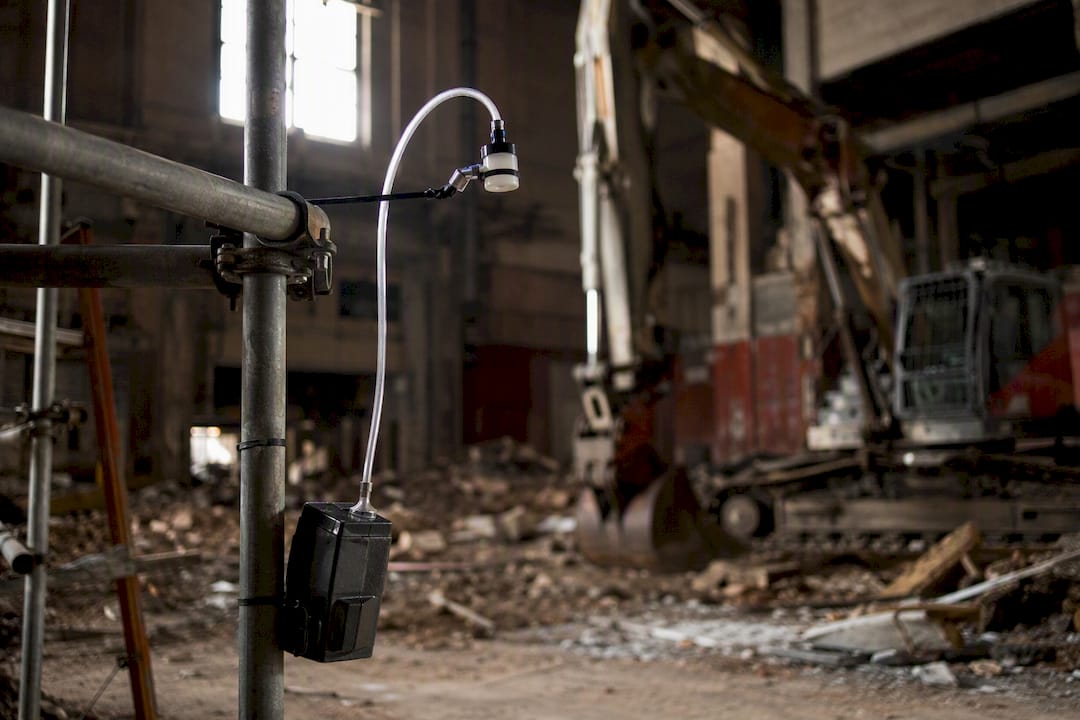
Asbestos air monitoring is the practice of pulling a measured volume of air through a filter with a calibrated pump, then counting fibers on that filter under a microscope to see whether airborne concentrations exceed regulatory limits. The benchmark every professional works against is OSHA’s Permissible Exposure Limit of 0.1 fiber per cubic centimeter (f/cc) as an 8-hour time-weighted average, with an excursion limit of 1.0 f/cc over any 30-minute period.
- Collection medium: 25-mm mixed-cellulose ester (MCE) filter cassette
- Screening method: phase contrast microscopy (PCM), fast but not species-specific
- Confirmation method: transmission electron microscopy (TEM), used when fiber identity or low-level detection matters
Quick reference: a compliant TWA sample generally needs a minimum air volume around the mid-twenties of liters; excursion sampling requires a higher volume close to fifty liters to be defensible.
Key Takeaways
Defensible asbestos air monitoring depends on matching sampling volume and flow rate to the target fiber density, then backing every result with an accredited lab and an unbroken chain of custody.
| Point | Details |
|---|---|
| Know the exposure limits | OSHA sets the PEL at a low fiber concentration limit for an 8-hour TWA and a higher limit for a 30-minute excursion. |
| Match equipment to method | Use 25-mm MCE cassettes with conductive cowls and calibrated pumps running 1 to 2 L/min. |
| Hit the right sample volume | Target 25 liters minimum for TWA and 48 liters for excursion sampling to reach proper fiber density. |
| Escalate to TEM when needed | Order TEM analysis for species identification or when low-level detection limits matter legally. |
| Keep monitoring roles separate | Use independent third-party monitors for clearance sampling to avoid conflicts of interest, an approach Corneliuswrecking builds into its abatement oversight on every certified project. |
Table of Contents
- What Regulations Govern Asbestos Air Monitoring
- Sampling Equipment and How to Set Flow Rates
- Project Monitoring vs. Clearance Sampling: Two Different Jobs
- PCM, TEM, and Lab Accreditation That Actually Matters
- Turning Fiber Counts Into a Compliance Decision
- A Field Checklist for Defensible Monitoring
- How Cornelius Wrecking Handles Monitoring and Compliance in the Field
- What the Data Actually Tells You to Prioritize
- Compliance Support Built Into Every Abatement Project
- Sources
What Regulations Govern Asbestos Air Monitoring
OSHA’s construction standard, 29 CFR 1926.1101 Appendix H, lays out the sampling and analytical procedures that most abatement and demolition projects must follow, while the general industry counterpart at 1910.1001 Appendix A sets the mandatory reference method for PCM analysis, including counting rules, field blank requirements, and laboratory quality control. These two documents are the compliance backbone. Get familiar with them before you write a sampling plan, not after a regulator asks for one.
The EPA plays a supporting role rather than a primary regulatory one for occupational exposure. Its guidance on monitoring asbestos-containing material frames air sampling as useful supplemental information for assessing building conditions and abatement effectiveness, not a standalone compliance trigger.
State rules add another layer, and they vary:
- Some states mandate third-party clearance sampling for school and public building abatement regardless of project size.
- Others require licensed asbestos consultants to review sampling data before an area is reoccupied.
- A handful of set stricter analytical turnaround or notification requirements than the federal minimum.
Always check your state’s environmental or labor agency for procedural add-ons layered on top of the OSHA and EPA framework.
Sampling Equipment and How to Set Flow Rates
Getting a usable sample comes down to matching your equipment setup to the job conditions, not just running a pump for a set number of minutes.
- Assemble the cassette. Use a 25-mm MCE filter housed in an electrically conductive 50-mm extension cowl. The conductive cowl reduces static-driven fiber loss, which matters more than most technicians assume on dry, dusty sites.
- Attach a calibrated pump. Battery-operated, constant-flow pumps are standard. OSHA’s non-mandatory sampling appendix allows flow rates from 0.5 to 5.0 L/min, but 1 to 2 L/min is the practical sweet spot for most personal and area samples.
- Calculate target volume. Aim for a minimum of 25 liters for an 8-hour TWA sample and 48 liters for a 30-minute excursion sample, adjusting flow and duration together to reach the total.
- Watch fiber density. The goal is a filter loading between 100 and 1,300 fibers per square millimeter. Overshoot that and the filter becomes too dense to count accurately; undershoot it and you risk a statistically weak result.
- Adjust for dust load. In visibly dusty containment areas, drop your target volume rather than push through an overloaded filter. A ruined filter is worse than a shorter sample.
- Calibrate before and after. Document pump flow with a calibration device both pre- and post-shift, and always run at least one field blank per sample set to catch contamination.
Pro Tip: Keep a spare, pre-calibrated pump on every job. A failed calibration mid-shift with no backup means re-sampling an entire shift, which costs far more than the spare pump did.
Project Monitoring vs. Clearance Sampling: Two Different Jobs
Project monitoring happens while abatement work is underway. It tracks whether containment is holding, whether fiber levels near the work area creep toward action thresholds, and whether workers inside the enclosure need better respiratory protection. It typically runs on a daily or per-shift schedule with visual containment checks layered on top of the air data.
Clearance sampling happens after the work is done and before the space reopens. It answers one question: is it safe to take the barriers down?
- Project monitors can be employed by the abatement contractor in most jurisdictions, since their job is process control.
- Clearance sampling is frequently required to come from an independent third party, precisely because a contractor grading its own final exam creates an obvious conflict of interest.
- Industrial hygiene programs consistently recommend independent clearance monitors even when local law doesn’t strictly require one, because it holds up better under legal review.
- Document every result with pump serial numbers, calibration logs, and cassette lot numbers. That paper trail is what survives a deposition, not the memory of who was on-site that day.
PCM, TEM, and Lab Accreditation That Actually Matters
PCM is fast and cheap, and it’s what most compliance sampling relies on. Its limitation is structural: it counts fibers by shape and size under phase contrast light, but it cannot distinguish asbestos fibers from other fibrous materials like fiberglass or cellulose. When a result needs to hold up to a legal challenge, or when you’re trying to detect low fiber concentrations that PCM’s resolution can’t reliably catch, TEM becomes necessary. TEM identifies mineral structure and can confirm species (chrysotile versus amosite versus crocidolite), which PCM simply cannot do.
Lab selection is where a lot of otherwise solid sampling plans fall apart. Look for:
- NVLAP accreditation for the specific method (PCM or TEM) you need
- AIHA LAP participation, which layers additional proficiency oversight on top
- NIOSH-trained analysts, since the person counting fibers matters as much as the microscope
- Active interlaboratory proficiency testing, because accreditation alone doesn’t guarantee ongoing accuracy
Something worth checking directly with any lab you hire: ask for recent round-robin proficiency test scores, not just an accreditation certificate. A lab that passed accreditation review two years ago and hasn’t run a blind recount since is a weaker choice than one that tests quarterly.
Turning Fiber Counts Into a Compliance Decision
A lab report gives you fibers counted per unit area of filter. Converting that into fibers per cubic centimeter of air requires the filter area, the number of fields counted, and the total air volume sampled, which is why the lab’s documented methodology matters as much as the raw number.
- Compare the calculated concentration to the PEL. Anything at or above 0.1 f/cc TWA, or 1.0 f/cc over a 30-minute excursion window, triggers an immediate response under OSHA’s exposure limits.
- Stop work or re-evaluate containment the moment a result approaches or exceeds those thresholds. Waiting for a second sample to confirm a bad number is a common and costly mistake.
- Order TEM confirmation when a PCM result is borderline, when species identification affects liability or disposal classification, or when the site history suggests amphibole contamination.
- Maintain chain-of-custody documentation from field collection through lab receipt and final report. Missing links in that chain are the single most common reason monitoring data gets thrown out during regulatory or legal review.
A Field Checklist for Defensible Monitoring
Good sampling technique means nothing if the paperwork around it can’t survive scrutiny. Build your process around three phases.
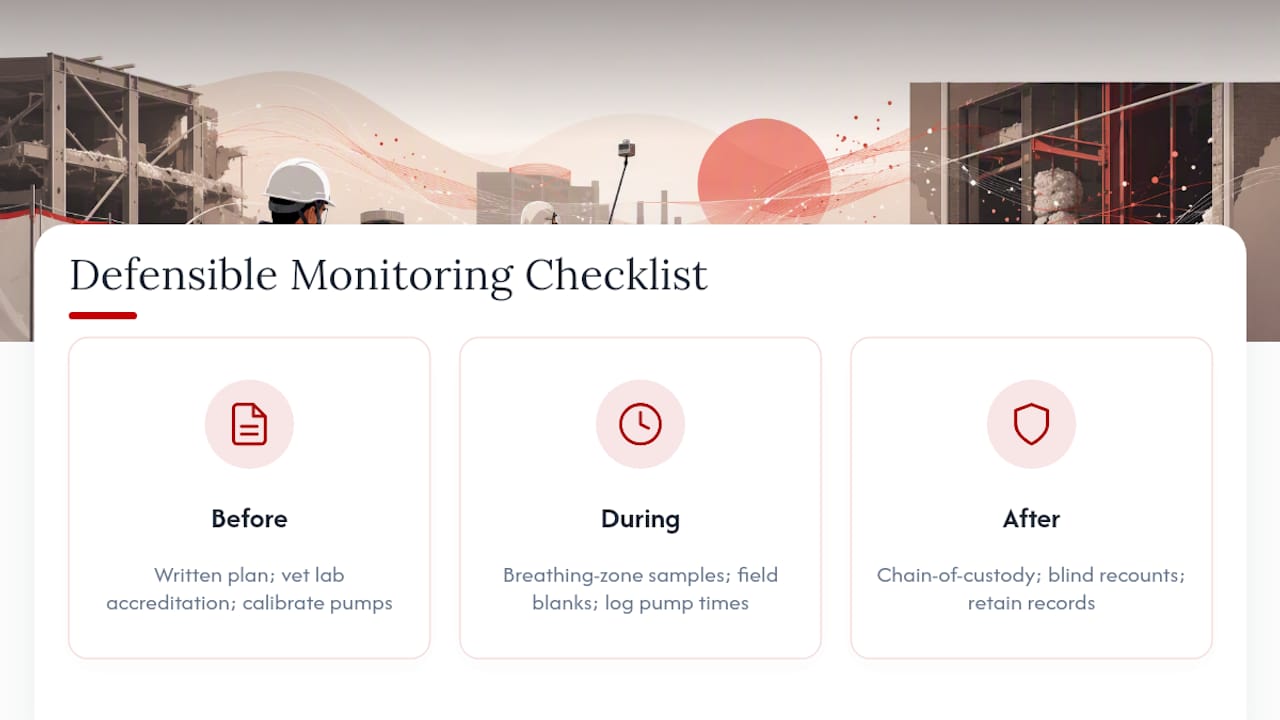
Before the job: finalize a written sampling plan, vet your lab’s accreditation and proficiency history, and confirm every pump is freshly calibrated.
During the job: place samples in the breathing zone, run field blanks with every batch, log pump start and stop times, and record any containment breaches or dust events that could affect filter loading.
After the job: preserve chain-of-custody forms, request blind recounts on borderline samples, and retain every record (calibration logs, lab certificates, sampling logs) for as long as your jurisdiction requires, often well beyond project closeout.
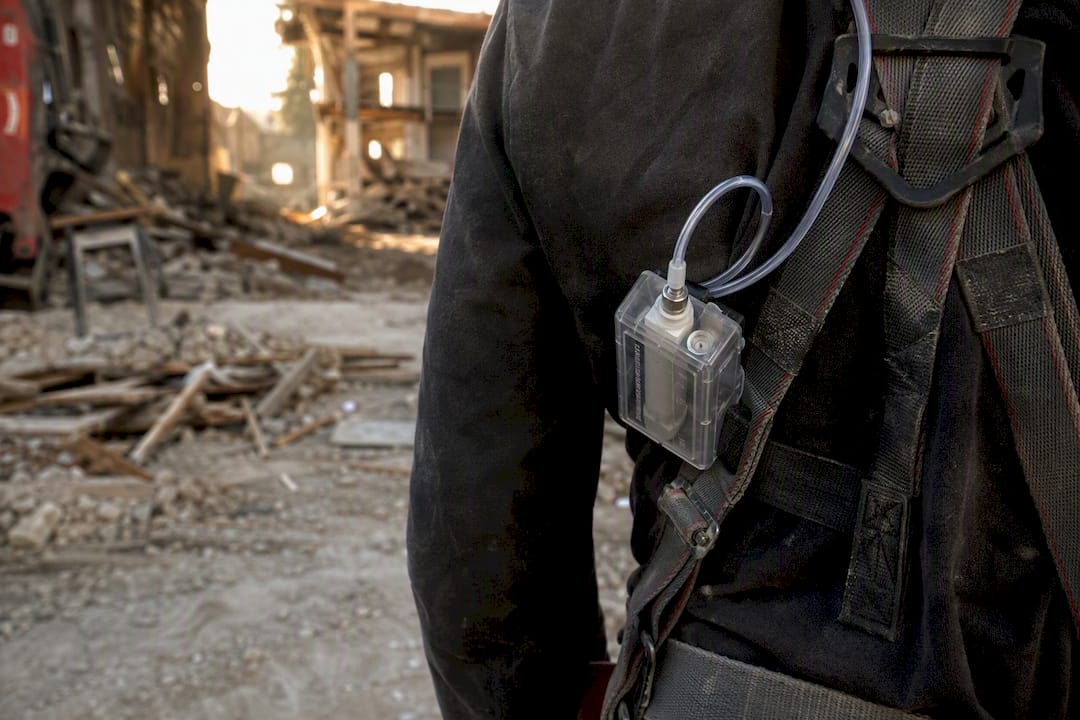
Pro Tip: Photograph your sampling setup in place before starting the pump. It sounds excessive until a challenge to sample placement shows up eighteen months later and you have zero contemporaneous proof of where the cassette actually sat.
How Cornelius Wrecking Handles Monitoring and Compliance in the Field
Compliance on a demolition or abatement site isn’t a paperwork exercise bolted onto the real work. It’s part of the real work. Corneliuswrecking operates under OSHA and asbestos abatement certifications on every project where hazardous materials are in play, which shapes how sampling and documentation get built into the schedule rather than added after the fact.
- Coordination with accredited third-party monitors for project and clearance sampling, keeping oversight independent of the demolition crew doing the physical work
- Structured chain-of-custody handling from field collection through lab reporting
- Documentation workflows built to survive regulatory review on power plant decommissioning, marine vessel dismantling, and industrial demolition projects alike
Explore the full scope of services, certifications, and project history at Cornelius Wrecking.
What the Data Actually Tells You to Prioritize
Most guidance on this topic treats accreditation as the finish line. It isn’t. A lab can hold NVLAP accreditation and still drift on accuracy if it isn’t running regular interlaboratory proficiency tests, which is a distinction that gets glossed over constantly in field training. If you take one thing from this article, make it that: ask labs for their recent round-robin scores, not just their certificate.
The other place conventional advice falls short is treating PCM as sufficient by default. It’s the right tool for routine compliance screening, but the moment a result sits near the PEL, or a project has legal exposure riding on fiber species, PCM’s blind spot becomes a liability. Order TEM before you need it, not after a borderline number forces your hand.
What actually separates defensible monitoring from a paperwork gesture is the chain-of-custody discipline behind the numbers. Flow rates and filter densities matter, but a lost calibration log or a missing field blank will sink an otherwise perfect sample in any legal or regulatory review. Prioritize the documentation trail as heavily as the sampling technique itself.
*— Zach *
Compliance Support Built Into Every Abatement Project
Corneliuswrecking is the contractor alternative to piecing together demolition, abatement, and monitoring oversight across separate vendors. One certified crew handles the hazardous material work and coordinates the independent sampling and documentation around it, so nothing falls through the gap between contractor and consultant.
That matters most on the projects where the stakes are highest: power plant decommissioning, marine vessel dismantling, refinery and chemical plant demolition, and public infrastructure work where a botched clearance report can stall a reopening for weeks. Corneliuswrecking’s OSHA and asbestos abatement certifications mean the crew tearing down the structure understands exactly what the air monitoring data needs to look like before the job even starts. If you’re planning a demolition or abatement project that needs compliance built in from day one, get in touch with Cornelius Wrecking to scope the work and talk through monitoring requirements before you break ground.
This article is general information, not a substitute for advice from a qualified doctor. Consult a qualified healthcare professional about your own circumstances before acting on anything here.
Sources
- 1926.1101 App H - OSHA - Sampling and analytical information
- Monitoring Asbestos-Containing Material (ACM) — EPA
- EMSL: Importance of laboratory accreditation and quality programs
Recommended
Planning a demolition or excavating project?
Get a fast, no-obligation quote from Cornelius Wrecking.
Request a Quote