Engineers: 5 Bridge Demolition Methods to Prevent Girder Damage
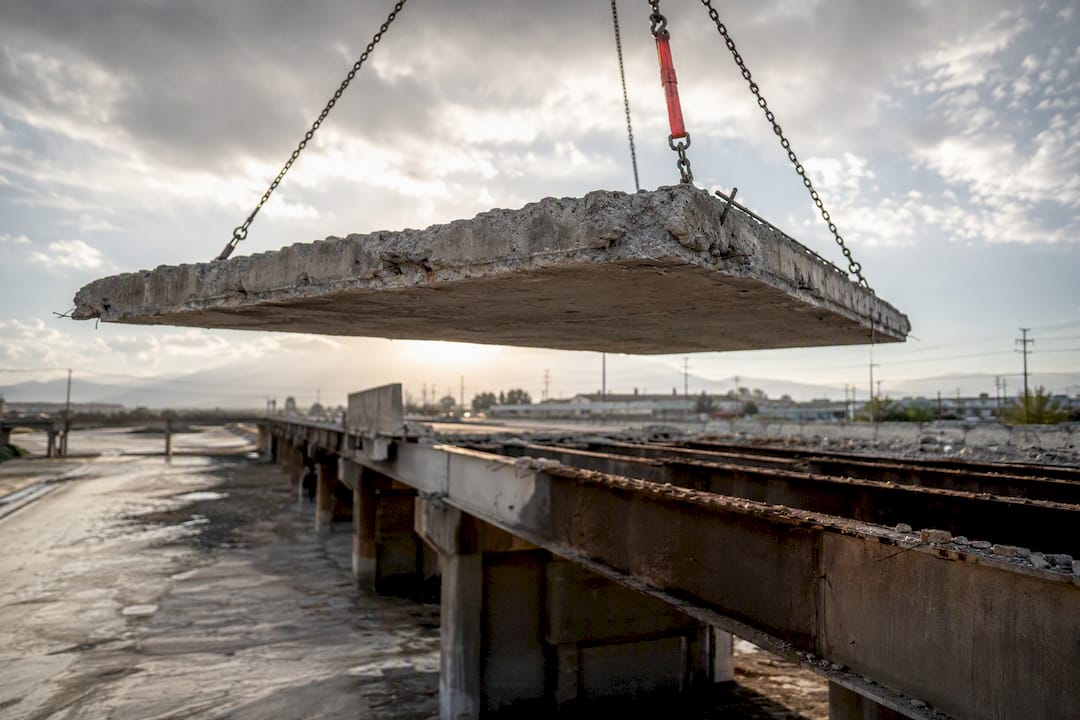
Bridge removal breaks down into five method families: saw cutting with panel lifting, hydrodemolition, mechanical breaking or peeling, cutting-and-lifting for large beams and girders, and explosive demolition. Choosing among them comes down to four checks: how the structure connects (shear connectors, post-tensioning, rebar density), what your cranes and access routes can actually lift, what your environmental permits allow near water and neighbors, and whether you have an engineered sequence for every intermediate structural state. Skip that last check and you’re gambling with a partially demolished structure that no longer behaves the way the original design assumed.
TL;DR:
Hydrodemolition minimizes girder damage and is preferred when structural steel must remain intact, though it involves higher water handling, noise, and site control costs.
Saw cutting with panel lifting offers a balanced approach, providing precision and reusability of girders, but requires careful stopping short of steel flanges to avoid damage.
Mechanical breaking is faster and more cost-effective for volume removal but risks girder flange damage if used improperly near load-bearing steel components.
Full superstructure removal uses diamond wire cutting and marine lifts for large members, with explosive demolition reserved for total, isolated structures in controlled conditions.
Demolition sequencing, strict engineering verification at each stage, and thorough monitoring are essential to prevent structural failures and ensure safety during bridge removal projects.
Table of Contents
-
Mechanical Breaking, Peeling, and Splitting: What’s the Difference?
-
What Safety Documentation Does OSHA Expect for Bridge Demolition?
-
How Cornelius Wrecking Applies These Methods on Real Projects
Which Bridge Demolition Method Fits Your Project?
Every method family trades speed against girder protection, and girder protection against cost. Get the trade honest before you write the specification, because the wrong pick shows up later as a change order or, worse, as a safety incident.
Saw cutting with panel lifting sits in the middle of that trade. It’s precise, it produces manageable debris sizes, and it lets you preserve girders for reuse or inspection. Production is moderate, typically about one full panel cycle per shift on a typical deck bay, and it needs enough headroom and lift capacity to swing panels off the structure.
Hydrodemolition wins on girder and reinforcing steel protection. Nothing else removes concrete without transmitting shock into the steel underneath. That advantage comes at the cost of water handling infrastructure, longer mobilization, and a production rate that lags saw cutting on straightforward decks.
Mechanical breaking (jackhammers, rig-mounted hydraulic breakers) is the fastest way to move volume cheaply, and most contractors already own the equipment. It’s also the method most likely to damage top flanges and shear connectors if operators get careless near the steel-concrete interface.
Cutting-and-lifting techniques (diamond wire, hydraulic shears, crane and barge picks) apply to large elements rather than deck slabs: full girders, truss sections, pier caps. They demand serious rigging engineering but produce the most predictable, controlled removal of heavy members.
Explosive demolition is a narrow-use tool for total superstructure removal in isolated locations and is almost never appropriate for staged, deck-only, or urban work.
A quick comparison of what matters most:
-
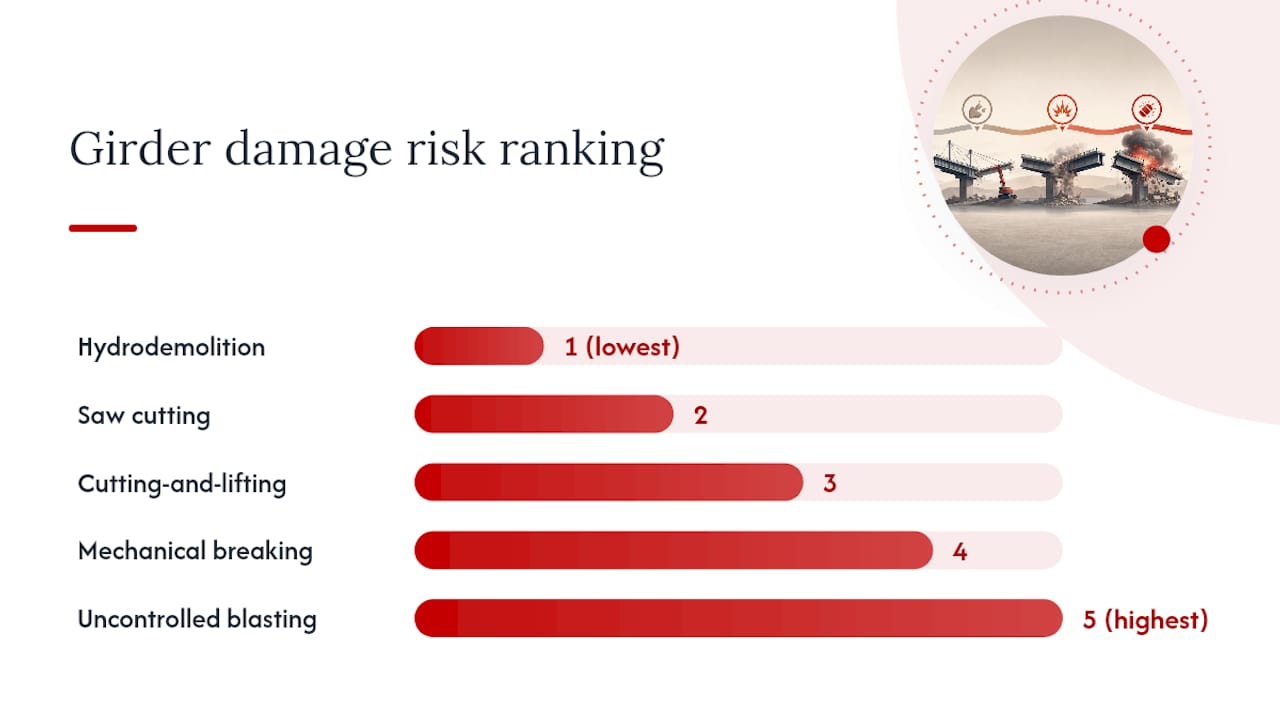
Girder damage risk: hydrodemolition (lowest) → saw cutting → cutting-and-lifting → mechanical breaking → uncontrolled blasting (highest)
-
Production speed: mechanical breaking (fastest) → saw cutting → cutting-and-lifting → hydrodemolition (slowest, due to water cycle time)
-
Environmental footprint: cutting-and-lifting (lowest, dry process) → saw cutting → mechanical breaking → hydrodemolition (wastewater volume) → blasting (highest, requires exclusion zones)
-
Access sensitivity: cutting-and-lifting and hydrodemolition both need substantial staging; mechanical breaking is the most forgiving of tight sites
For deck-only replacements where girders stay in service, hydrodemolition or careful saw cutting dominate state DOT practice. For full superstructure removal, cutting-and-lifting with crane or barge picks takes over, with explosives reserved for remote, total-removal scenarios. Many state agencies now write ball-and-crane restrictions directly into special provisions, pushing contractors toward precut panel lifts and wire saws instead of free-swinging wrecking balls, which are nearly impossible to control once debris starts falling.
How Does Saw Cutting and Panel Lifting Work?
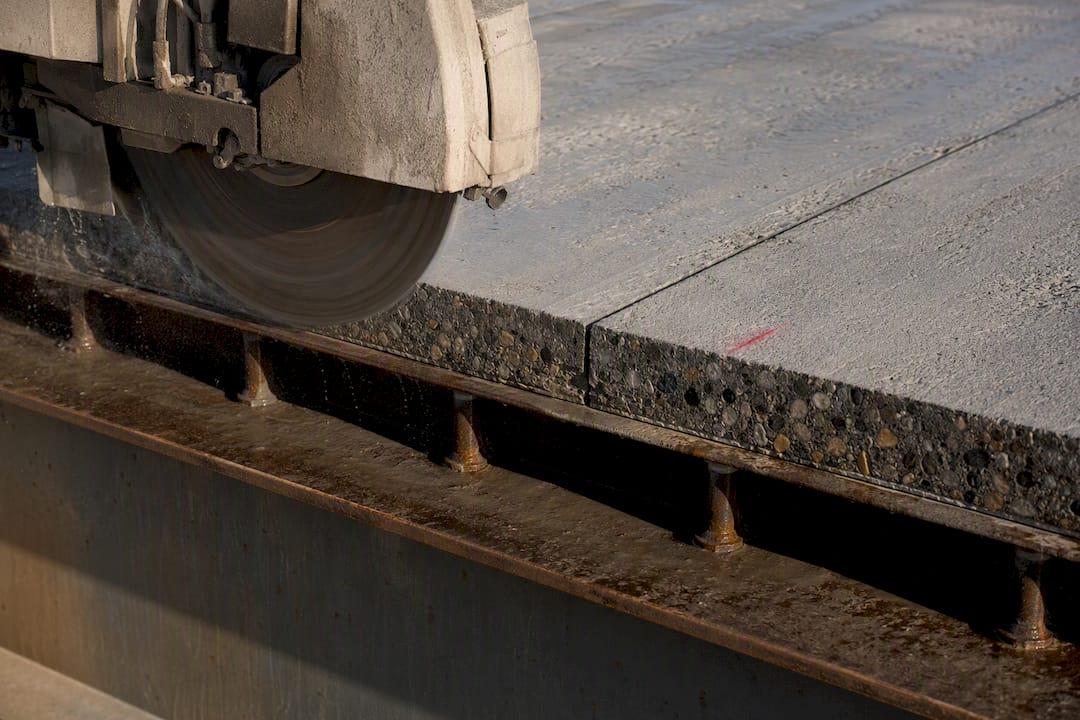
Saw cutting divides a bridge deck into manageable panels using full-depth transverse and longitudinal cuts, then lifts each panel clear with a crane or excavator-mounted grapple. The panel size is not arbitrary. It’s set by crane capacity, reach, and the load the remaining deck sections can carry once you’ve removed their neighbors.
Crews typically run wall or track saws for the long, straight transverse cuts across the deck width, switching to smaller hand-held or walk-behind saws for tighter geometry around barriers, drainage, and utility penetrations. Diamond blades cut through reinforced concrete cleanly, but blade selection and coolant flow both need adjusting based on rebar density, since a deck with closely spaced transverse bars cuts differently than one with widely spaced mats.
Lifting equipment ranges from standard excavators fitted with thumb attachments for smaller panels to slab crabs, mechanical grapples designed specifically to grip and lift precut concrete slabs without cracking them further. On bridges with limited overhead clearance or where a crane can’t get a clean pick, slab crabs mounted on a long-reach excavator often do the job a crane would otherwise need to do from an awkward angle.
The real risk in this method isn’t the cut itself. It’s what happens at the cut line. Full-depth transverse saw cuts must stop short of the top flange of steel girders, leaving a thin layer of concrete to be chipped away by hand or with a smaller breaker. Cutting straight through into the flange damages the girder and can sever shear connectors that the girder needs for composite action if it’s staying in service. Crews that rush this step end up with girders too damaged to reuse, turning a deck replacement into an unplanned girder replacement.
Pro Tip: Mark shear connector locations on the deck surface before cutting begins. A quick chalk line or paint marking, cross-referenced against as-built drawings, saves you from guessing where the saw blade needs to stop.
Temporary supports or debris platforms come into play whenever panel removal would leave a girder span unsupported longer than the structural analysis allows, or when falling debris could damage utilities or waterways below. The Caltrans Bridge Removal Manual documents debris platform configurations specifically for cases where girders below the deck can’t tolerate impact loads from falling material.
Before any panel comes loose, run through this sequence:
-
Confirm crane or excavator lift capacity against the actual panel weight, including a margin for water-saturated concrete, which is heavier than dry.
-
Verify rigging points and sling angles match the panel’s center of gravity, not just its geometric center.
-
Check that adjacent panels and girders can carry any redistributed load once the panel in question is removed.
-
Confirm ground conditions or barge stability under the lifting equipment before the pick begins.
-
Get a second set of eyes on the cut pattern against the as-built drawings, especially near skewed abutments or curved alignments where panel geometry gets irregular.
What Is Hydrodemolition and When Should You Use It?
Hydrodemolition uses high-pressure water jets, typically robotic and remote-controlled, to erode concrete away from reinforcing steel and girders without transmitting impact energy into the structure underneath. It’s the only common method that removes concrete without a mechanical or explosive shock component, which is exactly why state DOTs turn to it when girder preservation matters most.
A 2014 survey of 50 state DOTs identified hydrodemolition, alongside saw cutting and percussive tools, as one of the three most widely used deck removal methods, and trial testing confirmed it did not damage the steel girders it exposed. That’s a meaningful finding for any project where the girders below the deck are staying in service. Jackhammers and breakers routinely microfracture concrete around shear connectors even when operators are careful; hydrodemolition simply washes the concrete away and leaves the steel intact.
By the numbers: Hydrodemolition trials cited in state DOT research found the method produced no measurable damage to steel girders or shear connectors, a distinction that matters most on decks scheduled for rehabilitation rather than full replacement, per the InTrans TR-647 study.
The trade-off shows up in three places:
-
Wastewater volume. Hydrodemolition consumes large quantities of water, and the resulting slurry, loaded with cement fines and sometimes chlorides from deicing salt exposure, requires containment and treatment before discharge. Trial data from state research programs flagged this water handling burden as cost-prohibitive on some projects, particularly where treatment or trucking distances are long.
-
Noise. Operating pressures generate sound levels in the 90 to 100 decibel range at the source, loud enough to require hearing protection zones and, on urban or nighttime work, community noise mitigation.
-
Shadowing. Water jets can’t reach concrete directly beneath steel reinforcing mats or embedded elements at certain angles, leaving pockets that need supplemental hand removal.
Despite the added cost, hydrodemolition earns its place whenever the girders below are staying in service, whenever shear connectors need to survive intact for a new deck pour, or whenever agency specifications simply mandate it. Some state provisions require hydrodemolition specifically for that reason, shifting the water handling burden onto the contractor’s bid rather than leaving it as an open risk. Plan for containment tanks, a treatment or hauling plan for the slurry, and a permit review before you commit to this method on any site near a waterway.
Mechanical Breaking, Peeling, and Splitting: What’s the Difference?
Mechanical removal covers a wider range of tools than most planners realize, and the differences between them matter more once girder protection enters the equation.
Percussive breaking uses pneumatic jackhammers or hydraulic breakers mounted on mini-excavators to fracture concrete through repeated impact. It’s fast, it’s cheap because most contractors already own the equipment, and it scales down to tight, hard-to-reach areas that larger equipment can’t access. The sequencing matters here: crews should break from the top down and work away from the girder flange, never toward it, so each impact drives cracks away from the steel rather than into it. Working within a few inches of shear connectors calls for hand tools or smaller breakers, not full-size rig-mounted hammers.
Peeling strips the top layer of concrete using a combination of saw cutting and a hydraulic peeler or ripper attachment that lifts slabs away from the reinforcing steel in larger sections. It’s cost-effective and generally faster than pure percussive breaking, but it comes with real dust and vibration output, and it often leaves a thin residual layer around shear connectors that needs a secondary removal pass by hand. Research summarized in the InTrans deck removal study notes peeling’s reliance on contractor-owned equipment as a cost advantage, offset by these secondary removal needs.
Hydraulic splitting drives wedge-shaped tools into pre-drilled holes to fracture concrete along a controlled plane, useful for breaking large sections into liftable pieces without the impact energy of a breaker. Chemical splitting, which uses expansive chemical agents poured into drilled holes to crack concrete over time, sounds appealing on paper but underperformed in practice. Small-scale trials found chemical splitting agents did not sufficiently break reinforced concrete in real removal conditions, making it a poor substitute for hydraulic splitting on projects with meaningful rebar density.
-
Percussive breaking: fastest, cheapest, highest girder risk near flanges
-
Peeling: moderate speed, secondary removal needed at connectors
-
Hydraulic splitting: controlled fracture, works well on thick sections
-
Chemical splitting: unreliable performance on reinforced concrete, generally not recommended
Pro Tip: If your crew is using rig-mounted breakers near girders you plan to reuse, switch to hand-held tools within 6 inches of the flange line. The productivity loss is smaller than the cost of replacing a damaged girder.
When Do You Need Diamond Wire Cutting or Crane Lifts?
Full superstructure removal, whole girders, truss panels, pier caps, calls for cutting-and-lifting rather than deck-focused methods. This is where diamond wire saws, hydraulic shears, and barge-mounted cranes take over.
Diamond wire saws thread a diamond-embedded cable around a member and cut through concrete, steel, or composite sections with a controlled, low-vibration cut. Specify diamond wire when access is too tight for a saw blade, when the member includes embedded steel that a concrete saw can’t handle, or when structural sensitivity rules out any impact-based cutting. Setup takes longer than blade cutting because the wire needs a full loop around the member, which sometimes means drilling access holes first.
Hydraulic shears cut through steel and reinforced concrete with a mechanical pinching action rather than heat, which matters directly on structures coated in lead-based paint, common on older steel bridges, where thermal cutting would vaporize hazardous material into the air. Shears also work where fire risk or fuel storage nearby rules out any torch-based approach.
Barge and crane lift planning follows its own set of rules once you’re working over water. Barge stability requires spuds (vertical anchoring piles) sized for local current and wind conditions, and the crane’s load chart has to account for the combined weight and center of gravity of the crane and barge together, not just the crane in isolation. Project write-ups on marine bridge removals confirm that barge and crane configurations require site-specific stability calculations rather than generic load charts, since a floating platform behaves nothing like solid ground under load.
Pick sequencing on marine jobs generally follows this order:
-
Establish barge position and spud anchoring before any rigging begins.
-
Verify crane load chart against the actual combined weight of crane, barge, and pick, plus wind and current margins.
-
Sequence picks from the outside spans inward, so each removed section reduces load on the remaining structure predictably.
-
Confirm each remaining span’s capacity to carry its own weight plus any temporary loads before the next pick.
Ball-and-crane demolition, the classic wrecking ball swinging into a structure, has fallen out of favor for good reason: controlling where a free-swinging mass lands is nearly impossible, and the risk to adjacent structures, utilities, or waterways is too high for most modern agency specifications. Precut panel lifts, wire saws, and barged crane picks replace it because they produce debris in predictable sizes, at predictable locations, on a predictable schedule. Firms doing structural and civil engineering work often flag this shift toward controlled, engineered demolition sequencing as the defining change in how agencies specify removal methods today.
Is Explosive Demolition Ever the Right Choice for a Bridge?
Explosive demolition is precision severing, not brute-force collapse. Shaped charges cut through pre-weakened cross-sections cleanly, but they only work reliably when the structure has been pre-cut to reduce members to small enough sizes that the charge can sever them in a single, predictable event.
Skipping pre-cutting is where blasting goes wrong. Without it, partial failures leave unstable remnants hanging, twisted, or partially connected, conditions far more dangerous than a controlled dismantling would have produced in the first place. A structure that’s half-severed by an undersized charge is harder and riskier to finish removing than one that was never blasted at all.
Because of that risk profile, explosive demolition on bridges requires a specific set of controls before anyone gets near a detonator:
-
Full navigational coordination with waterway authorities if the structure spans a river, channel, or shipping lane
-
A detailed debris recovery plan, since blast debris scatters differently than mechanically removed material
-
Defined exclusion zones sized to the charge configuration and structure height, not a generic standard distance
-
Pre-blast engineering that documents exactly how the structure will fail, member by member, before a single charge is placed
This narrows explosive demolition to a specific use case: isolated, total-removal projects, generally away from adjacent structures, active waterways, or populated areas, where pre-cutting can be done safely and the fall zone can be fully controlled. For staged deck replacement, urban bridge removal, or anything requiring partial demolition, cutting-and-lifting or mechanical methods almost always win on both safety and cost.
Why Does Demolition Sequencing Determine Structural Safety?
Every cut you make changes how load moves through what’s left of the structure. A bridge under demolition is not the same structure it was during design, and it’s not simply “construction in reverse” either. Each intermediate state, after panel three is removed but before panel four comes out, after one girder is cut but before the crane lift begins, is its own distinct structural system that needs its own engineering check.
That’s not a formality. Skipping it is how demolitions turn into collapses. The InTrans research on deck removal makes the point directly: treating demolition as reverse construction without fresh per-stage analysis is unsafe, because the load paths, support conditions, and member capacities at each stage don’t match the original design assumptions.
A complete demolition plan needs specific deliverables, not just a general narrative of the work:
| Deliverable | Purpose |
|---|---|
| Sequence diagrams | Show exact order of cuts, lifts, and removals stage by stage |
| Temporary shoring design | Confirms how partially demolished spans stay supported between stages |
| Stability analysis per stage | Verifies each intermediate structural state independently |
| Monitoring plan | Defines what gets measured, how often, and who reviews it |
| Stop-work criteria | Sets objective triggers for halting work if conditions deviate from the plan |
The OSHA investigation into the April 2021 collapse at the Herbert C. Bonner Bridge in Dare County, North Carolina, laid out exactly what happens when this discipline breaks down. Investigators found the demolition contractor deviated from the engineered sequence, stockpiled removed deck components on a span that was no longer supported to carry that weight, and failed to follow the structural controls built into the original plan. The span collapsed under a load its remaining structure was never analyzed to carry, because nobody re-checked the analysis after the plan changed on the ground.
That’s the pattern worth remembering: unauthorized sequence changes and material stockpiling on partially demolished spans show up repeatedly in incident investigations as the leading contributors to collapse risk, and projects that stuck to their engineered sequence and monitored it consistently avoided these outcomes.
Monitoring during active demolition should include strain gauges or deflection monitoring on remaining spans, daily visual inspections tied to specific checklist items, and defined limit states that trigger an automatic stop if exceeded, not a judgment call made under schedule pressure. Daily sign-offs by a qualified engineer, confirming the structure still matches the assumptions in the plan, catch deviations before they become incidents.
Pro Tip: If field conditions force a sequence change, even a minor one like removing panels in a different order than planned, treat it as a new structural analysis, not a field decision. That single habit prevents most of the failure modes OSHA has documented.
What Environmental Rules Affect Bridge Demolition Planning?
Environmental constraints shape method selection as much as structural ones do, and they show up earliest when your project touches water.
Hydrodemolition’s wastewater volume is the first constraint most planners underestimate. The slurry produced during operation needs containment, typically vacuum trucks or holding tanks, and treatment before discharge, since it often carries elevated pH and suspended solids. On projects where treatment infrastructure or hauling distance makes this cost-prohibitive, planners sometimes shift toward saw cutting or careful mechanical removal instead, accepting the added girder risk to avoid the water handling burden.
Underwater and near-water operations bring their own toolkit: silt curtains to contain sediment disturbance, cofferdams where dry work areas are needed below the waterline, turbidity monitoring to satisfy permit conditions, and divers for inspection or cutting work below the surface. Any of these add real time and cost to a schedule, and skipping them risks a stop-work order mid-project.
Noise and vibration limits, particularly in urban or residential-adjacent sites, can rule out percussive methods entirely during certain hours or within certain distances of sensitive receptors. Hydrodemolition’s operating noise range and mechanical breakers’ impact noise both draw scrutiny under local ordinances, sometimes forcing a shift toward saw cutting or scheduling work during restricted hours.
Saw cutting itself needs Stormwater Pollution Prevention Plan (SWPPP) practices in place, capturing cutting slurry before it reaches a storm drain or waterway, since that slurry carries the same cement fines and pH concerns as hydrodemolition runoff, just in smaller volume.
The smartest move on any project touching a waterway is identifying every regulatory interface early: state DOT special provisions, Army Corps of Engineers permits if the structure spans navigable waters, EPA discharge requirements, and fisheries agency consultations if the site falls within protected habitat. Finding out about a fisheries window restriction after you’ve mobilized equipment is an expensive way to learn about permitting.
What Equipment and Production Rates Should You Budget For?
Matching equipment to method is straightforward once you know your method family, but production rates swing widely based on site conditions, and that swing is where budgets go wrong.
Saw cutting and panel lift work needs track or wall saws, diamond blades sized to the deck thickness and rebar density, and either a crane or excavator-mounted slab crab for lifting. Hydrodemolition needs a robotic water jet unit, high-pressure pumps, and full wastewater containment, tanks or vacuum trucks, staged on site before work starts. Mechanical breaking needs little beyond excavators with breaker attachments and, for tighter work, hand-held pneumatic tools. Cutting-and-lifting for large members needs diamond wire rigs or hydraulic shears plus a crane rated for the specific pick weights involved. Marine work adds barges, spuds, and a crane rated for the combined floating configuration rather than a standard load chart.
Production rates vary enough that a single number is misleading. A few of the variables that move the needle most:
-
Access: a deck reachable from both sides moves twice as fast as one worked from a single lane closure
-
Reinforcement density: heavily reinforced decks slow both saw cutting and mechanical breaking substantially
-
Environmental controls: wastewater containment, noise mitigation, and SWPPP compliance all add time that doesn’t show up in a simple production rate
When an agency specifies the method outright, hydrodemolition mandates and ball-and-crane prohibitions being the most common examples, that decision belongs in the bid documents as a defined scope item, not an assumption. Contractors bidding against agency-specified methods should price the water handling, containment, or rigging requirements as explicit bid lines and check them against the solicitation during the proposal review process rather than folding them into a general demolition lump sum, which is how change orders happen later.
What Safety Documentation Does OSHA Expect for Bridge Demolition?
The documentation trail for a bridge demolition project isn’t paperwork for its own sake. It’s the record that shows every stage was engineered, reviewed, and executed as planned, and it’s the first thing an investigator asks for if something goes wrong.
A complete safety package includes:
-
A written method statement describing the specific removal technique, equipment, and sequence for each structural element
-
An engineered demolition sequence with stage-by-stage stability verification, not a general narrative
-
Lift plans for every crane or barge pick, including load charts and rigging configurations
-
Temporary works design for any shoring, bracing, or debris platforms used during the process
-
A hazardous materials abatement plan covering lead paint, asbestos, or other materials identified in pre-demolition surveys
The pattern OSHA’s investigators keep finding across incidents is consistent: unauthorized changes to the engineered sequence, debris or material stockpiled on spans not designed to carry that extra load, and a general absence of engineering re-checks when field conditions shifted from the plan. Each of these is preventable with the same control: nobody changes the sequence without a fresh engineering sign-off, full stop.
Pro Tip: Build your stop-work criteria into the contract documents before mobilization, not as a verbal understanding on site. A written threshold, like a specific deflection reading or a visible crack pattern, gives every crew member the authority to halt work without waiting for a supervisor’s judgment call.
Daily monitoring should tie back to specific, measurable criteria: strain readings against defined limits, visual inspection checklists signed by a qualified person, and a clear escalation path to the agency’s engineer of record if anything falls outside expected ranges. Coordination with agency inspectors isn’t a courtesy step. On most public infrastructure projects, it’s a contractual requirement, and the projects that treat it as routine communication rather than a hurdle tend to catch small deviations before they become large ones.
How Cornelius Wrecking Applies These Methods on Real Projects
This contractor works across residential, commercial, and industrial demolition, including power plant decommissioning and marine vessel dismantling, with certifications supporting infrastructure work involving lead paint, hazardous coatings, or contaminated materials. That certification base is what lets the crew move between a land-based structure and a marine dismantling job without bringing in a separate specialty contractor for hazardous materials handling.
On projects where girder preservation matters, decks scheduled for rehabilitation rather than full replacement, the method selection logic runs the same way it does throughout this guide: hydrodemolition or careful saw cutting protects the steel underneath, while mechanical breaking gets reserved for sections where the girders are coming out regardless. Marine picks follow the same barge and crane stability discipline outlined above, sizing rigging and load charts to the specific site conditions rather than a generic plan.
[Author credentials and project case studies to be added]
[Client testimonials to be added]
What Should Planners Prioritize First on a Bridge Removal?
Sequence engineering, girder protection, and environmental planning decide whether a bridge demolition runs on schedule or turns into an incident report. Method selection matters, but it’s downstream of those three factors, not the starting point. A contractor with the right saw or the right water jet still needs an engineered sequence behind every cut.
Before committing to a method, work through three items:
-
Review the as-built drawings and connection details, shear connectors, post-tensioning, splice locations, before assuming any method is viable.
-
Choose a primary removal family and a backup, since site conditions or permit delays can force a switch mid-project.
-
Prepare the monitoring plan and temporary works design before mobilization, not after the first panel comes out.
— Zach
Get a Bridge Demolition Quote from Cornelius Wrecking
This company provides OSHA-certified crews and asbestos abatement licensing to bridge and infrastructure removal projects nationwide, enabling a single contractor to handle hazardous materials, marine lifts, and structural demolition without subcontracting specialty work. That matters most on public infrastructure jobs where every additional subcontractor adds coordination risk and schedule slippage.
For a fast, accurate scope estimate, planners should have a few documents ready before reaching out: as-built structural drawings, known site constraints (waterway permits, access restrictions, adjacent structures), a target demolition window, and any key permits already secured or in progress. That package lets the estimating team match method to structure quickly instead of guessing at conditions from a site photo.
Whether the project calls for hydrodemolition on a deck rehabilitation, barge-mounted crane lifts on a marine crossing, or full mechanical removal ahead of a rebuild, request a project quote from Cornelius Wrecking and get a scope review from a crew that handles the hazardous materials side of the job as readily as the structural side.
Sources
Before finalizing a method, planners should review these directly:
FAQ
Can a Damaged Girder Be Repaired Instead of Replaced During Demolition?
Sometimes, but only if the demolition method preserved the girder without damaging shear connectors or the flange surface. Hydrodemolition and careful saw cutting are the two methods most likely to leave a girder in reusable condition; mechanical breaking near the flange line often forces a replacement decision.
What Are the Three General Types of Building Demolition?
The three broad categories are mechanical demolition (breakers, excavators), controlled dismantling (cutting-and-lifting, saw cutting), and explosive demolition. Bridge work draws mainly from the first two, reserving explosives for isolated, total-removal cases.
What Are the Main Methods Used to Build Bridges, and Does That Affect Removal?
Bridges are typically built using cast-in-place concrete, precast segmental construction, or steel girder erection, and the original construction method strongly influences removal. A precast segmental bridge, for instance, often has post-tensioning that must be de-stressed in a specific, engineered order before any section comes out, unlike a simpler cast-in-place deck.
Why Do Certain Structures Restrict Marching or Concentrated Loads During Demolition?
Concentrated or rhythmic loading, like stockpiled debris or heavy equipment clustered in one spot, can excite resonant frequencies or overload a partially demolished structure that no longer has its original support conditions. This is exactly the mechanism OSHA identified in the Bonner Bridge collapse, where stockpiled material overloaded an unsupported span.
Is Hydrodemolition Worth the Extra Cost Compared to Saw Cutting?
It depends on whether the girders below are staying in service. If they are, hydrodemolition’s proven ability to avoid steel damage typically outweighs its higher water handling and mobilization costs; if the girders are also being removed, saw cutting or mechanical breaking is usually more economical.
Planning a demolition or excavating project?
Get a fast, no-obligation quote from Cornelius Wrecking.
Request a Quote