Can You Remove a Concrete Slab Yourself?
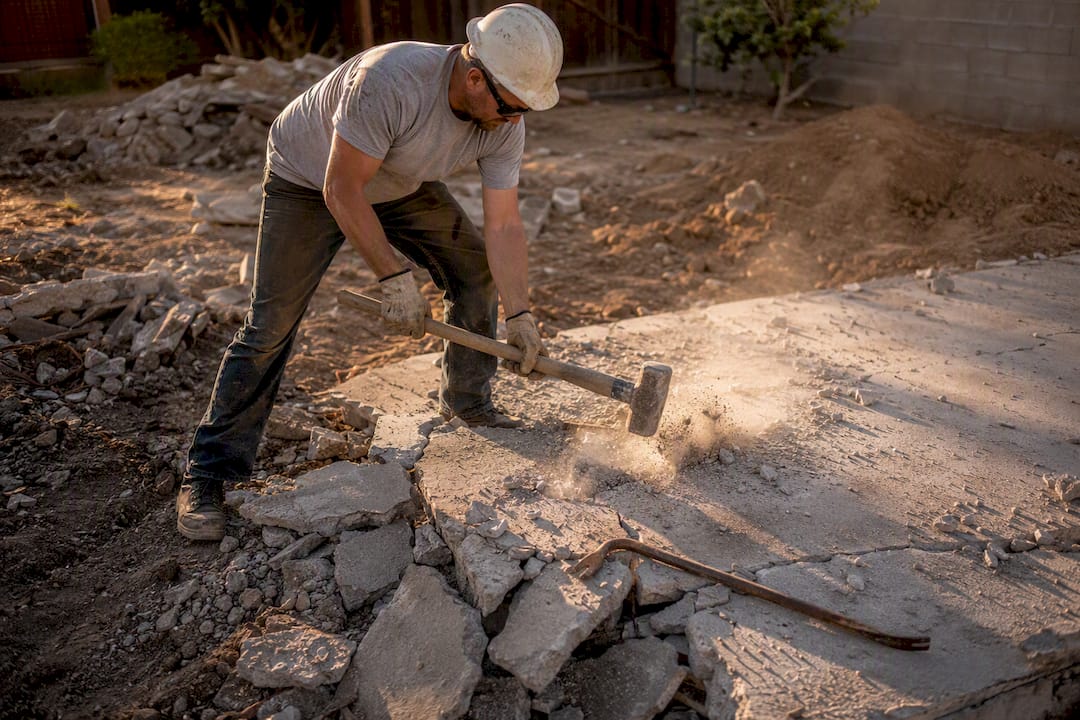
Yes, if the slab is small, thin, and unreinforced. A patio or walkway under 200 square feet and 4 inches thick with no rebar is a reasonable weekend DIY project. Anything bigger, thicker, reinforced, or close to a foundation is a job for a licensed contractor.
Hiring out concrete removal typically runs $2 to $8 per square foot, depending on thickness, access, and whether the crew has to cut through rebar. Doing it yourself means renting a breaker, renting a dumpster, and spending a full day or two swinging tools.
- DIY green light: ≤200 sq ft, ≤4 in thick, no rebar, easy truck access
- Hire a pro if: slab exceeds 200 sq ft, contains wire mesh or rebar, sits near a foundation, or you suspect asbestos in old flooring or mastic
Quick math: a 400 sq ft driveway section removed by a contractor lands somewhere in the $640 to $2,087 range nationally for typical jobs, while the same job DIY might cost $300 to $600 in rental and dumpster fees, plus your weekend.
Stop and call a pro if you see buried utility lines, structural rebar mats, or any material that looks like old asbestos tile or roofing felt.
Key Takeaways
Concrete slab removal comes down to three variables: size, thickness, and reinforcement, and getting those three right determines whether a weekend project turns into a costly mistake.
| Point | Details |
|---|---|
| DIY threshold | Slabs under 200 sq ft and 4 in thick without rebar are reasonable DIY candidates. |
| Rebar changes the math | Reinforced slabs add cutting time and roughly 50 to 75 cents per sq ft to contractor bids. |
| Score before you break | Cutting control lines with a wet diamond blade reduces effort and unpredictable cracking. |
| Disposal costs add up | Concrete is heavy; confirm dumpster weight limits and check local recyclers before hauling. |
| Call a pro for the hard cases | Cornelius Wrecking handles large reinforced slabs, asbestos concerns, and tight-clearance sites with OSHA and asbestos abatement certifications. |
Table of Contents
- Should You DIY Concrete Slab Removal or Hire It Out?
- What Are the Main Concrete Removal Methods?
- Which Tools Do You Need to Rent?
- How Do You Remove a Concrete Slab Step by Step?
- Where Does Broken Concrete Go After Removal?
- What Safety Gear and Permits Do You Need?
- What Does Concrete Slab Removal Actually Cost?
- When Does This Job Need a Licensed Contractor?
- Where Can You Find More Concrete Removal Resources?
- The Real Question Isn’t Cost, It’s Risk Tolerance
- Skip the Rental Runaround for the Jobs That Matter
- Sources
Should You DIY Concrete Slab Removal or Hire It Out?
Run through this checklist before you rent anything. It takes five minutes and saves you from a half-broken slab and a rented jackhammer you can’t return until Monday.
Size and thickness matter most. Slabs up to roughly 200 square feet and about 4 inches thick without rebar are reasonable DIY candidates using a rented electric demolition hammer. Push past that and you’re fighting physics with a tool that isn’t built for the job.
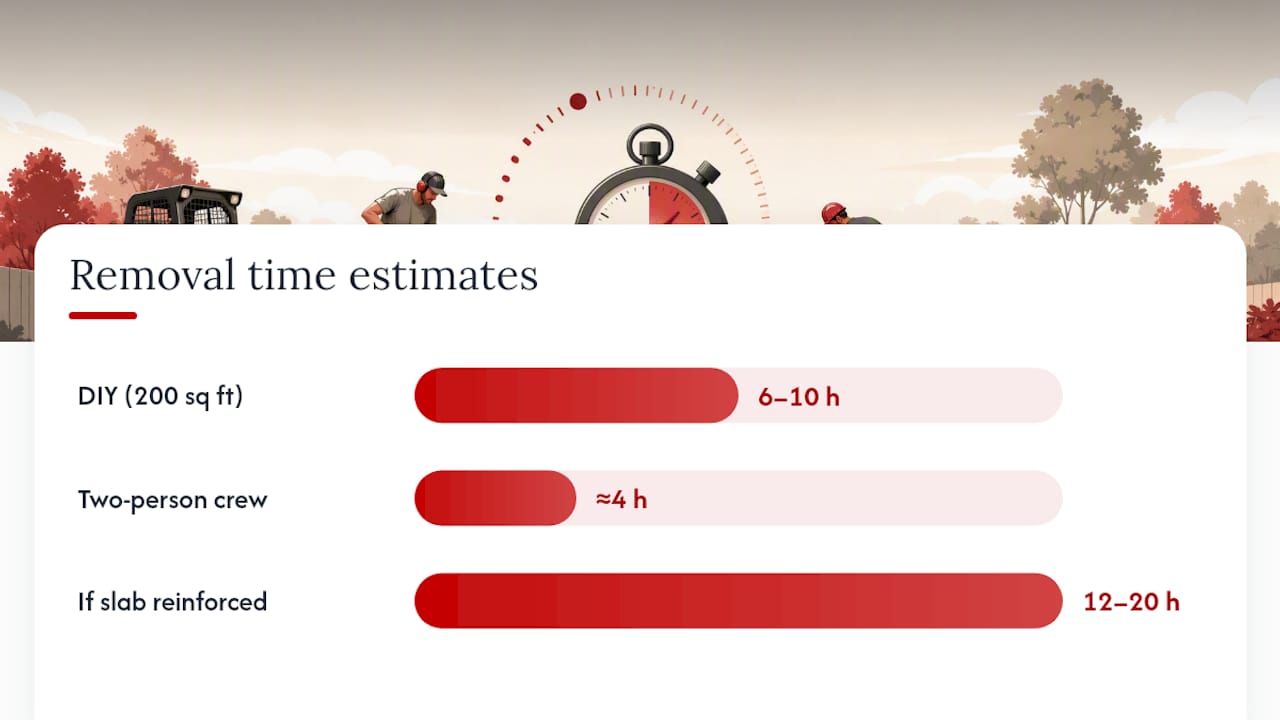
Reinforcement changes everything. Tap the slab with a hammer near an edge or a crack. If you hit wire mesh or rebar a couple inches down, plan on double the time and a reciprocating saw or grinder just for cutting steel. Heavily reinforced driveways and garage floors are usually not worth the DIY attempt.
Site access decides the rest. A backyard patio you can wheelbarrow debris out of in five-gallon loads is doable. A slab boxed in by fences, with no truck access for a dumpster, often costs more in labor hours than it saves in cash.
- Physical demands: expect 6 to 10 hours of hard labor for 200 sq ft
- Permits: many municipalities require a demolition permit for slabs over a certain size or near property lines
- Time: DIY realistically eats a full weekend; a two-person crew with power tools can finish the same job in half a day
Pro Tip: Before you rent anything, dig a 12 inch test hole at one corner. If you hit a thick gravel base and no mesh, the rest of the slab is probably the same. If you hit rebar, assume the whole slab is reinforced.
What Are the Main Concrete Removal Methods?
Every method trades speed for cost, noise, or physical effort. Matching the right one to your slab saves you money and your back.
Manual demolition with a sledgehammer and pry bar is the cheapest option and requires zero rental fees, just muscle. It works fine on thin, unreinforced concrete under 3 inches, but expect it to take three or four times longer than powered tools on anything bigger than a small walkway.
Electric demolition hammers hit a sweet spot for homeowners. They’re quieter than gas-powered breakers, don’t produce exhaust fumes, and handle medium slabs (4 to 6 inches) reasonably fast. Most rental centers stock 15 to 35 pound models that one person can control without a second set of hands.
Pneumatic breakers and excavator-mounted hydraulic hammers are built for speed on large or heavily reinforced slabs. A mini-excavator with a breaker attachment can clear a 1,000 square foot driveway in a few hours, but you need truck or trailer access to get the machine on site, and most homeowners hire an operator rather than rent the rig themselves.
Saw cutting with wet diamond blades doesn’t remove concrete on its own. It scores control lines that turn a random, unpredictable crack pattern into clean, manageable sections. Proper site assessment and controlled cutting before breaking genuinely cuts down on wasted effort, especially on slabs where you want to protect an adjacent section or a foundation edge.
Chemical expansive agents are the quiet option. You drill a grid of holes, pour in the expanding powder, and let it work over 12 to 24 hours as the material swells and fractures the slab from the inside. There’s no jackhammer noise and almost no vibration, which matters if you’re working near a shared wall, a municipal noise ordinance, or a neighbor who works nights. The tradeoff is time: you’re waiting a full day or two instead of finishing in an afternoon.
Here’s how the methods stack up in practice:
- Thin, small slab, easy access: sledgehammer and pry bar
- Medium slab, moderate size: electric demolition hammer
- Large or reinforced slab: pneumatic breaker or excavator with hydraulic attachment
- Precision edges or protecting adjacent structures: wet diamond saw for scoring
- Noise-restricted or vibration-sensitive site: chemical expansive agents
Which Tools Do You Need to Rent?
Renting the wrong tool is the most common DIY mistake. A sledgehammer feels free until hour three; an excavator feels excessive for a 10 by 10 patio.
Here’s what actually gets used on a typical homeowner project:
- Sledgehammer (16 lb): free if you own one, otherwise $15 to $25 per day to rent
- Electric demolition hammer: $60 to $100 per day, handles most driveways and patios under 6 inches thick
- Pneumatic jackhammer: $80 to $150 per day, plus a compressor rental if the unit doesn’t include one
- Mini-excavator with breaker attachment: $300 to $500 per day and usually requires towing capability or delivery fees
- 14 to 16 inch wet saw with diamond blade: $100 to $200 per day, essential for control-line scoring on anything you want to break cleanly
- Reciprocating saw or angle grinder: $30 to $50 per day for cutting through rebar you expose while breaking
- Bolt cutters: $20 to $40 per day for lighter wire mesh
- Wheelbarrow: you’ll want at least one, ideally two, for moving broken chunks to the dumpster
Demolition hammers over 25 pounds are genuinely hard to control solo for more than 20 minutes at a stretch. If you’re renting anything in that weight class, plan on trading off with a second person, both to save your shoulders and because fatigue is when accidents happen. Excavators and larger breakers effectively require an operator with experience, not just a rental agreement.
How Do You Remove a Concrete Slab Step by Step?
The sequence matters as much as the tools. Skip a step and you either waste hours or hit something you didn’t expect.
-
Call 811 before anything else. This is free, mandatory in most states, and marks buried gas, water, and electrical lines. Give it two to three business days before you start.
-
Photograph and measure the slab. Note thickness at a few points, check for cracks that reveal rebar, and confirm whether your municipality requires a demolition permit for the square footage you’re tackling.
-
Set up your work zone. Lay plywood or tarps over anything you want to protect, and give neighbors a heads-up if you’re running a jackhammer or saw for a full day.
-
Score control lines with a wet diamond blade before you break anything. Cutting a grid of 2 to 3 inch deep lines turns one unpredictable slab into predictable sections and reduces the physical effort of every swing that follows, a point confirmed by demolition professionals who use this exact technique on far bigger jobs.
-
Break in sections, not the whole slab at once. Work in roughly 2 foot by 2 foot or 18 to 24 inch chunks. Trying to crack an entire driveway in one go just tires you out for no benefit.
-
Create an air gap where you can. Digging a small trench under one edge or wedging a floor jack under a section gives the concrete somewhere to move, which makes it fracture far more easily than breaking against solid ground.
-
Deal with rebar as you find it. Clear the concrete around exposed bars with a chisel, then cut with a reciprocating saw or bolt cutters. Watch for tension. A cut bar under load can spring back with real force.
-
Load rubble into a wheelbarrow, not by hand. Keep loads manageable, position your dumpster or truck as close to the work area as the site allows, and don’t overload a single wheelbarrow trip just to save steps.
-
Recompact and regrade the subgrade once the slab is out. Remove leftover debris, compact the base, and slope it slightly away from any structure so water doesn’t pool where the slab used to sit.
Pro Tip: Homeowners on DIY forums consistently report that scoring lines before breaking is the single change that made the biggest difference in how long the job took. Skip it and you’re fighting the slab instead of working with it.
Where Does Broken Concrete Go After Removal?
Disposal costs sneak up on people who budget for the breaking but not the hauling. Concrete is heavy, and most dumpster companies charge by weight once you cross a threshold, not just by the container size.
- Rent a heavy-debris dumpster, not a standard construction one, and confirm the weight limit in the rental agreement before you start filling it. Overage charges on concrete debris add up fast.
- Call local concrete recyclers first. Many accept clean, unreinforced concrete for free or a nominal fee, since crushed concrete gets reused as road base and fill material.
- Landfills charge per ton, and rates vary widely by region, so a quick call to two or three facilities before you commit to a dumpster size can save real money.
- Reuse what you can on site. Broken chunks make solid fill under a new patio base or informal garden edging, which cuts your hauling volume without costing anything.
For rough budgeting: a 400 square foot patio at 4 inches thick generates roughly 5 tons of broken concrete, and a 1,000 square foot driveway can produce 12 to 15 tons depending on thickness. That weight is exactly why recyclers matter, and why rebar contamination disqualifies a load from the cheaper recycling stream at most facilities.
What Safety Gear and Permits Do You Need?
Concrete demolition isn’t dangerous in the dramatic sense. It’s dangerous in the slow, cumulative sense: dust in your lungs, a chip in your eye, a bar snapping back and catching your arm.

PPE isn’t optional here. You need an N95 or, better, a P100 respirator rated for silica dust, safety glasses or a full face shield when cutting, hearing protection for anything powered, and steel-toe boots for the inevitable dropped chunk of concrete.
Silica dust is the hazard people underestimate. Cutting or breaking concrete releases fine silica particles that cause long-term lung damage with repeated exposure. Wet cutting and basic dust control cut down airborne dust dramatically compared to dry breaking. Close windows near the work area and cover HVAC intakes if you’re working close to the house.
Stop if you suspect asbestos. Homes built before the 1980s sometimes have asbestos in old mastic, tile adhesive, or certain flooring layers poured over the slab. If you see black or dark adhesive residue on an older slab, don’t cut into it. Call a certified abatement contractor for testing.
- Call 811 before digging or breaking near buried lines
- Check your city’s demolition permit rules; many require one over a set square footage
- Confirm allowed working hours for noisy tools if you’re in a residential zone
Pro Tip: If you’re not sure whether a slab has rebar or asbestos risk, spend $200 on a professional assessment before you spend $300 on tool rentals. It’s the cheapest insurance in the whole project.
What Does Concrete Slab Removal Actually Cost?
Cost breaks into the same buckets whether you DIY or hire out: labor, equipment, rebar handling, and disposal. The difference is who’s doing the labor.
Contractor pricing typically runs $2 to $8 per square foot, with national job totals commonly landing between $640 and $2,087 depending on slab thickness, access, and reinforcement. Rebar pushes costs higher: expect an extra 50 to 75 cents per square foot when a slab has dense reinforcement, since cutting steel slows the crew down and adds wear on equipment.
DIY costs build differently. You’re paying for tool rental, dumpster rental, and disposal fees, but not labor since that’s your own time.
| Cost Component | Typical Range |
|---|---|
| Electric demolition hammer rental (1 day) | $60 to $100 |
| Heavy-debris dumpster rental | $300 to $500 |
| Landfill or recycler disposal fee | Varies by region and weight |
| Reciprocating saw/grinder (rebar cutting) | $30 to $50 |
| Total DIY cost, 400 sq ft unreinforced | $400 to $700 plus your labor |
Worked example: a 20 by 20 patio (400 sq ft). DIY, expect $400 to $700 in rental and disposal costs across a full weekend of work. Hired out, that same patio typically runs somewhere in the low thousands depending on your local rates and access.
Worked example: a 1,000 sq ft driveway with rebar. This is where DIY math stops making sense for most homeowners. Reinforced concrete at that scale needs mechanized breaking equipment, a crew to move debris efficiently, and specialized rebar cutting. Contractor rates on a job this size commonly land well above what a weekend DIY attempt would cost once you factor in multiple dumpster loads and the extra time reinforcement adds. You can run your own numbers with a concrete cost calculator before requesting quotes, which gives you a real baseline to compare contractor bids against.
When Does This Job Need a Licensed Contractor?
Some slabs simply aren’t DIY projects, no matter how motivated you are with a rented breaker.
Cornelius Wrecking handles the jobs that sit past the DIY line: large reinforced slabs, concrete near a foundation or load-bearing wall, and any site where asbestos abatement might be involved. That last category matters more than most homeowners realize, since older slab coatings and adhesives can contain regulated materials that require certified handling, not a weekend project.
A slab under 200 square feet and a few inches thick is a different animal than 1,000 square feet of reinforced driveway sitting six feet from a garage foundation. The first is a Saturday project. The second needs someone who’s cut rebar mats professionally and knows exactly how a slab that size wants to fracture, and who carries the OSHA and asbestos abatement certifications to handle whatever’s underneath it safely.
Professional demolition earns its cost fastest on the edge cases: dense reinforcement, hazardous materials, and tight clearances where one bad break could crack a foundation.
Where Can You Find More Concrete Removal Resources?
Run your own numbers before calling contractors. A concrete cost calculator lets you plug in slab dimensions and thickness for a project-specific estimate. For the technical side of specialized methods like diamond wire sawing, the MDPI review on demolition technologies breaks down how low-dust techniques compare to traditional breaking.
The Real Question Isn’t Cost, It’s Risk Tolerance
Most guides on this topic treat DIY concrete removal as a pure cost calculation: rental fees versus contractor quotes. That framing misses the point. The math almost always favors DIY on paper for small slabs. What it doesn’t account for is what happens when you’re two hours into breaking a “simple” patio and discover wire mesh you didn’t test for, or a slab thickness that varies by two inches across its length because nobody poured it evenly.
Homeowners tend to underestimate how physically brutal manual and even powered demolition gets past hour three. That’s not a reason to avoid DIY. It’s a reason to test thoroughly before committing, and to have a real exit plan if the slab turns out different than expected.
The conventional advice says “measure your slab, rent a tool, go.” Better advice says test a corner first, confirm what’s underneath, and only then decide which of the five methods actually fits what you’re standing on.
— Zach
Skip the Rental Runaround for the Jobs That Matter
Cornelius Wrecking is the option for the slabs this article just told you to leave alone: reinforced driveways, concrete near a foundation, and anything with a hint of asbestos underneath. Instead of renting equipment for a job that turns into three trips to the rental counter, you get a crew that already carries OSHA and asbestos abatement certifications and shows up with the right machine the first time.
That certification matters most on exactly the edge cases this guide flagged: dense rebar mats, tight clearances near structures, and older slabs with suspect coatings. Those aren’t situations where a second rental day saves you money. They’re situations where the wrong call costs a lot more than a contractor quote would have.
If your slab falls outside the DIY thresholds covered here, get a project quote from Cornelius Wrecking and find out what professional removal actually costs for your specific site.
Sources
- ConcreteNetwork — Demolition
- How to Remove a Concrete Slab: DIY Demolition Guide — SlabCalc
- Thumbtack — Concrete removal cost
- Lowe’s — How to break up concrete
Recommended
Planning a demolition or excavating project?
Get a fast, no-obligation quote from Cornelius Wrecking.
Request a Quote