Cooling Tower Demolition: Methods, Case Studies, and Costs
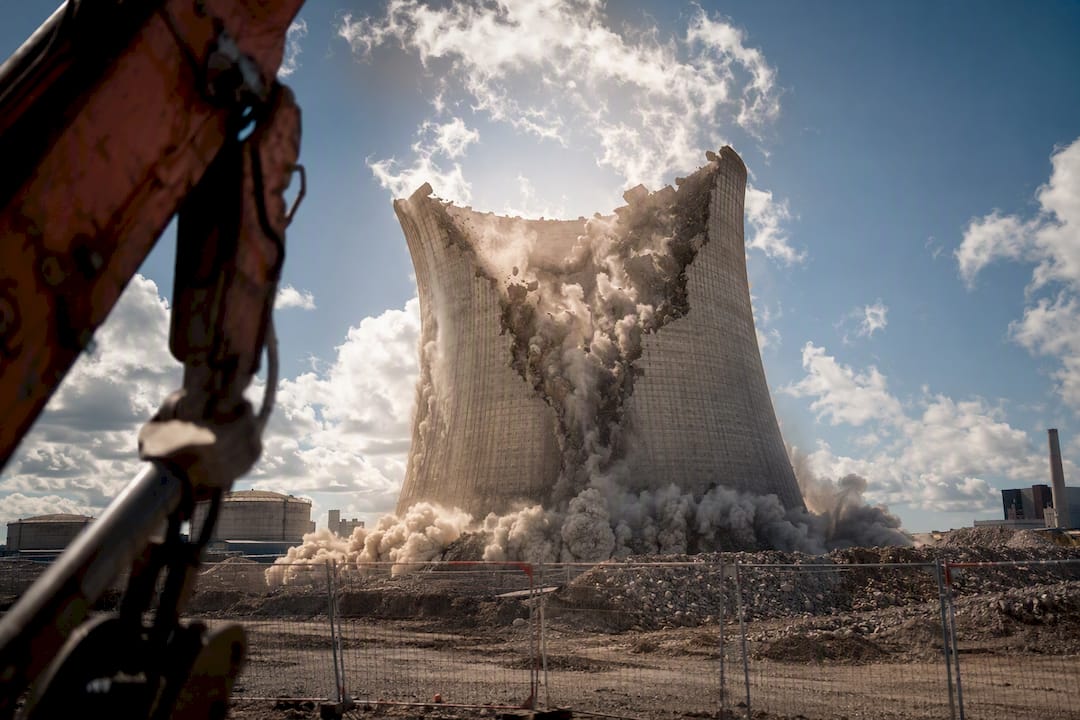
Cooling tower demolition is a controlled structural removal operation, most often done through explosive implosion or mechanical dismantling, that clears obsolete industrial infrastructure while managing hazards like asbestos and unstable concrete shells. This guide walks through recent case studies, the engineering behind each demolition method, permitting and safety requirements, recycling outcomes, realistic timelines and costs, and how Cornelius Wrecking approaches projects of this scale.
TL;DR:
- Explosive implosion requires precise pre-weakening, extensive planning, and is most suitable when structures are far from occupied sites or utilities.
- Recycling strategies involve on-site crushing for concrete and salvaging steel to significantly reduce disposal costs and environmental impact.
- Safety, hazard abatement, and permit acquisition are critical steps completed months in advance, with thorough hazard surveys especially for asbestos and PCB materials.
- Multi-tower demolitions demand synchronized detonation sequencing to prevent debris interference, which increases complexity and cost.
- The total project timeline spans several months, with demolition lasting only days to weeks, heavily influenced by site access, abatement scope, method choice, and recycling logistics.
Table of Contents
- What Recent Cooling Tower Implosions Teach Us
- How Do Contractors Actually Bring a Cooling Tower Down?
- What Has to Happen Before Demolition Day?
- What Happens to the Concrete and Steel Afterward?
- How Long Does It Take and What Drives the Cost?
- How Should You Document a Cooling Tower Implosion?
- How Cornelius Wrecking Approaches Cooling Tower Projects
- Why Getting This Right Matters More Than the Explosion Itself
- Ready to Plan Your Cooling Tower Removal Project?
- Sources
What Recent Cooling Tower Implosions Teach Us
The best way to understand how a cooling tower comes down is to look at how the last few actually did. Two recent events, one in Tennessee and one in Germany, show just how differently a demolition team can approach the same basic problem.
In September 2025, the Tennessee Valley Authority (TVA) imploded a 540-foot hyperbolic cooling tower at its Hartsville site. The tower had sat unused for decades, a leftover from a nuclear plant that was never finished. TVA framed the decision around public safety: an aging, unused structure of that height posed a standing risk, and removing it opened the site for future power generation projects. Reporting on the Hartsville implosion noted the tower collapsed into itself in a matter of seconds, folding straight down into its own footprint rather than toppling outward. That collapse pattern isn’t luck. It’s the entire point of weeks of engineering work beforehand.
TVA also built recycling into the plan from the start. Crushed concrete from the Hartsville cooling tower is being reused on-site, larger chunks as equipment storage pads and smaller material as gravel for site lots. Steel gets pulled out and salvaged separately. Nothing about that is unusual for a modern demolition contractor, but it’s a useful reminder that “demolition” and “waste disposal” aren’t the same job anymore.
Germany’s Gundremmingen plant offers the sharpest numbers in this space. Crews there brought down two 160-meter towers using roughly 600 kilograms of explosives distributed across about 1,800 boreholes drilled into the concrete shells. The explosives were distributed evenly across boreholes to weaken the structure uniformly, spread across a huge grid designed to weaken the structure uniformly rather than blast it apart. The Gundremmingen demolition produced about 56,000 tonnes of material, all slated for recycling rather than landfill.
Quick numbers from Gundremmingen:
- Two towers, each of significant height
- A measured amount of explosives total
- Numerous boreholes across both structures
- About 56,000 tonnes of resulting material processed for recycling
Statistic Callout: A 160-meter cooling tower brought down with roughly 600 kilograms of explosives across 1,800 boreholes generates about 56,000 tonnes of concrete and steel, nearly all of it destined for a crusher or a scrap yard rather than a landfill.
Multi-tower events like Gundremmingen also highlight something single-tower projects don’t: timing. Bringing down two towers close together requires synchronized detonation sequencing so that shockwaves, dust plumes, and debris fields don’t interfere with each other. Get the timing wrong by even a fraction of a second and you risk one tower’s collapse throwing debris into the exclusion zone meant for the other. Coordinated demolitions of this scale have made headlines for their scale and precision, and they’ve become something of a benchmark for what “clean” simultaneous implosions look like.
The takeaway for owners and planners is consistent across both cases: the safety rationale drives the decision, the engineering determines the outcome, and the recycling plan determines whether the project pencils out financially. Skip planning any one of those three and the other two suffer.
How Do Contractors Actually Bring a Cooling Tower Down?
Four methods dominate cooling tower removal, and picking the wrong one for the site is one of the more expensive mistakes an owner can make.
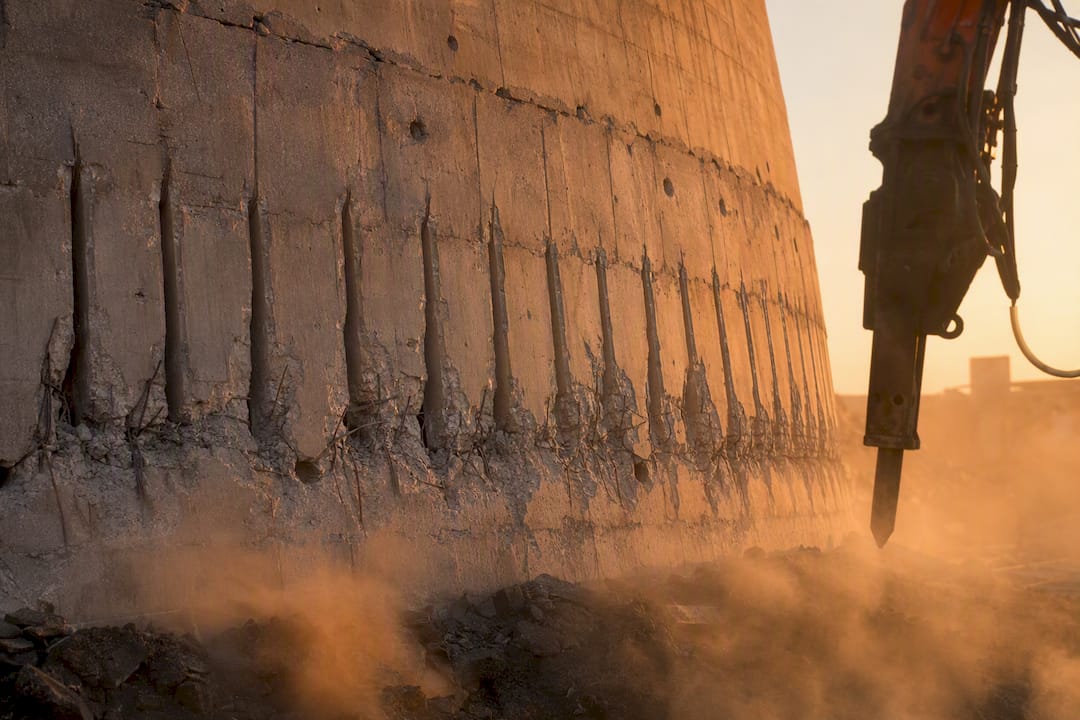
Explosive implosion is the method most people picture when they hear “demolition.” Crews drill boreholes into the concrete shell, typically in a grid pattern, then place charges designed to fail specific structural sections in a precise sequence. Before any charge goes in, engineers pre-weaken the structure using drop slots and vertical slots cut into the concrete. This isn’t cosmetic. Pre-weakening determines whether the tower folds straight down into its footprint or leans and topples where you don’t want it to. Structural stability analysis, factoring in wind load, remaining rebar strength, and the shell’s hyperbolic geometry, tells engineers exactly where those slots and charges need to go.
Blowdown, or synchronized collapse, applies the implosion concept to multiple towers at once. The goal is to keep every piece of debris inside a defined footprint even when two or more structures are coming down within seconds of each other. This demands tighter sequencing and more conservative exclusion zones than a single-tower job.
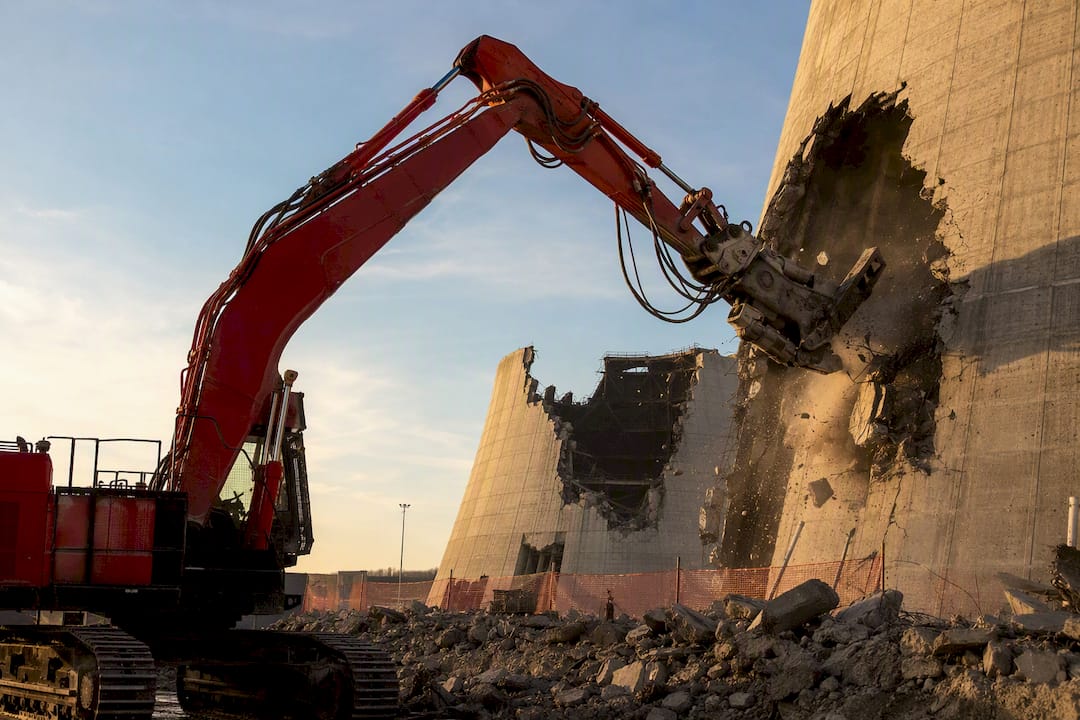
Mechanical, top-down demolition skips explosives entirely. Long-reach excavators fitted with hydraulic shears or breaker attachments work from the top of the structure downward, often assisted by hoisting rigs for larger chunks. Crews favor this approach when a site sits too close to occupied buildings, active rail lines, or underground utilities to risk an implosion’s shockwave and debris scatter, even a well-planned one.
Remote-controlled and digitalized demolition takes the mechanical approach a step further by removing the operator from the cab entirely. LiDAR scanning and point-cloud visualization let an operator control an excavator from a safe distance with a real-time 3D model of the structure, rather than relying on a camera feed alone. Research on remote-controlled demolition excavators found that LiDAR-based teleoperation systems improve both safety and precision over older camera-only setups, though weather conditions and sensor range still limit how far and how reliably these systems can operate.
Pro Tip: Don’t assume explosive implosion is automatically the fastest option. On sites with heavy asbestos legacy materials or dense surrounding infrastructure, mechanical demolition with remote-controlled equipment can actually finish faster once you account for the extra abatement and exclusion-zone planning implosion requires.
The choice usually comes down to three questions: how close is the nearest occupied structure, what’s buried or running underneath the site, and how much hazardous material needs to come out before anything gets touched.
What Has to Happen Before Demolition Day?
Nobody sets a charge or swings an excavator arm at a cooling tower until a long list of compliance and safety work is finished. Skipping steps here is where projects get shut down mid-schedule or, worse, where someone gets hurt.
- Deactivate and drain the system. Cooling towers that were still operational, or recently were, need their water systems drained, power and water lines isolated, and chemical dosing tanks removed. This matters more than it sounds. Standing water in a cooling system is a known breeding ground for Legionella bacteria, and leaving dosing chemicals in place creates both a safety hazard for crews and a documentation gap that can come back to bite an owner during environmental review.
- Conduct hazard surveys. Asbestos and PCB surveys come first, since older towers frequently contain asbestos in gaskets, insulation, and fireproofing. Abatement crews, certified for the work, need to clear these materials before structural work begins.
- Secure permits and coordinate with agencies. Local and state permitting bodies need engineering plans, hazard survey results, and a defined exclusion zone before signing off. This is also when spectator management gets planned. Well-publicized demolitions draw crowds, and clear communication with local authorities about viewing areas prevents the kind of last-minute crowd-control scramble that turns a well-engineered implosion into a public-relations headache.
- Set up vibration and structural monitoring. Adjacent structures get baseline surveys and, in many cases, real-time vibration sensors during the event itself. This data also feeds contingency planning: what happens if fly-rock travels farther than modeled, or if the structure doesn’t collapse the way the engineering predicted.
- Document everything. Every abatement certificate, every permit, every monitoring log becomes part of the record that supports future redevelopment approval on the site. Skipping this step doesn’t just create risk during demolition. It creates paperwork gaps that slow down whatever gets built on that land next.
Statistic Callout: At Gundremmingen, engineers didn’t just place explosives. They mapped roughly 1,800 individual borehole locations across two towers, a scale of planning that reflects how much of a “demolition” project is actually pre-event engineering rather than the event itself.
None of these steps are optional extras. Skip the chemical dosing tank removal, for instance, and you’re not just risking a safety violation. You’re creating an environmental compliance liability that can surface months after the tower is already gone.
What Happens to the Concrete and Steel Afterward?
A cooling tower doesn’t just disappear when it comes down. It turns into tens of thousands of tonnes of material that has to go somewhere, and increasingly, that “somewhere” is a crusher rather than a landfill.
On-site crushing is now standard practice on large jobs. Concrete gets fed through mobile crushers positioned near the collapse footprint, producing a graded base material that’s often reused right there on the property. TVA’s plan for the Hartsville site is a good example: larger crushed chunks become storage pads for equipment, while finer material becomes gravel for site lots. No trucking, no tipping fees, no landfill volume.
Steel is handled separately. Rebar and structural steel get pulled from the debris pile, sorted, and sold into scrap metal markets, a revenue stream that offsets some of the demolition cost rather than adding to it. At Gundremmingen, the roughly 56,000 tonnes of resulting material is being processed specifically for recycling rather than disposal, treating the demolition as much as a materials-recovery operation as a removal job.
A basic logistics checklist keeps this part of the project from bottlenecking:
- Sort concrete and steel debris on-site immediately after collapse, before it gets buried under subsequent work.
- Stage crushed material in defined zones so trucks and loaders aren’t fighting for space.
- Line up buyers or processors for scrap steel before demolition day, not after.
- Confirm the site has permits for on-site crushing operations, since some jurisdictions treat this separately from the demolition permit itself.
Recycling isn’t just good optics. It cuts disposal costs meaningfully and, because there’s less material leaving the site by truck, it usually speeds up final site cleanup too.
How Long Does It Take and What Drives the Cost?
Large cooling tower demolitions move through five phases, and each one has its own timeline pressure points.
- Survey and engineering. Structural analysis, hazard surveys, and demolition plan development. This phase alone can run several weeks for a single tower and considerably longer for multi-tower sites with complex adjacent infrastructure.
- Permitting. Running in parallel with engineering where possible, but final permits usually depend on the engineering plan being complete, so this phase often becomes the schedule bottleneck.
- Abatement and prep. Asbestos and hazardous material removal, system deactivation, and pre-weakening work like drop and vertical slot cutting.
- Demolition execution. The shortest phase by far. The implosion itself takes seconds; even a full mechanical top-down job typically wraps in days to a couple of weeks per structure.
- Cleanup and recycling. Crushing, sorting, hauling, and site grading. This can stretch on for weeks after the visible “event” is long over.
A single-tower project can move from initial survey to final site cleanup in a few months under a tight schedule. Multi-tower sites, especially those requiring synchronized collapse sequencing, routinely take longer given the added coordination and monitoring requirements.
Cost swings on a handful of variables more than anything else:
- Site access for cranes, crushers, and hauling trucks.
- Abatement scope, since asbestos removal can rival the structural demolition cost on older towers.
- Method chosen, as explosive charges versus mechanical labor hours carry very different cost structures depending on site constraints.
- Disposal and recycling logistics, where on-site crushing and steel salvage can meaningfully offset costs versus hauling everything to a landfill.
- Traffic control and exclusion zone management, particularly for high-visibility events near public roads.
Owners who want to keep the cost of cooling tower removal predictable should commission site surveys early and build a recycling plan into the bid process from day one, rather than treating it as an afterthought once the tower is already down.
How Should You Document a Cooling Tower Implosion?
Video and photo documentation of a cooling tower implosion serves three audiences at once: engineers verifying the collapse behaved as modeled, the public watching a landmark disappear, and marketing teams telling the story afterward. Getting the capture right takes more planning than pointing a phone at the structure.
Drone operators need to stay outside the defined exclusion zone at all times, and any aerial footage should come from an FAA-certified operator with appropriate airspace clearance for the event. This isn’t a nice-to-have. Debris fields from a large implosion can travel farther than expected, and drone operators inside or near the collapse radius put themselves and any nearby aircraft at risk.
A strong capture strategy layers multiple angles:
- Ground-level cameras positioned at safe distances to capture the collapse sequence and dust plume behavior.
- Drone footage from outside the exclusion zone for overall scale and site context.
- High-frame-rate cameras aimed at specific structural sections, useful for engineers reviewing whether pre-weakening and charge placement performed as predicted.
Public interest in these events tends to be high, and coordinated public communication around viewing areas and event timing helps keep spectators safely outside exclusion zones without turning the event into a logistical scramble. Footage also does double duty after the dust settles: engineering teams use it to validate collapse mechanics, and it becomes documentation supporting the recycling and cleanup logistics that follow.
How Cornelius Wrecking Approaches Cooling Tower Projects
Cornelius Wrecking works cooling tower and power plant decommissioning projects across Missouri, Kansas, and nationwide, backed by OSHA and asbestos abatement certifications that matter enormously on jobs where hazardous materials are baked into the structure. A tower built decades ago almost never comes down clean. It comes down with legacy insulation, gaskets, and coatings that need certified handling before anyone touches structural steel or concrete.
The workflow on a project like this typically runs through the same phases covered earlier in this guide, but with a contractor managing every handoff between them:
- Survey and engineering assessment, identifying hazards, structural condition, and site access constraints before any method gets chosen.
- Abatement, clearing asbestos and other regulated materials under proper certification.
- Method selection, weighing explosive implosion against mechanical or remote-controlled dismantling based on proximity to occupied structures, underground utilities, and site geometry.
- Execution, carried out with a heavy-equipment fleet suited to everything from long-reach excavation to bulk debris handling.
- Recycling and site handoff, crushing concrete on-site where feasible and salvaging steel to reduce disposal costs and speed up redevelopment.
Facility owners rarely need a one-off subcontractor for a job like this. They need a single contractor who can carry a decommissioning project from the first hazard survey through final site handoff without losing accountability at each handoff point. That continuity is where certified, full-scope demolition experience earns its keep.
What sets a contractor apart on projects of this scale isn’t just having a crane and a permit. It’s the ability to coordinate abatement, structural engineering, and regulatory sign-off as one continuous process instead of three separate vendors passing the job around. Cornelius Wrecking’s national project experience spans exactly the kind of heavy industrial and energy facility work that cooling tower removal demands, from initial survey through the final recycled gravel lot.
Why Getting This Right Matters More Than the Explosion Itself
The implosion footage is what gets shared online, but it’s the least interesting part of the job to anyone who actually runs these projects. The real work, and the real risk, sits in the months before the charges ever go in: the hazard surveys, the pre-weakening calculations, the exclusion zone planning that keeps a crowd of onlookers a safe distance from a collapse radius that doesn’t always behave exactly the way a model predicted.
What gets underestimated most is the recycling math. Owners often treat crushing concrete and salvaging steel as a nice environmental bonus tacked onto the real project. It’s not a bonus. On a job producing tens of thousands of tonnes of material, the difference between hauling everything to a landfill and processing it on-site can be the difference between a project that overruns its budget and one that comes in clean. Gundremmingen’s roughly 56,000 tonnes of recycled material wasn’t an afterthought bolted onto the demolition plan. It was baked into the plan from the start, which is exactly where it belongs.
Cornelius Wrecking treats every cooling tower project with that same weight: safety planning and hazard abatement come first, method selection follows the site’s actual constraints rather than habit, and recycling gets built into the bid instead of pitched afterward as an upsell. If your facility has a project like this on the horizon, that’s the conversation worth having early.
— Zach
Ready to Plan Your Cooling Tower Removal Project?
Cornelius Wrecking handles power plant and cooling tower decommissioning the way large industrial clients actually need it done: one contractor managing hazard abatement, structural engineering coordination, method selection, and final site recycling, instead of three separate vendors you have to stitch together yourself. Our OSHA and asbestos abatement certifications mean the hazardous material survey and cleanup happen under the same roof as the structural demolition, which is exactly where the schedule risk on projects like this tends to hide.
Whether you’re planning a single-tower removal or a multi-structure decommissioning across a retired energy facility, our crew and equipment fleet scale to the job rather than the other way around. If you have a cooling tower demolition project on the horizon in Missouri, Kansas, or anywhere nationwide, request a project estimate from Cornelius Wrecking and get a straight answer on scope, timeline, and method before you commit to a plan.
Sources
- TVA brings down Hartsville’s cooling tower – ANS / Nuclear Newswire
- Cooling towers brought down at German plant - World Nuclear News
- Watch as cooling tower crumbles down in epic demolition - USA TODAY
- A digitalization-based approach for dismantling a cooling tower using a remotely controlled demolition excavator | Springer Nature
Recommended
Planning a demolition or excavating project?
Get a fast, no-obligation quote from Cornelius Wrecking.
Request a Quote