3 Bonds, 6 Insurance Lines: Demolition Compliance for Project Managers

3 Bonds, 6 Insurance Lines: Demolition Compliance for Project Managers
Most demolition jobs need three kinds of bonds (state license, municipal permit, and, on public contracts, performance and payment bonds meeting Miller Act requirements) plus six core insurance lines: general liability, workers’ compensation, commercial auto, inland marine, Contractors Pollution Liability, and umbrella coverage. Before you bid, pull the permit language and contract insurance exhibit and get a demolition-specialist broker or surety agent on the phone. A reputable demolition contractor handles this combination on every job it takes, and getting the paperwork wrong is the fastest way to lose a bid or a claim.
TL;DR:
- Contractors must ensure they have separate bonds for licensing, permits, and public work projects, each with specific obligations and durations.
- Insurance coverage should include demolition-specific general liability, Contractors Pollution Liability, and auto, with correct classifications and endorsements for hazardous materials.
- Proper documentation and timing are critical; bonding and insurance applications should be submitted at least two weeks before permits are needed, with accurate survey and permit info.
- Pollution coverage is mandatory on structures built before 1978, and misclassified policies often lead to claim denials, making correct class coding essential.
- Owners and agencies separately verify bonds and insurance; combining these efforts under one contractor improves compliance and reduces delays.
Table of Contents
- What to Check Before You Bid or Mobilize
- Which Bond Type Does Your Project Actually Need?
- Insurance Coverages Demolition Projects Actually Require
- How Bonds and Insurance Overlap With Permits and Contracts
- How to Get Bonded and Insured for a Demolition Job
- What a Working Demolition Contractor Sees on the Ground
- Why Pollution Coverage Deserves Attention First
- Get Bonded, Certified Demolition Work Without Managing Three Vendors
- Where to Verify These Requirements Yourself
- Sources
- FAQ
What to Check Before You Bid or Mobilize
Run this list against every permit and contract before you commit crew time or equipment:
- Confirm whether the municipality requires a per-project demolition permit bond, separate from your state license bond.
- Check if the job is public work that triggers Miller Act performance and payment bond requirements.
- Verify required insurance limits in the contract’s insurance exhibit, not just your standard policy.
- Gather your certificate of insurance (COI), additional insured endorsement, and waiver of subrogation.
- Pull together asbestos and hazardous-material survey documentation before permit submission.
Typical minimums cluster around $1 million to $2 million in general liability per occurrence, $2 million/$4 million aggregate on larger commercial jobs, and Contractors Pollution Liability limits running $1 million to $5 million depending on the structure’s age and hazard profile. A municipality or general contractor that asks for a specific endorsement won’t accept a substitute, so match the wording exactly before you submit.
Which Bond Type Does Your Project Actually Need?
Contractors often assume one bond covers everything. It doesn’t. A state license bond, a municipal permit bond, and public-contract bonds serve different obligees, run for different durations, and get sized by entirely different rules. You cannot swap one for another, even when the dollar amounts look similar, according to bond industry guidance on demolition-specific requirements.
The license bond stays active as long as you hold your contractor license, regardless of how many jobs you run under it. The permit bond exists for one job and gets released once the city signs off on final inspection and site restoration. §3131](https://uscode.house.gov/view.xhtml?req=granuleid:USC-prelim-title40-section3131&num=0&edition=prelim), covering both project completion and subcontractor/supplier payment.
| Bond type | Obligee | Typical amount | Duration / release |
|---|---|---|---|
| State license bond | State licensing board | Set by statute, often several thousand dollars | Continuous while licensed |
| Municipal permit bond | City/county building department | Set by municipal code, tied to project cost or square footage | Per-project, released at final inspection |
| Bid bond | Project owner | 5% to 10% of bid amount | Released when contract is awarded or bid withdrawn |
| Performance bond | Owner/GC | Full contract value (Miller Act threshold projects) | Held until substantial completion |
| Payment bond | Owner/GC | Full contract value (Miller Act threshold projects) | Held until subcontractors and suppliers are paid |
Every surety bond runs as a three-party arrangement. If the surety pays a claim, it expects indemnity from you afterward, which is why your balance sheet and loss history directly affect your bonding capacity.
Insurance Coverages Demolition Projects Actually Require
A generic contractor policy will not hold up on a demolition job, and the gap usually shows up at the worst possible moment: after a claim, not before one.
Your core program needs to include general liability written specifically for demolition class codes (not a generic contractor code), workers’ compensation under Code 5057, commercial auto for debris hauling, inland marine for owned and rented equipment, Contractors Pollution Liability, and umbrella or excess limits sized to the project. On large industrial or public jobs, umbrella limits of $5 million to $10 million over the CPL layer are common.
- Confirm your GL policy is classed correctly for demolition, not remodeling or general construction.
- Add CPL any time the structure predates 1978 or contains asbestos, lead paint, or unknown contaminants.
- Check for collapse and vibration exclusions, which standard forms often carry as boilerplate.
- Verify your policy covers completed operations, not just active work on site.
Standard general liability policies almost always carry an absolute pollution exclusion. That single clause is why CPL is functionally mandatory on any pre-1978 structure. Without it, an asbestos or lead claim gets denied outright, and you’re paying defense costs out of pocket.
Misclassification is the quieter trap. Insuring demolition work under a general contractor class code can void coverage entirely when a claim comes in, because the underwriter priced the risk you told them about, not the risk you actually ran. Confirm your policy explicitly names demolition or wrecking operations, and read the collapse and vibration language before you sign, not after a neighboring structure cracks.
How Bonds and Insurance Overlap With Permits and Contracts
Owners and municipalities don’t treat bonds and insurance as interchangeable, and they won’t accept one in place of the other. A state license bond proves you’re allowed to operate in that state. A municipal permit bond guarantees a specific job gets finished and the site restored. A performance bond on public work guarantees contract completion to the government agency that hired you. Three different documents, three different obligees, and municipal reviewers who check for all three separately.
Insurance requirements ride alongside, not instead of, bonds. A typical municipal or owner insurance exhibit asks for additional insured status naming the owner and municipality, primary and non-contributory wording, a 30-day cancellation notice, and CPL whenever hazardous materials are present on site, patterns confirmed in published municipal contract requirements. Miss one endorsement and the permit office or GC’s insurance reviewer will bounce your paperwork back, often days before mobilization.
How to Get Bonded and Insured for a Demolition Job
Start the paperwork before you finalize your bid, not after you win it. Underwriters on both the bond and insurance side need time to review financials, and demolition gets scrutinized harder than general construction.
- Assemble your surety application package: three years of loss runs, current financial statements, an experience list of completed projects, and references from owners or GCs.
- Pull together your insurance submission: current policy declarations, an equipment schedule, payroll broken out by classification, your written safety program, and any asbestos abatement certifications.
- Submit to your broker or agent at least two to four weeks ahead of your permit deadline, since standard license and permit bonds usually clear in 2 to 10 business days, while insurance with custom endorsements can take same-day to two weeks.
- If a standard carrier declines the class, expect your broker to place the CPL or GL layer in the excess and surplus (E&S) market, where forms flex more but pricing runs higher.
Pro Tip: Improving your bonding capacity is less about shopping sureties and more about how you present your balance sheet. A clean current-year profit statement and a documented safety record move underwriters faster than a lower bid ever will.
What a Working Demolition Contractor Sees on the Ground
A demolition and excavating contractor operating out of Missouri often handles residential, commercial, and industrial demolition projects, including power plant decommissioning and marine vessel dismantling on projects across the country. Staff holding OSHA and asbestos abatement certifications matter directly for the CPL and permit conversation above.
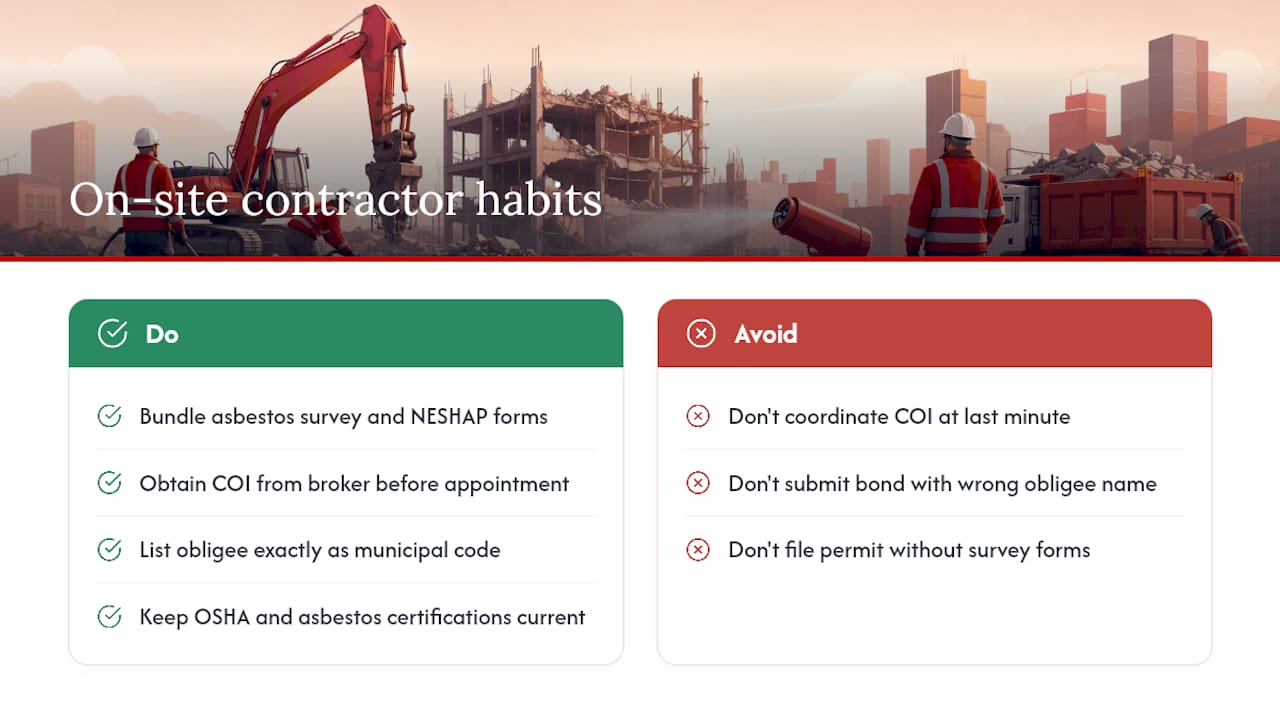
A few habits worth borrowing: keep asbestos survey results and NESHAP notification forms in the same packet as your permit application, coordinate COI issuance with your broker before your scheduled permit appointment (not the morning of), and list the obligee on your bond form exactly as it appears in the municipal code, since a name mismatch is a common reason bonds get kicked back.
Why Pollution Coverage Deserves Attention First
Most claim denials on demolition jobs trace back to two things: pollution exclusions and misclassified policies. Fix CPL and correct class coding before you touch anything else. Lock in your COIs and endorsements before mobilization, and confirm the permit bond trigger during pre-bid, not after you’ve already committed the crew.
— Zach
Get Bonded, Certified Demolition Work Without Managing Three Vendors
Coordinating a permit bond, a state license bond, contract insurance exhibits, and a hazardous-materials survey across separate vendors is where most timelines slip. Some demolition contractors run demolition, asbestos abatement, and site restoration under one roof, with their own crew and equipment fleet, so the compliance paperwork tracks a single point of contact instead of three.
Some teams hold OSHA and asbestos abatement certifications and take on commercial and industrial demolition, power plant decommissioning, and marine vessel dismantling nationwide. If your project needs financing coordination alongside construction, partners like Mayday Private Capital work with investment property owners on that side of the process. For your project, start by reviewing Cornelius Wrecking’s services and reach out to coordinate pre-bid documentation, including survey results and permit-ready paperwork, before your bid deadline.
Where to Verify These Requirements Yourself
Check the Miller Act text for federal bond thresholds, San Diego’s municipal demolition bond code for permit bond structure, and OSHA’s demolition standards for the safety rules permit offices reference. Municipal amounts vary by code, so confirm your specific jurisdiction rather than assuming a national figure applies.
Sources
- 40 U.S.C. §3131 (Miller Act)
- Demolition Contractor Insurance Requirements 2026 | CoverageCriteria
- Terrebonne Parish demolition insurance requirements (2025)
- San Diego municipal code – demolition permit bond
FAQ
What insurance does a demolition company need?
A demolition company typically needs general liability written on a demolition class code, workers’ compensation, commercial auto, inland marine for equipment, Contractors Pollution Liability, and umbrella coverage on larger jobs. CPL becomes close to mandatory on any structure built before 1978 because standard GL policies exclude pollution claims.
How do bonds work for insurance?
Bonds and insurance solve different problems: a bond guarantees you’ll finish a job or meet a legal obligation, and the surety can seek reimbursement from you if it pays a claim. Insurance, by contrast, pays covered losses without expecting repayment, which is why a surety bond functions as a three-party credit instrument rather than a risk-transfer product.
How much does a $1,000,000 surety bond cost?
Bond premiums typically run a small percentage of the bond’s face value, based heavily on your credit, financial statements, and prior claims history. Demolition contractors with strong financials and clean loss runs generally see lower rates than newer or higher-risk operators, since underwriters price demolition as a specialty class.
What does it mean if you are bonded and insured?
It means you carry the specific bonds and insurance policies a jurisdiction, licensing board, or contract requires, verified through a bond number and a certificate of insurance. A demolition contractor maintaining OSHA and asbestos abatement certifications alongside insurance and bonding allows owners and municipalities to verify credentials before awarding a contract.
Can a state license bond replace a municipal permit bond?
No. A state license bond and a municipal demolition permit bond serve separate obligees and one cannot substitute for the other. The license bond covers your right to operate statewide, while the permit bond guarantees completion and restoration on one specific job site.
Planning a demolition or excavating project?
Get a fast, no-obligation quote from Cornelius Wrecking.
Request a Quote