4 Numbers Contractors Need to Pick Demolition Cranes
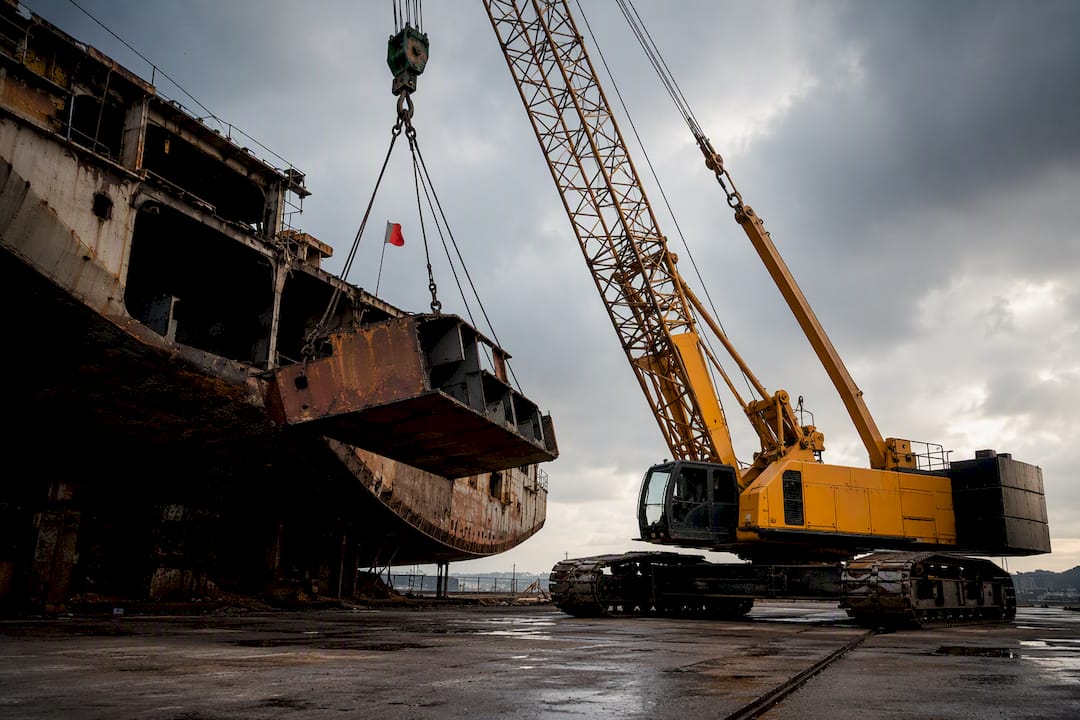
Crawler, tower, telescopic, truck, all-terrain, rough-terrain, and bridge/gantry cranes cover most demolition crane types, alongside high-reach excavators and duty-cycle wrecking cranes for niche work. Crawlers handle heavy, long-duration lifts on stable ground; all-terrain and rough-terrain units win on mobility and tight access; high-reach excavators dominate top-down structural work; bridge and gantry cranes handle precision indoor strip-outs. Most modern jobs favor controlled deconstruction with shears and splitters over the use of wrecking balls.
TL;DR:
- The choice of demolition crane type depends on site access, ground stability, and task specifics, with crawler cranes favored for heavy, long-term lifts.
- All-terrain and rough-terrain cranes are best suited for sites with restricted space or uneven ground, while high-reach excavators often substitute for mobile cranes in vertical demolition work.
- Attachments such as shears, breakers, and control systems significantly influence the precision, safety, and efficiency of demolition operations.
- Regulatory and manufacturer safety rules strictly limit crane usage for dynamic loads, with test lifts and load monitoring essential for compliance.
- Ground conditions, outriggers’ supporting capacity, and rigging coordination often outweigh crane specifications when determining the most practical equipment for a specific site.
Table of Contents
- Demolition Crane Types Explained: Matching Machine to Task
- What Attachments Turn a Crane Into a Demolition Tool
- How to Choose the Right Crane for a Demolition Project
- Safety Rules and Manufacturer Warnings That Shape Crane Selection
- How a Demolition Contractor Actually Picks Cranes on Site
- The Gap Between Crane Specs and Crane Reality
- Sources
Demolition Crane Types Explained: Matching Machine to Task
Choosing among demolition crane types starts with a blunt question: what does the site actually let you bring in, and what does the structure demand you take out? A crawler crane on steel mats can outlift almost anything on a job site, but it needs room to set up and ground that can bear its own weight before it lifts a pound of debris. A rough-terrain crane can thread into a cramped industrial yard that would swallow a crawler’s setup time whole.
Crawler cranes run on tracks instead of tires, which spreads their weight and lets them handle long booms and heavy capacities without outriggers. On demolition sites, that stability makes them the default choice for wrecking ball work, heavy structural steel removal, and duty-cycle applications where a load swings and drops repeatedly over hours. Their tradeoff is mobility. Moving a crawler between sites usually means trucking it in pieces and reassembling on location, which adds days to a schedule a wheeled crane wouldn’t need.
Tower cranes rarely get built specifically for demolition, but they show up on congested urban deconstruction jobs where a fixed, tall reach beats ground-based mobility. Anchoring one into a structure that’s partway through demolition raises real engineering questions: you’re bolting a permanent lifting system into something you’re actively taking apart. Most contractors reserve tower cranes for phased deconstruction where the building’s core stays intact while floors come down around it.
Telescopic and truck cranes give you fast setup and decent reach overlap between mobile crane classes, which makes them useful when a project needs both a demolition lift and general material handling on the same day. They’re less suited to sustained heavy-impact work like wrecking ball cycles, since their outrigger-dependent stability wasn’t built for repeated dynamic loading.
All-terrain and rough-terrain cranes solve the access problem crawlers create. All-terrain units drive highway speeds between jobs and still handle rough ground on site; rough-terrain cranes trade highway speed for even better off-road capability on soft or uneven demolition yards. When a site has no room for a crawler’s assembly footprint, one of these usually wins.
High-reach excavators aren’t cranes at all, but they’ve displaced a lot of crane-based demolition work. A tracked base with a long articulating boom and shear or breaker attachment lets a single operator work top-down on a structure without a separate lifting rig. For straightforward vertical demolition, they’re often faster and cheaper than crane-and-attachment combinations.
Bridge and gantry cranes serve a narrower purpose: indoor strip-outs and machine foundation dismantling where linear, low-vibration load guidance matters more than reach. Their precise positioning capability makes them a strong fit for placing demolition shears exactly where a cut needs to happen, repeatedly, without the swing risk a mobile crane’s boom introduces.
What Attachments Turn a Crane Into a Demolition Tool
The crane is only half the equation. What hangs off the hook or boom tip determines whether you’re doing controlled deconstruction or coarse tear-down.
- Shears and combi shears cut through steel, rebar, and mixed structural members with a scissoring hydraulic jaw. Combi shears add a crushing function for concrete, which makes them the versatile pick for mixed-material structures.
- Hydraulic breakers deliver percussive force for concrete and masonry where cutting isn’t practical, though they generate more vibration and dust than shears.
- Wrecking balls and duty-cycle cranes still have a place in industrial-scale demolition. A specialist duty-cycle crane has operated a wrecking ball at 75 meters, a scale where excavator booms simply can’t reach. But the decline of wrecking balls against hydraulic excavators reflects a real control problem: a swinging ball is far less precise than a shear.
- Skips and material handling attachments move debris off-site, but filling a skip while it’s suspended is a hard no in most safety guidance.
- Dust-control curtains, taglines, and anti-sway systems keep loads and debris where they’re supposed to be, which matters more with every job that shifts toward deconstruction over demolition.
Pro Tip: Test-lift any filled skip a few inches off the ground before hoisting it to height. It’s the fastest way to catch a shifted load or an overweight pick before it becomes a swinging hazard.
How to Choose the Right Crane for a Demolition Project
Picking from the available demolition crane types comes down to four numbers you need before you commit equipment to a job.
- Required lift at working radius. Every crane’s capacity drops as the load moves farther from the machine. Pull the actual load chart for the radius you need, not just the maximum rated capacity.
- Tip height or full reach. Confirm the boom or jib actually reaches the top of the structure or the drop zone you’re clearing, with margin for swing.
- Outrigger spread versus ground-bearing capacity. A crane rated for 80 tons is worthless if the pad beneath its outriggers can’t support the reaction load. Get a ground-bearing assessment before mobilization, not after.
- Cycle time and productivity. A high-reach excavator running continuous shear cycles can outproduce a crane-and-attachment setup that needs a rigger for every pick.
Once those four gates check out, apply a safety margin. Site conditions can override the math entirely: a cracked slab, tight access, a neighboring structure too close for boom swing, or high wind exposure can rule out a crane that looks perfect on paper. When top-down structural removal is the whole job and lifting isn’t required, a tracked high-reach excavator usually beats a crane-based approach on both cost and cycle time.
Safety Rules and Manufacturer Warnings That Shape Crane Selection
Regulatory limits aren’t background noise. They dictate which attachments and crane classes are even legal for a given task. California’s Title 8 Section 4941 sets specific limits on demolition ball weight relative to a crane’s rated load and line strength, and restricts truck cranes without outriggers from balling work at all.
Manufacturer guidance reinforces the same caution from a different angle:
Cranes should not be used for dynamic pulling or dragging loads, and skips should never be filled while suspended. Test lifts on the ground are standard procedure before any load goes to height.
Beyond the chart and the code, real site control matters:
- Taglines on every suspended load to control swing.
- Load monitoring systems for picks near rated capacity.
- Certified operators, current inspections, and the permits your jurisdiction requires before the crane ever mobilizes.
Pairing pre-lift briefings with documented safety procedures, using something like construction safety meeting software, keeps that verification trail intact if an inspector or insurer ever asks for it.
How a Demolition Contractor Actually Picks Cranes on Site
A demolition and excavating contractor runs projects nationwide, from residential tear-downs to power plant decommissioning and marine vessel dismantling, with OSHA and asbestos abatement certifications enabling the crew to handle hazardous material sequencing alongside the mechanical work.
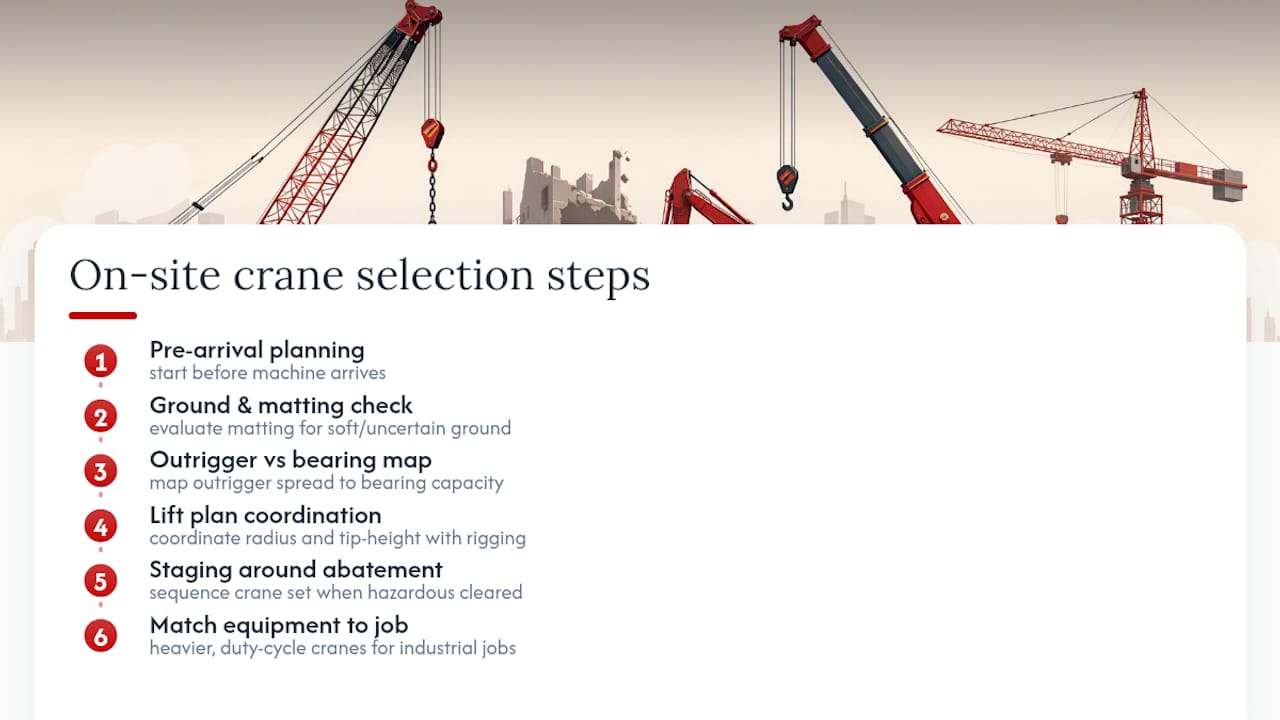
Crane selection on a live job starts before the machine ever arrives. Crews evaluate matting requirements for soft or uncertain ground, map outrigger spread against the site’s actual bearing capacity, and coordinate lift plans with rigging teams so nobody’s guessing at radius or tip height on the day of the pick. On abatement-heavy jobs, crane staging gets sequenced around hazardous material removal, since you can’t set outriggers on a pad that’s still being tested or cleared.
Industrial decommissioning and marine dismantling projects push crane choice toward heavier, longer-duration equipment. A power plant teardown might call for sustained duty-cycle capacity where a residential job would never need it. If you’re scoping a project that doesn’t fit neatly into a standard crane class, Corneliuswrecking’s team can walk through site-specific equipment planning before you commit to a bid.
The Gap Between Crane Specs and Crane Reality
Most guides to demolition crane types read like a parts catalog: here’s a crawler, here’s a tower crane, here’s what each one lifts. That’s not wrong, but it skips the part that actually determines project outcomes, which is that the crane is rarely the constraint. Ground-bearing capacity, outrigger reaction, and rigging coordination decide whether the “right” crane on paper is usable on a specific Tuesday on a specific slab.
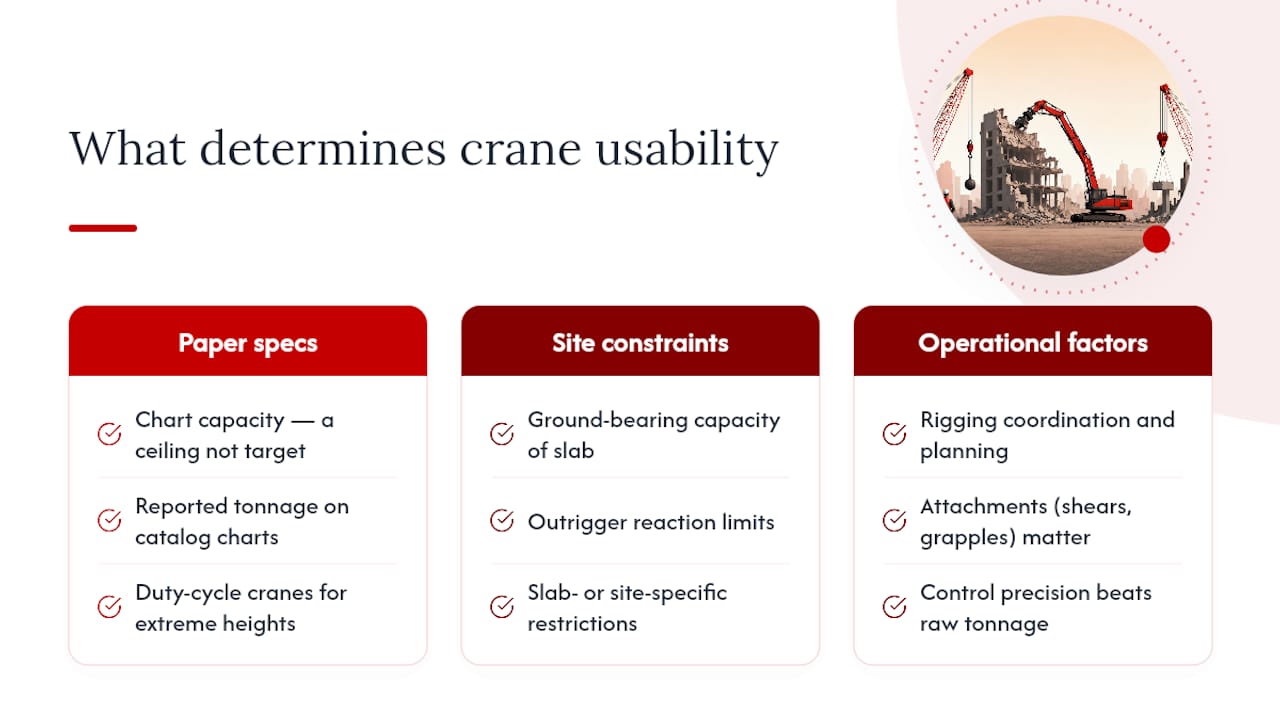
The industry’s own trajectory backs this up. Deconstruction, not demolition, is where the equipment conversation is heading, and that shift rewards contractors who think in terms of attachments and control rather than raw tonnage. A shear that places a cut exactly where you need it beats a bigger crane swinging a ball, in almost every scenario except the handful of extreme-height industrial jobs where duty-cycle cranes still make sense.
If there’s one thing planners underweight, it’s the safety margin conversation. Chart capacity is a ceiling, not a target.
— Zach
Sources
Planning a demolition or excavating project?
Get a fast, no-obligation quote from Cornelius Wrecking.
Request a Quote