Permit Delays Stall Dewatering: Groundwater Control for Contractors
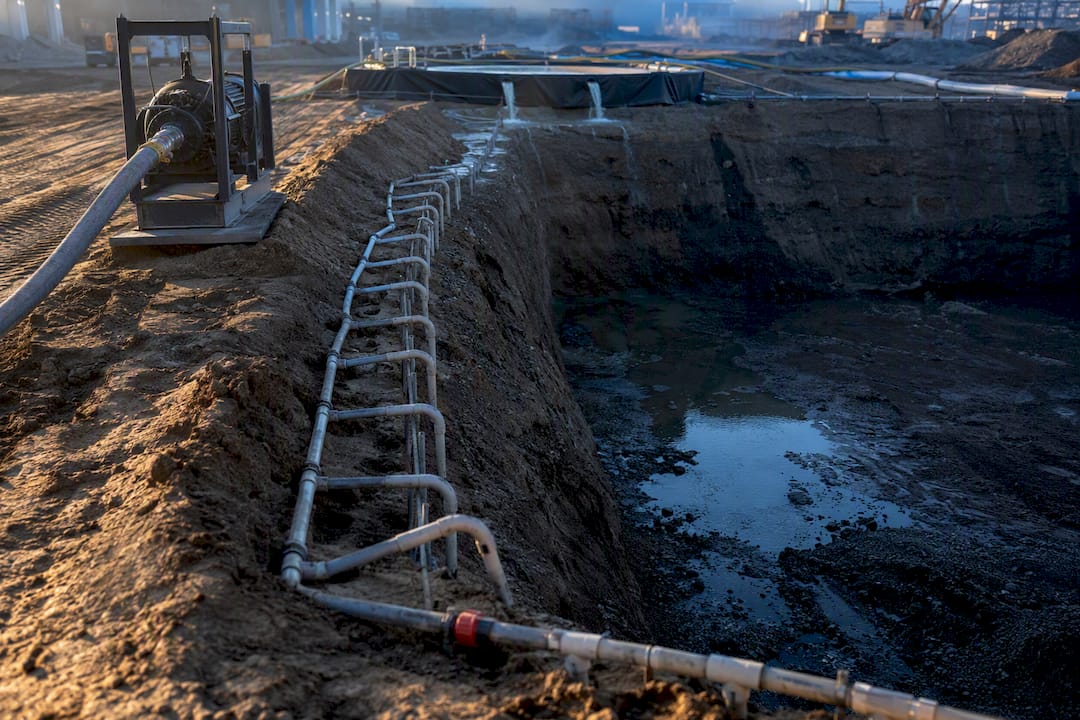
Use a pumping system (dewatering), a cutoff wall (exclusion), or both together, chosen by soil permeability, water table depth, and excavation depth. Get a geotechnical engineer involved before you finalize a schedule, since they set the drawdown target, well spacing, and monitoring plan. Line up your discharge permit early too, because permitting delays stall more dewatering jobs than equipment failures do.
TL;DR:
- Proper design requires geotechnical data to select the appropriate groundwater control method based on soil permeability and excavation depth.
- Monitoring instrumentation must be installed before dewatering begins to track water levels, discharge quality, and pump performance, ensuring compliance and early failure detection.
- Discharge permits in the US often require sediment, pH, and other water quality treatments, with discharge pathways needing early planning and authorization to avoid delays.
- Mismatched system design and soil heterogeneity are common causes of failure, emphasizing the importance of site-specific testing and correct sequencing of investigation and method choice.
- Site safety must be maintained through daily inspections, proper shoring, hazardous materials handling, and electrical protections, especially when working with contaminated groundwater or confined spaces.
Table of Contents
- Groundwater Control Excavation Methods: What Actually Works
- How Do You Design a Groundwater Control System?
- What Monitoring Do You Need During Dewatering?
- Where Does Dewatering Water Actually Go?
- Recognizing Failure Modes Before They Become Emergencies
- Health and Safety Rules Contractors Can’t Skip
- Assessing and Reducing Environmental Impact
- What Does Groundwater Control Cost on a Project?
- What Real Projects Reveal About Method Selection
- Keeping a Dewatering System Running Without Surprises
- Why Method Selection Beats Equipment Brand Every Time
- How Cornelius Wrecking Supports Excavation and Dewatering Projects
- Sources
- FAQ
Groundwater Control Excavation Methods: What Actually Works
Every groundwater control excavation strategy falls into one of two families: pumping the water out (dewatering) or keeping it out (exclusion). Most contractors default to pumping because it’s cheaper to mobilize, but the right call depends entirely on what’s under your feet and how deep you’re going. Here’s how the common methods stack up.
- Sump pumping: The simplest option. Water collects in a pit at the excavation’s low point and gets pumped out as it arrives. It works well in coarse, granular soils with modest inflow, but it struggles in fine sands and silts, where it drags soil particles along with the water and can undermine the excavation floor.
- Wellpoints: A line of small-diameter wells connected to a header pipe and a vacuum pump, effective to roughly 15 to 20 feet of drawdown per stage. For deeper cuts, crews stage wellpoints in lifts, dropping a new row as the excavation deepens.
- Deep wells: Drilled wells with submersible pumps set below the excavation base. These handle high-flow aquifers and depths where wellpoints run out of suction capacity, and they’re the standard choice for large infrastructure cuts.
- Eductors and ejectors: Jet-pump systems that can pull water from low-permeability or fine-grained soils where a vacuum wellpoint system loses efficiency. Slower yield, but they work where wellpoints don’t.
- Cutoff walls, grouting, and ground freezing: These are exclusion methods. Instead of removing water, they block it. Sheet pile walls, slurry cutoff trenches, jet grouting, and freezing all reduce inflow rather than manage it after the fact.
Combining methods is common practice, not a compromise.
How Do You Design a Groundwater Control System?
Design starts with data, not a pump catalog. You need borings, permeability testing (typically slug tests or pumping tests), water table elevation, and an understanding of recharge sources like nearby rivers, canals, or leaking utilities. This becomes your conceptual hydrogeologic model, and it drives every decision that follows.
Permeability and required drawdown together point you toward a method. Recent engineering reviews synthesizing decades of project records have expanded the practical range for vacuum deep wells and single-stage wellpoint systems, so don’t assume older rules of thumb still hold. High-permeability gravels and coarse sand generally favor deep wells or sumps. Silty sands sit in wellpoint or eductor territory. Clays and low-permeability silts often call for exclusion instead of pumping, since abstraction rates are too low to justify the equipment.
Sizing follows a similar logic:
- Estimate the abstraction rate using simplified radial flow equations (Dupuit or Thiem methods work for straightforward, roughly homogeneous aquifers).
- Move to numerical groundwater modeling when the site has layered soils, nearby surface water, or overlapping wells that complicate the flow pattern.
- Size pumps with a safety margin above the calculated peak flow, not the average.
- Set wellpoint spacing based on soil permeability and drawdown radius, typically tighter in finer soils.
- Build in redundancy: a second pump or generator on standby, because a single pump failure on a critical excavation can flood a footing overnight.
Pro Tip: Set your action limits for settlement monitoring before pumping starts, not after you notice cracking. An action limit tied to a specific millimeter threshold gives your crew a clear, pre-agreed trigger to slow or stop pumping instead of a judgment call made under pressure.
Phase your installation where possible. Installing wells in stages lets you calibrate drawdown against actual field performance instead of betting the whole system on a paper calculation.
What Monitoring Do You Need During Dewatering?
Instrumentation goes in before you start pumping, not after. You need observation wells or piezometers both inside the excavation and around its perimeter, settlement monuments on nearby structures, and turbidity or discharge meters if you’re monitoring water quality for permit compliance.
- Install piezometers early enough to capture baseline groundwater levels before any drawdown begins.
- Log pump run-time continuously, and read water levels daily during active dewatering, tapering to weekly once conditions stabilize.
- Sample turbidity and pH at whatever frequency your discharge permit specifies. Missing a sampling window is a common compliance violation.
- Follow ASTM D5092 for monitoring well construction, and present drawdown and discharge data as hydrographs so trends are visible at a glance rather than buried in a spreadsheet.
- Add telemetry on critical pumps so a failure at 2 a.m. triggers an alert instead of a flooded excavation by sunrise.
Keep dated records of every reading. A tool like Ditch can simplify jobsite photo logs and daily documentation, which matters more than most PMs expect when a permit inspector or an adjacent property owner asks for proof of what happened on a given date. Set escalation triggers ahead of time: a specific drawdown rate, settlement reading, or turbidity spike that automatically calls the engineer, not just the site super.
Where Does Dewatering Water Actually Go?
Discharge planning is not an afterthought. In the United States, discharging dewatering effluent commonly requires NPDES coverage under a construction general permit, or separate authorization from the local sewer utility if you’re routing to sanitary sewer instead of surface water.
- Check both state NPDES delegation and local sewer-authority rules before you assume a discharge path is open.
- Treatment needs to depend on soil fines and water chemistry: clarifiers and sand separators handle sediment, coagulation or flocculation knocks down suspended fines, and pH correction addresses acidic or alkaline groundwater.
- Storm drain discharge usually requires permit coverage and sediment control; sanitary sewer discharge requires utility sign-off, often with volume and quality limits; recycling water on-site or trucking it offsite sidesteps both but adds cost.
Documented sampling and discharge logs aren’t paperwork for its own sake. They’re what closes out your permit file and protects you if a downstream complaint or inspection happens six months after the project wraps.
Recognizing Failure Modes Before They Become Emergencies
Most dewatering failures trace back to one root cause: the system didn’t match the soil. Mismatched design between measured permeability and installed method is one of the most frequent causes of dewatering trouble on record, often compounded by soil heterogeneity that wasn’t fully captured in the original borings, according to geotechnical engineering literature.
- Fines pumping and sand migration: Cloudy discharge water or a settling excavation floor signals soil is moving with the water. Install filter packs or gravel envelopes around wells, and if it’s already happening, reduce drawdown rate and replace filters rather than just running the pumps harder.
- Heave and slope sloughing: Bulging at the excavation base or slumping side slopes calls for immediate shoring and a staged, slower drawdown rather than continued excavation.
- Adjacent settlement: Tie your action limits directly to survey benchmarks on nearby structures. If limits are approached, slow pumping and consider recharge wells to relieve the pressure differential.
- Boils and artesian breakthroughs: Treat any sudden upward water surge as a stop-work event. Stabilize the area and call the engineer immediately. Increasing sump pumping to fight a boil almost always makes it worse.
Health and Safety Rules Contractors Can’t Skip
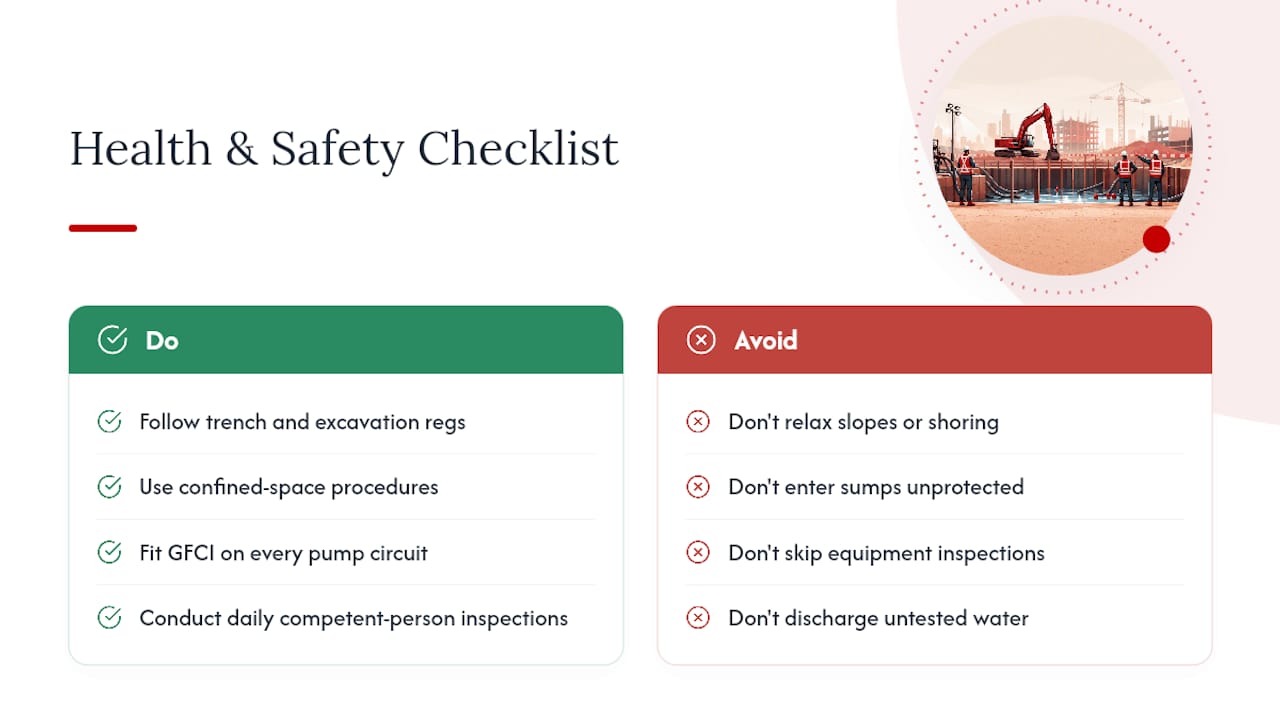
Groundwater control excavation carries the same trench and excavation hazards OSHA regulates on any dig, layered with the added risk of standing water, submerged equipment, and slick, unstable soil. Confined space protocols apply when crews enter sumps or below-grade pump vaults, and electrical safety around submersible pumps in wet conditions is non-negotiable. Ground fault protection on every pump circuit isn’t optional.
Excavation slopes and shoring requirements don’t relax just because a dewatering system is running. If anything, saturated soil near a partially dewatered cut is often less stable than dry soil, so daily competent-person inspections matter more, not less, once pumps are active.
On sites with contamination history, groundwater control interacts directly with hazardous materials handling. Pumped water from a former industrial site or demolition project can carry contamination that changes both your discharge permit requirements and your personal protective equipment standards. This is where OSHA certification and asbestos abatement credentials intersect with dewatering planning: a crew qualified to handle hazardous materials on a demolition site is also the crew equipped to recognize when dewatering discharge needs additional testing before it goes anywhere. Lockout/tagout procedures on pump systems, daily equipment inspections, and clear emergency shutdown protocols round out a baseline safety program that any groundwater control plan should include from day one.
Assessing and Reducing Environmental Impact
Lowering a water table doesn’t stay contained to your excavation footprint. Drawdown radiates outward, and depending on local aquifer connectivity, it can affect wells, wetlands, or surface water features well beyond the project boundary. USGS groundwater science explains how abstraction interacts with recharge, and that relationship is exactly what an environmental impact assessment for a dewatering project needs to model before pumping starts, not after neighbors complain about a dry well.
Mitigation starts with limiting drawdown to what’s actually needed. Overdesigning a system “for safety margin” can pull more water than necessary and widen the radius of influence. Recharge wells or infiltration basins can return treated water to the aquifer downgradient of the excavation, offsetting some of that impact.
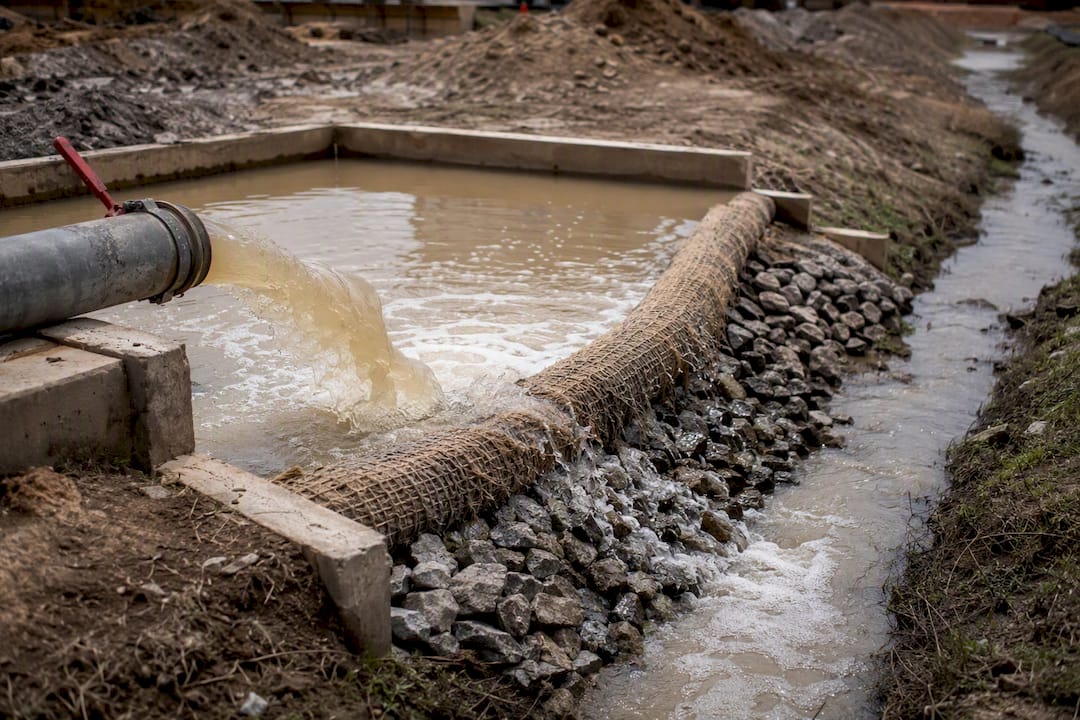
Discharge water quality is itself an environmental concern separate from where the water physically goes. Untreated sediment or altered pH released into a stream or storm system affects aquatic life, which is exactly why regulators increasingly treat discharge quality, not just abstraction volume, as the determining factor in how a system gets approved. Erosion and sediment control at the discharge point, whether that’s a rip-rap pad, a settling basin, or a filter sock, is a small line item that prevents a much larger compliance problem.
What Does Groundwater Control Cost on a Project?
Cost breaks down into four buckets: investigation, equipment and installation, operation, and discharge or treatment compliance. Skimping on the first bucket almost always inflates the other three.
Geotechnical investigation, including borings and permeability testing, is the smallest line item but the one that determines whether your method choice is right the first time. A soil investigation report that clearly documents permeability and stratigraphy, similar in structure to example geotechnical deliverables used in the industry, gives your engineer what they need to size the system correctly instead of guessing.
Equipment costs scale with method complexity: sump pumps are the cheapest to mobilize, wellpoint systems cost more for the header pipe and vacuum unit, deep wells add drilling costs per well, and cutoff walls or grouting carry the highest upfront price but can lower long-term pumping and treatment costs on a multi-month job.
Operating costs accumulate through fuel or power for continuous pumping, monitoring labor, and periodic filter or screen replacement. Treatment and discharge compliance costs, permit fees, sampling, and any required treatment equipment rental, are often underestimated in early budgets and then show up as change orders. Building a contingency line specifically for permit delays and treatment upgrades protects the schedule as much as the budget.
What Real Projects Reveal About Method Selection
A deep foundation excavation in a high-permeability sand and gravel aquifer typically calls for deep wells, since sump pumps or wellpoints can’t keep pace with the flow volume once the excavation passes 15 to 20 feet. A shallow utility trench in tight clay, by contrast, might need almost no active pumping at all. Perched water and slow seepage are better handled with sump pits at low points than a full wellpoint array.
Sites near rivers or canals illustrate the recharge problem directly. When a nearby surface water body is hydraulically connected to the aquifer, pumping can pull river water toward the excavation continuously, meaning the system never really “dewaters” the ground so much as it manages a constant through-flow. That changes both pump sizing and the discharge conversation, since you may be moving significantly more water over the project life than a simple static water table calculation would suggest.
Contaminated sites add another layer. Demolition or industrial redevelopment projects where groundwater has been affected by past site use require dewatering plans that account for both hydraulic control and the handling of potentially contaminated water, which shifts discharge and treatment decisions substantially compared to a clean greenfield excavation.
Keeping a Dewatering System Running Without Surprises
Most operational problems during dewatering are preventable with routine attention, not emergency response. Pump wear, screen clogging, and generator fuel management are the three issues that cause the most unplanned downtime.
Screens and filter packs clog gradually as fine sediment accumulates, and a well that pumped clear water in week one can be pulling turbid, sediment-laden water by week six if nobody’s checking. Scheduled inspection and periodic redevelopment of wells, essentially flushing them to restore flow, catches this before it becomes a discharge permit violation.
Pump failure is the single event most likely to turn a controlled excavation into an emergency. A backup pump on standby, paired with telemetry that flags a drop in flow or a power interruption immediately, closes the gap between failure and response. Fuel and power reliability matter just as much: a generator that runs out of fuel overnight has the same effect as a pump that physically breaks.
Trend your hydrograph data weekly even when nothing looks wrong. A slow, steady rise in water levels despite constant pump operation often signals a clogging well or an undersized system long before it becomes visible at the excavation floor.
Why Method Selection Beats Equipment Brand Every Time
The biggest gap in how contractors approach groundwater control isn’t a lack of good pumps. It’s skipping the geotechnical step and picking a method based on what worked last time, on a different site, with different soil. Permeability testing feels like an avoidable expense on a tight bid, right up until a wellpoint system stalls out in silty sand that needed eductors instead.
The conventional advice tends to treat monitoring as a compliance checkbox rather than an operational tool. Piezometer readings and hydrographs aren’t just for the permit file. Trended correctly, they tell you a system is failing days before it becomes visible at the surface, and that lead time is what separates a minor pump adjustment from an emergency shore-up.
If there’s one thing worth prioritizing above equipment selection, it’s sequencing: geotech first, drawdown target second, method third. Contractors who reverse that order, choosing equipment before they understand the aquifer, end up retrofitting mid-project, which costs more in schedule than the investigation would have cost upfront.
— Zach
How Cornelius Wrecking Supports Excavation and Dewatering Projects
Our team runs its own crews and equipment fleet for excavation, site clearing, and demolition work, helping to avoid delays that can occur when relying on subcontractors. On sites with contamination history, this integrated approach can improve coordination of hazardous material handling and reduce scheduling and accountability gaps on complex industrial jobs.

A typical engagement starts with a site visit to assess soil conditions and existing structures, followed by direct coordination with your geotechnical engineer on drawdown targets and permit requirements. From there, our crews handle excavation, site clearing, and installation support, with monitoring and closeout reporting documented through the project’s finish. Whether you’re planning a foundation excavation, a utility trench, or a full site clearing package ahead of new construction, our excavating and demolition services cover the scope. Reach out through Cornelius Wrecking to schedule a site assessment and get a project quote.
Sources
- Chapter 8 Groundwater control | Geological Society
- USBR: Groundwater control chapter — Geology field manual
- EPA — NPDES (National Pollutant Discharge Elimination System)
- USGS: Aquifers and groundwater
FAQ
How Deep Do You Have to Dig Before You Hit Groundwater?
Groundwater depth varies enormously by location, from a few feet in coastal or wetland areas to much deeper in arid regions, and it’s not predictable without site-specific borings. A geotechnical investigation is the only reliable way to know the water table depth on a given site before you plan your excavation dewatering approach.
What Are the Four Types of Excavation?
Excavation is commonly categorized as topsoil, earth (rock and soil), rock, and muck (wet, unstable material) excavation, based on the material being removed. Groundwater control mainly affects earth and muck excavation, where standing or seeping water complicates both digging and slope stability.
What Are the Different Methods for Controlling Groundwater?
The main groundwater control methods split into pumping (sump pumping, wellpoints, deep wells, eductors) and exclusion (cutoff walls, grouting, ground freezing), with combinations of both common on complex sites. Method choice depends on soil permeability, required drawdown, and excavation depth.
What Are the Three Types of Dewatering?
Dewatering is generally grouped into predrainage (lowering the water table before excavation, using wells or wellpoints), open pumping or sump pumping (collecting water as it seeps into the excavation), and cutoff or exclusion methods (physically blocking water entry). Most real projects use a mix of these rather than relying on just one.
Does Cornelius Wrecking Handle Groundwater Control on Excavation Projects?
Cornelius Wrecking provides excavating contractor services and coordinates directly with geotechnical engineers on dewatering and site preparation for both residential and large industrial projects. Current service details and project scopes are listed on the Cornelius Wrecking services page.
Planning a demolition or excavating project?
Get a fast, no-obligation quote from Cornelius Wrecking.
Request a Quote