Contractors: Heavy Equipment for Demolition When Jobs Exceed 5 Stories
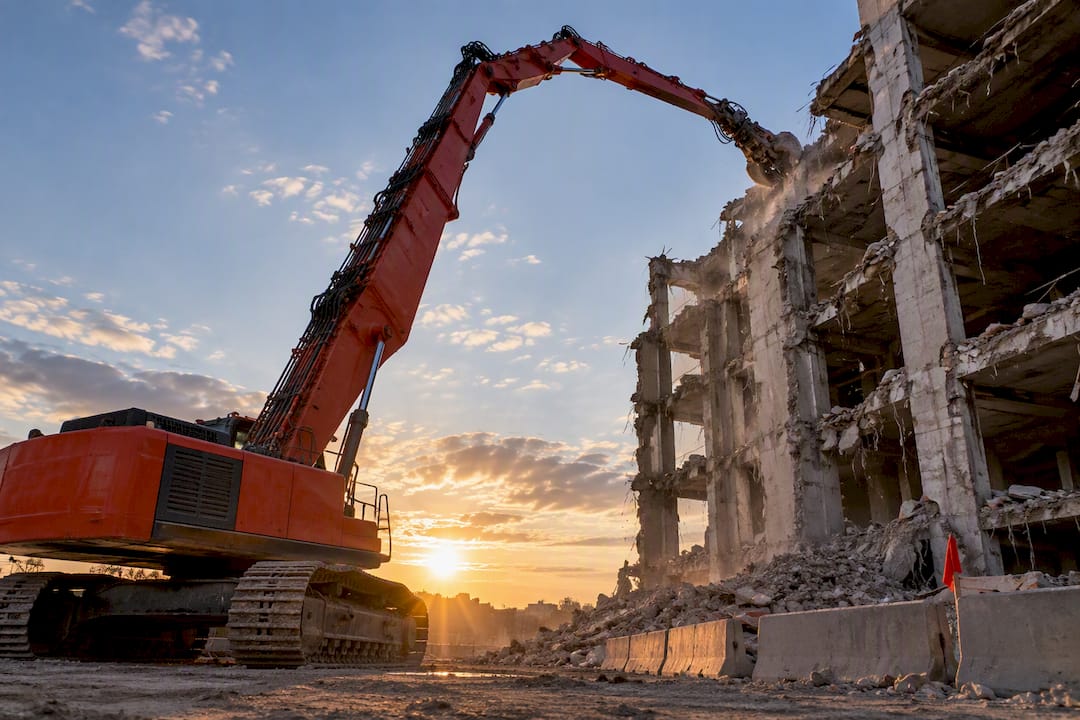
Most demolition jobs come down to a handful of machine classes: excavators, bulldozers, skid steers, material handlers, cranes, and haul trucks. Excavators do the heavy lifting on the majority of jobs. But the machine is only half the equation. Breakers, shears, pulverizers, and grapples turn a bare carrier into a demolition tool, and the right pairing depends on structure height, building material, site access, and the permits governing the job.
TL;DR:
- High-reach demolition machines are essential for structures taller than five or six stories, requiring larger ground space and longer mobilization time.
- Selecting the correct attachment, like breakers or shears, depends on the material and must match the carrier’s weight limit to avoid damage.
- Certified operator training, especially for attachments over 10,000 pounds, is critical to ensure safety and compliance during demolition.
- The project scale and site access influence whether contractors use a single excavator or a fleet of specialized equipment, impacting efficiency and cost.
- Contractors with OSHA and asbestos certifications can better manage hazardous materials and streamline project sequencing, reducing delays.
Table of Contents
- Types of Heavy Equipment for Demolition Projects
- Attachments and End-of-Arm Tools: Matching the Tool to the Material
- High-Reach Machines for Multi-Story Demolition
- How to Choose the Right Demolition Equipment for Your Project
- How a Certified Contractor Builds a Demolition Fleet
- Operator Training and Certification for Demolition Equipment
- What Contractors Get Wrong About Equipment Selection
- Get an Equipment Consultation From a Certified Demolition Contractor
- Sources
- FAQ
Types of Heavy Equipment for Demolition Projects
Excavators carry the workload on most demolition sites, and for good reason. A standard excavator in the 20 to 30 ton range handles residential teardowns and small commercial strip-outs without much fuss. Once you’re into multi-story commercial or industrial work, you’re generally looking at 40 ton class carriers or larger, often paired with a straight boom or ultra-high-reach front to keep the operator at a safe distance from falling material.
Cat’s demolition lineup, including the 340 UHD and 352 UHD, illustrates how manufacturers now build excavators specifically for this work rather than adapting standard machines. These carriers come with reinforced undercarriages, upgraded operator cabs rated for falling-object protection, and boom configurations that accept quick-change attachments.
Beyond the excavator, several other machine classes fill specific roles:
- Bulldozers strip sites, push accumulated debris into piles, and grade the pad once structures are down. They’re less precise than an excavator but move volume faster on open ground.
- Skid steers and compact track loaders earn their keep in tight urban lots, interior demolition, and any job where a full-size excavator simply won’t fit through a gate or doorway. Quick-attach plates let a single carrier swap between a bucket, grapple, and hammer in minutes.
- Material handlers sort and load debris streams, often running orange-peel grapples or clamshell buckets to separate concrete, metal, and wood on the fly.
- Cranes and wrecking balls see limited modern use. They still show up on select industrial jobs or unusual structural configurations, but tighter urban regulations and better hydraulic tools have pushed most contractors toward excavator-mounted methods.
- Articulated dump trucks and roll-off trucks move debris off site, and their capacity often dictates how fast a crew can clear a footprint between demolition passes.
The mix you assemble depends heavily on scale. A residential teardown might run a single 25 ton excavator with a breaker and a couple of dump trucks. A power plant decommissioning or refinery job typically stacks high-reach excavators, material handlers, cranes for structural steel, and a rotating fleet of haul trucks working in shifts. Matching the fleet to the job, rather than defaulting to whatever’s parked in the yard, is what separates efficient mobilization from a site full of idle iron.
Attachments and End-of-Arm Tools: Matching the Tool to the Material
The carrier gets you on site; the attachment does the actual demolition, and picking the wrong one wastes hours and wears out equipment faster than it should.
- Hydraulic breakers fracture concrete and masonry through repeated impact, and they remain the primary impact tool for foundations, slabs, and block walls.
- Demolition shears cut structural steel cleanly, which makes them the standard choice for industrial dismantling and steel-framed buildings where a breaker would just bounce off.
- Pulverizers and crushers clamp down and crush concrete while separating out rebar, a step that speeds up recycling and cuts hauling volume.
- Multi-processors and crusher buckets combine crushing and sorting in one attachment, useful when a site wants to process debris for reuse rather than trucking it away.
- Drum cutters and diamond wire tools handle precision cuts on reinforced concrete where vibration needs to stay low, often near occupied structures or utilities.
Attachment weight has to match the carrier. Genesis Demolition Recycler models span roughly 28,000 pounds for the GDR 150 up to about 100,000 pounds for the GDR 400, and mounting a heavy attachment on an undersized excavator strains the hydraulics and the boom alike.
Pro Tip: Dust suppression isn’t optional gear. Impact tools generate silica dust fast, and water-spray attachments or misting systems paired with a breaker keep exposure within safe limits on concrete-heavy jobs.
High-Reach Machines for Multi-Story Demolition
Standard excavator booms run out of reach somewhere around five or six stories. Past that point, contractors move to high-reach or long-front machines built specifically for tall structures.
The SENNEBOGEN 870 E extends to roughly 33 to 36 meters, while Volvo’s EC400FHR offers factory high-reach configurations up to about 118 feet with an operating weight near 105,380 pounds. These aren’t modified standard machines. They’re purpose-built platforms designed to carry a breaker or shear at height without tipping the balance of the carrier.
High-reach demolition works top-down, removing material floor by floor from the top of the structure downward, which keeps the building’s remaining mass stable and limits uncontrolled collapse. That method has a footprint cost, though. Planning has to account for:
- A larger ground-bearing footprint than a standard excavator, since the extended boom shifts the center of gravity outward.
- A geotechnical assessment of the pad the machine will sit on, particularly on sites with basements, utility vaults, or soft fill.
- Modular transport, since many high-reach fronts ship in sections and require on-site assembly before work starts.
Mobilization for a high-reach job often takes longer than the demolition itself. Budget for it accordingly.
How to Choose the Right Demolition Equipment for Your Project
Run through this before you finalize a bid:
- Assess the structure. Height, construction material, and structural condition determine whether you need a standard excavator, a high-reach unit, or a mix of both plus shears for steel components.
- Check site access. Narrow lots, overhead utilities, and adjacent occupied buildings often push contractors toward compact carriers or precision cutting tools instead of a full-size breaker.
- Define material recovery goals. If the client wants recycled aggregate, budget for a pulverizer or crusher bucket and the extra processing time that comes with it.
- Confirm permits and utility disconnects. Most jurisdictions require utility shutoffs verified before mechanical demolition begins, and OSHA’s demolition standards require a documented engineering survey before work starts.
- Set the mobilization window. High-reach and modular equipment need extra lead time for transport and assembly, so build that into the schedule up front.
A residential teardown might run one excavator and a breaker over two or three days. A commercial or industrial job with high-reach equipment, shears, and multiple haul trucks can stretch into weeks, with mobilization alone eating several days.
Pro Tip: Operators running attachments over roughly 10,000 pounds on excavators typically need manufacturer-specific training beyond a general equipment certification. Confirm your crew’s credentials match the attachment before it ships to site, not after.
How a Certified Contractor Builds a Demolition Fleet
Certifications shape fleet planning as much as machine size does. Some demolition contractors hold OSHA and asbestos abatement certifications, which changes how a project gets sequenced: hazardous material surveys and abatement happen before mechanical demolition starts, rather than as a separate contractor’s problem to coordinate around.
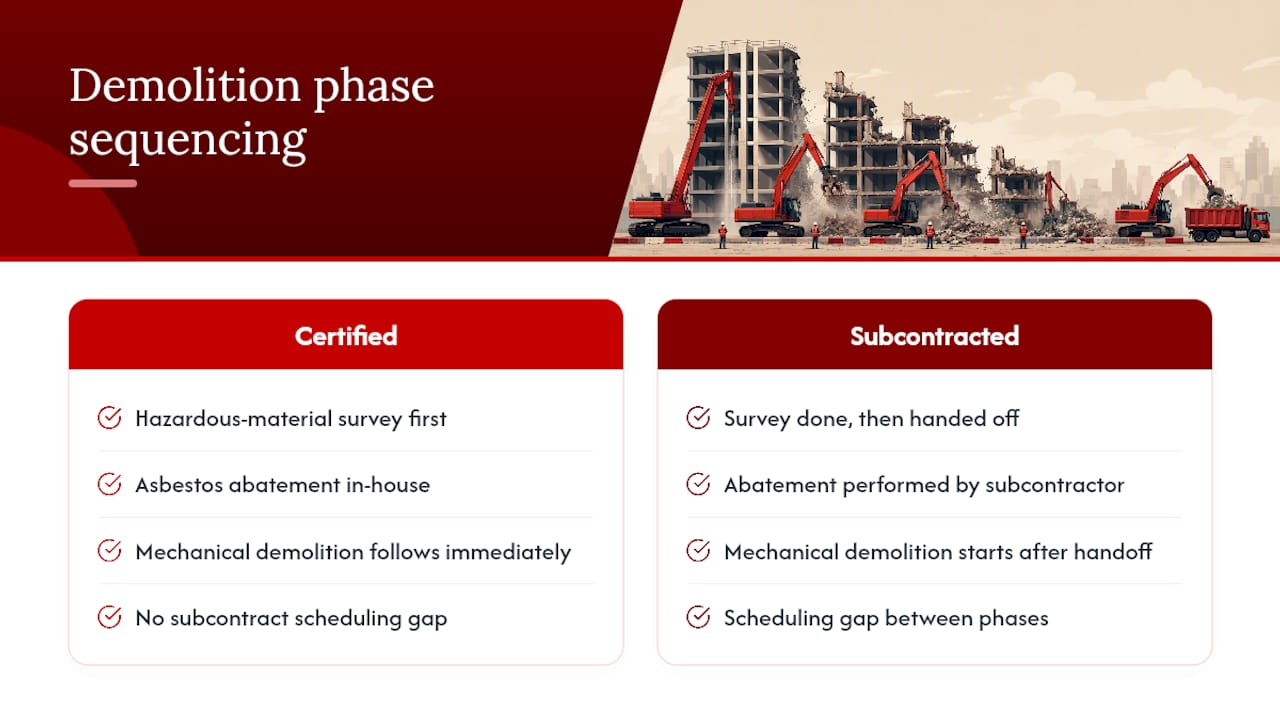
A typical residential fleet mix might pair one mid-size excavator with a breaker and a single dump truck. Commercial jobs often add a material handler for sorting and a second haul truck. Industrial and energy-sector decommissioning, the kind involving refineries or power plants, generally calls for high-reach excavators, shears for structural steel, and a rotating truck fleet to keep pace with debris volume. Handling both demolition and abatement in-house removes a scheduling gap that trips up projects relying on subcontracted crews for each phase.
Operator Training and Certification for Demolition Equipment
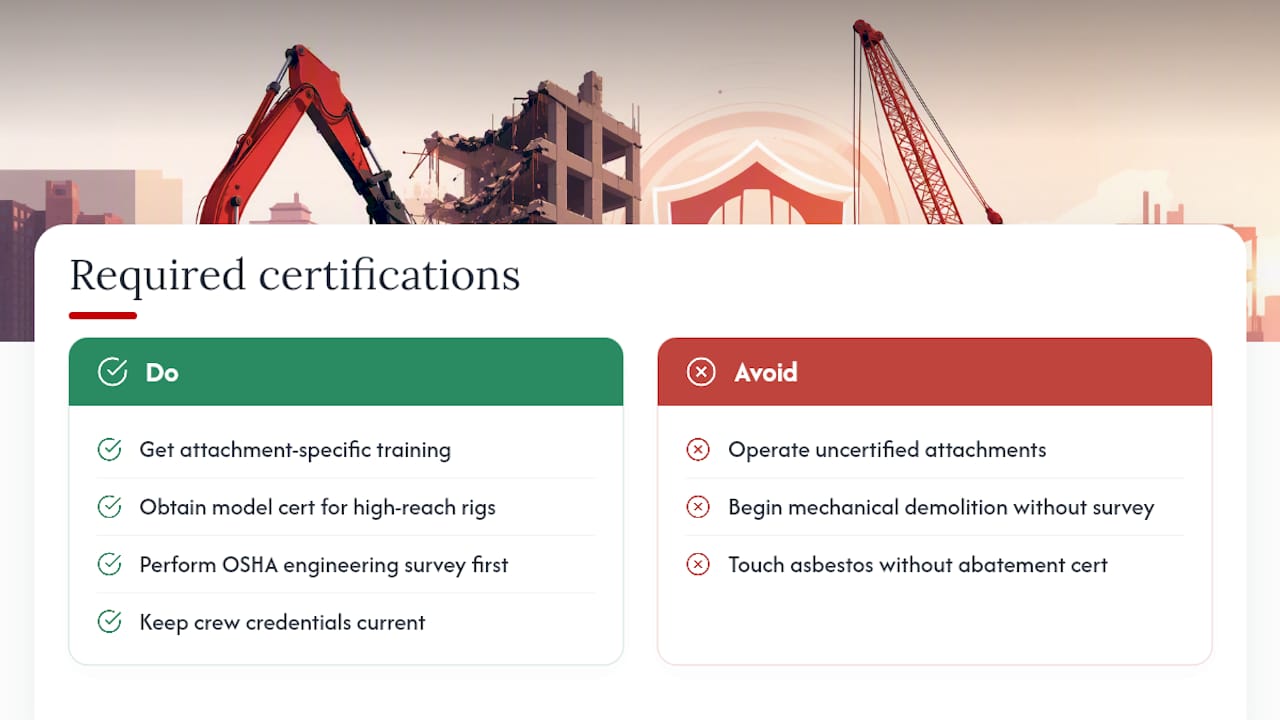
Running a breaker or shear safely takes more than a general heavy-equipment license. Most manufacturers require attachment-specific training before an operator works with tools rated above certain weight thresholds, since hydraulic flow rates and pressure settings vary between breakers, shears, and pulverizers.
OSHA’s demolition standards call for a qualified person to conduct an engineering survey of the structure before mechanical demolition starts, documenting condition and identifying hazards like unsupported walls or unstable floors. Operators working near that structure need to understand exclusion zones, which shift as the demolition sequence progresses. High-reach machine operators face an added layer: manufacturers like Volvo and SENNEBOGEN typically require model-specific certification given the stability calculations involved in extending a boom 100-plus feet while carrying an attachment.
Asbestos abatement work adds a separate certification track entirely, governed by state and federal rules around hazardous material handling. Crews working demolition sites with legacy building materials need that credential before touching anything, not after material turns up mid-job. Contractors who keep this training current across their crew avoid the scheduling delays that come from pulling in outside certified operators mid-project. It also cuts down on the liability exposure that shows up when an uncertified operator runs an attachment outside its rated parameters.
What Contractors Get Wrong About Equipment Selection
The instinct to buy multi-purpose attachments makes sense on paper. One carrier, several jobs, less capital tied up in idle iron. But a dedicated shear will outcut a multi-processor on structural steel every time, and dedicated tools tend to hold their edge longer under heavy use. The real trade-off is mobilization cost against maintenance cost. Emission standards and operator-protection requirements keep tightening, and ultra-high-reach adoption keeps climbing as urban demolition pushes higher.
— Zach
Get an Equipment Consultation From a Certified Demolition Contractor
Picking the right excavator, breaker, or high-reach rig is only useful if the crew running it has the certifications to back the plan up. A certified demolition contractor with OSHA and asbestos abatement certifications and an in-house fleet and crew can ensure hazardous material removal, demolition, and site clearing happen under one accountable team rather than being split across subcontractors.
Corneliuswrecking handles commercial demolition, industrial demolition, residential demolition, site clearing, land clearing, excavating, concrete and asphalt tear out, asbestos abatement, crane services, dump trucking, and inground pool excavation, backed by crews certified to work around hazardous materials that stall out projects run by less credentialed contractors. If you’re mobilizing a project that needs a fleet matched to structure height, material type, and site access, request an equipment consultation and get a scope built around what your job actually requires.
Sources
For deeper technical detail beyond this guide, OSHA’s demolition regulations cover engineering survey requirements and exclusion zones. Cat’s demolition equipment page details purpose-built excavator specs, and Epiroc’s attachment catalog breaks down breaker and cutter compatibility by carrier tonnage.
- Long-front SENNEBOGEN 870 Demolition machine
- Hydraulic breaker explained: core concepts and operational principles
- Genesis Demolition Recyclers product data
- OSHA demolition regulations (Subpart T references)
FAQ
What Equipment Is Needed for Demolition?
Most demolition jobs need at minimum an excavator with a breaker or shear attachment, plus a hauling vehicle to remove debris. Larger commercial or industrial jobs add material handlers for sorting, high-reach excavators for tall structures, and multiple trucks to keep pace with debris volume.
How Much Does It Cost to Demolish a 2,000 Square Foot House?
Residential demolition costs vary widely based on location, structural material, and whether hazardous materials like asbestos require abatement first. Corneliuswrecking provides project-specific quotes through its services page rather than a flat rate, since site access and material type change the scope significantly.
What Are the Three Types of Demolition?
The three broad categories are manual demolition (hand tools for small-scale or selective work), mechanical demolition (excavators and attachments handling the bulk of commercial and residential jobs), and implosion (controlled explosives used mainly for tall structures in open areas). Mechanical demolition covers the vast majority of contractor work.
What Is the Best Size Excavator for Residential Demolition?
Most residential teardowns run efficiently with an excavator in the 20 to 30 ton range paired with a hydraulic breaker or pulverizer. Anything smaller struggles with load-bearing walls and foundations; anything larger often can’t maneuver on a tight residential lot.
When Do Projects Need a High-Reach Excavator Instead of a Standard One?
Structures taller than roughly five or six stories typically exceed a standard excavator’s boom reach, which is when contractors move to high-reach machines like the SENNEBOGEN 870 E or Volvo EC400FHR. These machines work top-down and require extra ground-bearing footprint and mobilization time compared to standard equipment.
Planning a demolition or excavating project?
Get a fast, no-obligation quote from Cornelius Wrecking.
Request a Quote