Make Your Engineering Survey Inspection Ready for OSHA Demolition
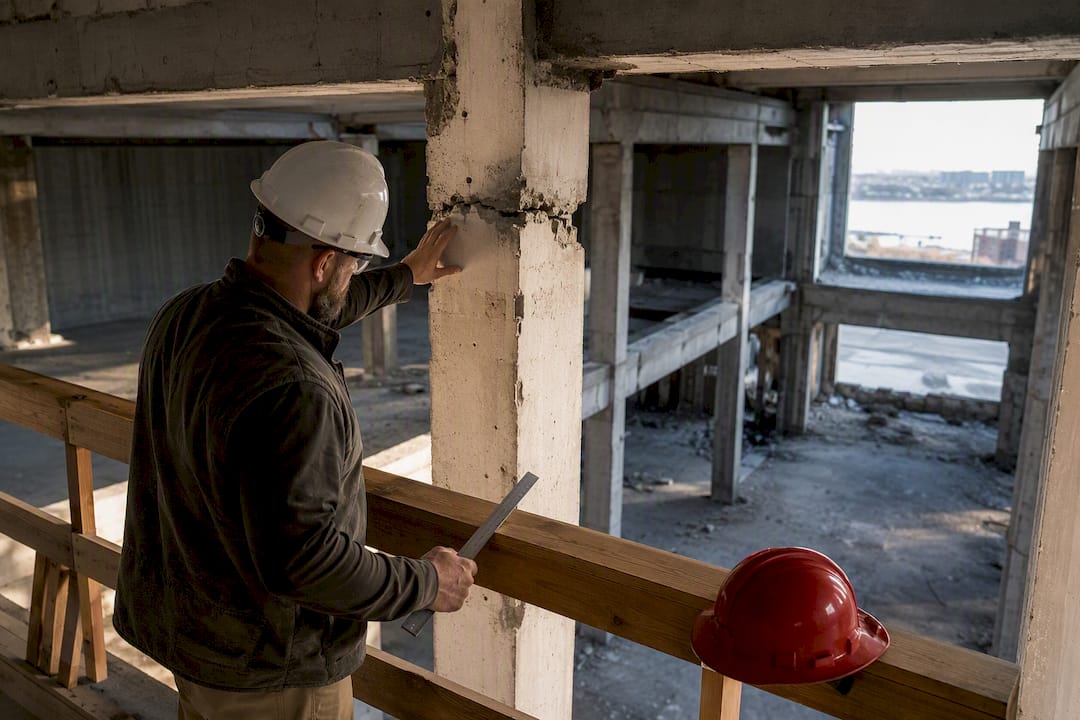
Under 29 CFR 1926 Subpart T, no demolition work can begin until a competent person completes a written engineering survey of the structure. Before demolition tools touch anything, contractors also need utilities disconnected and confirmed, hazardous materials and asbestos checked, and fall protection in place, with every step documented. With serious violations now capped at $16,550 and willful or repeated violations reaching $165,514 per instance in 2026, skipping the paperwork is an expensive mistake.
TL;DR:
- Contractors must complete a written engineering survey and document utility disconnections, hazardous material testing, and fall protection before starting demolition work.
- Proper documentation, including inspection records, training certificates, and hazard assessments, is essential to pass inspections and avoid penalties.
- Demolition work must follow specific methods and safety zones depending on whether it involves mechanical removal, hand work, or explosive collapse.
Table of Contents
- Which OSHA Standards Actually Govern Demolition Work?
- What Preparatory Steps Does OSHA Require Before Demolition?
- How Do Subpart T’s Operational Rules Apply On Site?
- What Are OSHA’s Most-Cited Violations On Demolition Sites?
- What Belongs In an Inspection-Ready Compliance File?
- Who Qualifies As a Competent Person, and What Records Prove It?
- Where to Find the Primary Regulations and Guidance
- How Compliance Actually Works On a Live Demolition Site
- Sources
- FAQ
Which OSHA Standards Actually Govern Demolition Work?
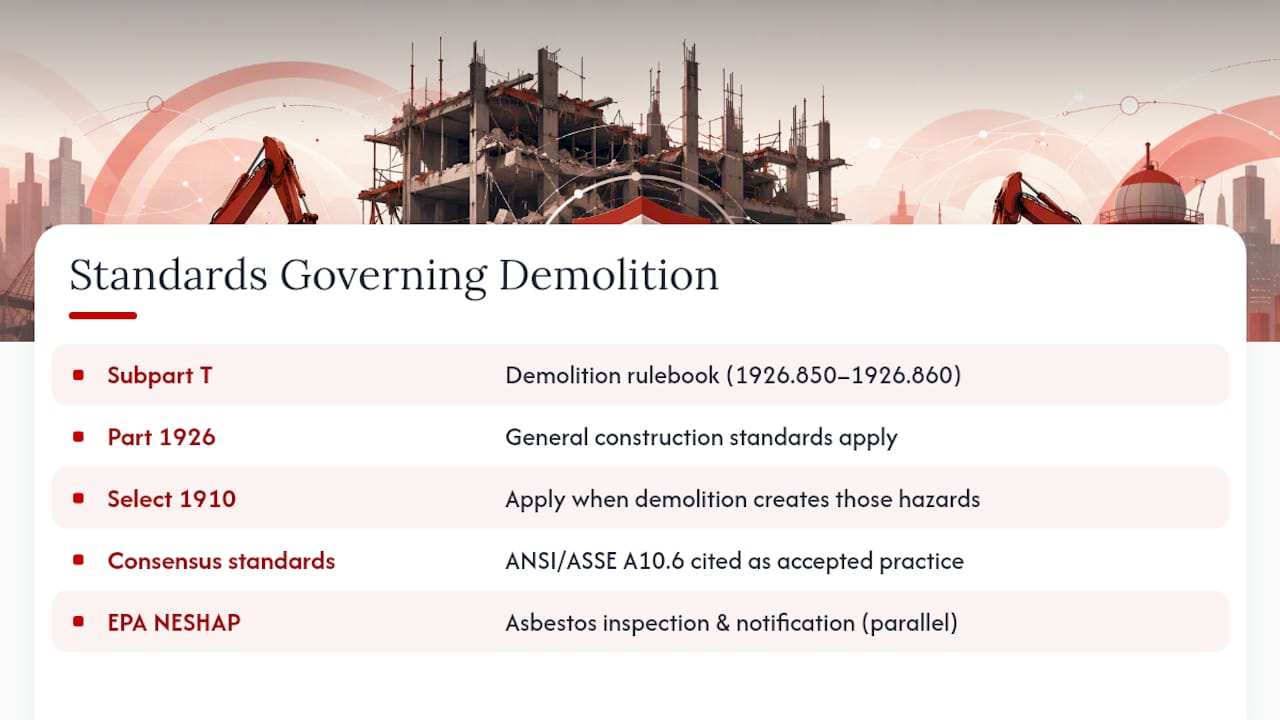
29 CFR 1926 Subpart T is the demolition-specific rulebook, spanning 1926.850 through 1926.860. It covers preparatory operations, stairways and passageways, chutes, floor-opening removal, mechanical demolition, and explosives. But Subpart T doesn’t operate alone.
General construction standards in Part 1926, plus select 1910 standards like Hazard Communication, apply anywhere a demolition site creates the hazards those rules address, from fall exposure to chemical labeling. When a specific standard doesn’t cover a unique hazard, OSHA inspectors often point to consensus standards like ANSI/ASSE A10.6 as evidence of accepted practice under the General Duty Clause. Asbestos work adds another layer entirely: EPA’s NESHAP rule governs inspection and notification requirements that run parallel to, not instead of, OSHA’s demolition standards.
What Preparatory Steps Does OSHA Require Before Demolition?
The engineering survey is the anchor requirement. 1926.850 requires written evidence that a competent person surveyed the structure before any employee starts demolition operations, assessing framing condition, floor and wall integrity, and the risk of unplanned collapse in adjacent structures.
Utilities come next. Every electric, gas, water, steam, and sewer line has to be shut off or capped outside the building line, with written confirmation from the utility company on file, not just a verbal assurance from a crew lead. Any excavation work tied to the demolition triggers an 811 call first.
Hazardous-material testing rounds out the pre-job phase:
- Test and purge lines or containers that may hold flammable, corrosive, or toxic substances before cutting or breaching them.
- Conduct an asbestos inspection on any structure scheduled for demolition, regardless of age assumptions.
- File the required 10-working-day NESHAP notification once regulated asbestos-containing material meets the EPA’s threshold.
- Document purging and testing results alongside the engineering survey, not as a separate, easily lost record.
How Do Subpart T’s Operational Rules Apply On Site?
Subpart T’s requirements get specific once demolition actually starts. A few govern nearly every job:
- Protect floor and wall openings. Any opening created during demolition needs barricades, and material dropped through floor openings requires enclosed chutes when the drop exceeds the height Subpart T specifies.
- Work top-down unless engineering justifies otherwise. Standard sequence removes materials floor by floor, from the top down; exceptions require the competent person to document why an alternate method is structurally sound.
- Keep stairways, passageways, and ladders clear and stable throughout the job, since they double as emergency egress routes.
- Match removal method to material. Mechanical demolition, hand removal, and selective use of explosives each carry distinct clearance, signaling, and safety-zone rules under Subpart T and the OSHA Technical Manual.
- Shore or brace damaged structures before entry. Fire or flood damage means physical shoring goes up first; the employer has to prove structural stability at the end of every shift, not assume it.
For deliberate collapse work like chimneys or stacks, the Technical Manual recommends a clear fall area of at least 45 degrees on each side and 1.5 times the structure’s height, plus vibration monitoring where underground utilities run through the fall path.
What Are OSHA’s Most-Cited Violations On Demolition Sites?
Fall protection isn’t just a demolition issue. It’s OSHA’s single most cited standard across all of construction, and demolition sites generate exactly the elevated openings, unguarded edges, and unstable footing that make 1926.501 violations so common.
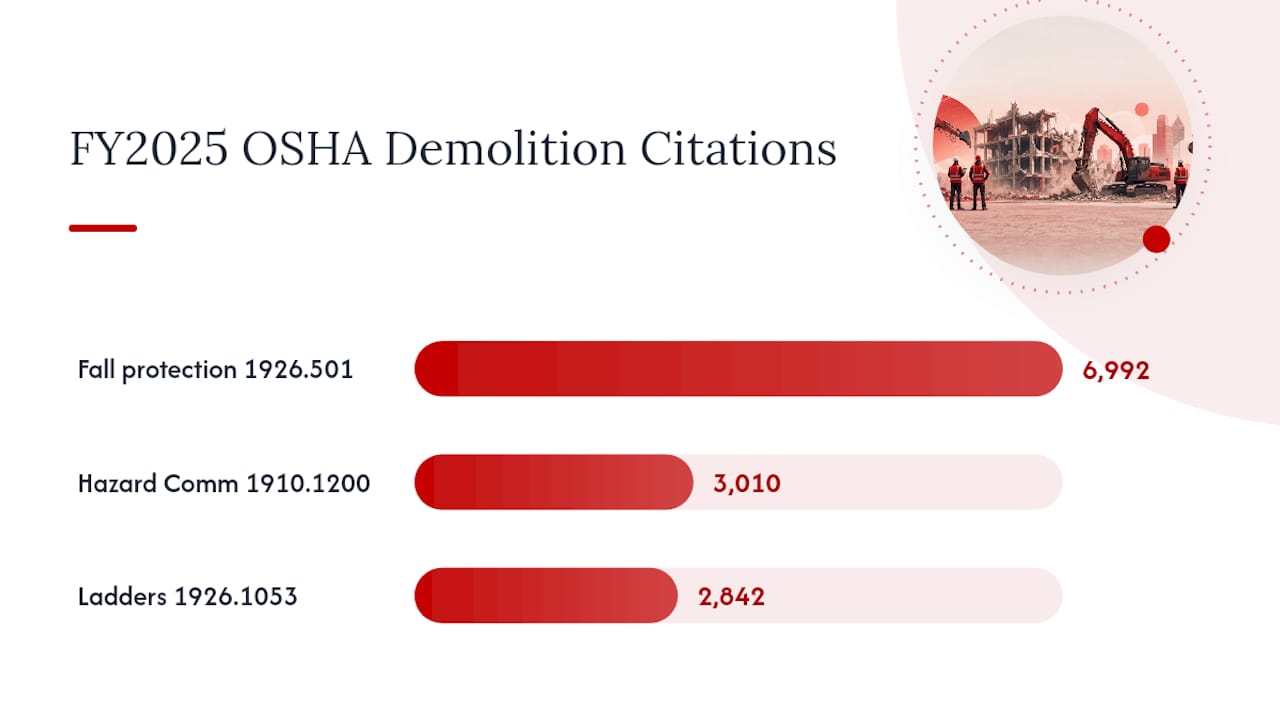
By the numbers: Fall protection (1926.501) drew 6,992 citations in FY2025, more than double the next entries, Hazard Communication (1910.1200) at 3,010 and Ladders (1926.1053) at 2,842.
Those three standards keep appearing on demolition sites for the same reason: temporary conditions get treated as permanent risk acceptance. A ladder borrowed for one task stays in place unsecured for a week. A chemical container loses its label during transport. Guardrails come down for “just this floor” and never go back up.
The documentation failures that turn these hazards into citations are predictable:
- No written fall protection plan specific to the demolition sequence.
- Missing or expired ladder inspection logs.
- Safety Data Sheets that don’t match what’s actually stored on site.
- No record tying a specific worker to specific hazard training.
What Belongs In an Inspection-Ready Compliance File?
An inspector doesn’t just want to see safe conditions. They want proof the safety program was planned, not improvised. Build the file before the first excavator shows up.
- Engineering survey package: the signed written report, the competent person’s name and qualifications, and dated photographs of the conditions assessed.
- Utility disconnection proof: written confirmations from each utility provider plus the 811 ticket number for any related excavation.
- Asbestos documentation: inspection results, the NESHAP notification filing when thresholds are met, and the licensed transporter and disposal facility information.
- PPE and systems logs: fall-protection system inspections, scaffold and ladder logs, and respirator fit-test records where asbestos or dust exposure requires them.
- Corrective-action trail: every identified hazard assigned an owner, a deadline, and photographic proof of correction.
Pro Tip: Timestamp every photo and store records centrally instead of in individual supervisors’ phones. When an inspector asks for the engineering survey on day one of a citation review, “I’ll have to find it” is the answer that turns a passable site into a penalty.
Who Qualifies As a Competent Person, and What Records Prove It?
A competent person needs the training and authority to identify existing and predictable hazards, and the ability to stop work to correct them. Simply assigning the title on a job site sign-in sheet doesn’t satisfy OSHA. The engineering survey itself often becomes the deciding document in an inspection, and it needs the competent person’s identity and qualifications attached directly to it.
Training records should cover fall protection, hazard communication, and asbestos awareness where relevant, tied to the specific hazards the survey flagged, not generic annual refreshers. For each employee, keep:
- Date and content of every training session attended.
- Certification or qualification documents for specialized roles like riggers or explosives handlers.
- Fit-test records for respiratory protection.
- Signed acknowledgment of site-specific hazards identified in the survey.
Centralized, digital recordkeeping with expiration alerts beats a filing cabinet every time a certification lapses without anyone noticing.
Where to Find the Primary Regulations and Guidance
Three source types matter for demolition compliance, and knowing which to pull up depends on the question you’re answering.
- For the regulatory text itself, go to 1926 Subpart T on eCFR.
- For practical planning interpretation, including survey content and safety-zone distances, use the OSHA Technical Manual.
- For enforcement priorities and where inspectors focus, check the OSHA top 10 cited standards page.
- For asbestos inspection and notification thresholds, refer to EPA’s NESHAP rule.
Regulatory text answers what’s required. Technical guidance answers how to meet it. Citation data answers where inspectors are actually looking.
How Compliance Actually Works On a Live Demolition Site
Regulations read cleanly on paper. Applying them on a partially collapsed industrial structure, with utilities still hot and asbestos results pending, is a different exercise entirely. Some demolition contractors carry OSHA and asbestos abatement certifications to ensure that engineering surveys and hazardous-material handling are properly managed on large-scale demolition and decommissioning projects. Documented competency and inspection-ready records don’t just satisfy an auditor. They prevent the stop-work orders that turn a scheduled project timeline into a missed deadline. For projects involving power plants, refineries, or marine vessels, disciplined documentation can be critical to maintaining project schedules.
— Zach
Sources
- OSHA top 10 cited standards (FY2025)
- OSHA 2026 annual adjustments to civil penalties
- 1926 Subpart T - Demolition (OSHA)
- OSHA Technical Manual (OTM) - Section V: Chapter 1
- EPA NESHAP — National Emission Standards for Hazardous Air Pollutants: Asbestos
FAQ
What Is OSHA’s Most-Cited Violation On Demolition Sites?
Fall protection under 1926.501 was OSHA’s top-cited standard in FY2025 with 6,992 citations across construction, with Hazard Communication and Ladders following close behind. Demolition sites are especially prone to fall violations because of constantly changing floor and edge conditions.
What OSHA Compliance Changes Take Effect in 2026?
OSHA’s 2026 civil penalty adjustment raised the maximum for a single serious violation to $16,550 and willful or repeated violations to $165,514 per instance, with failure-to-abate penalties accruing daily.
What Are the Three Types of Demolition?
Demolition methods generally fall into mechanical demolition (equipment-driven removal), hand removal (selective, floor-by-floor dismantling), and demolition by explosives (deliberate structural collapse), each governed by distinct provisions within Subpart T.
What Does OSHA Require Before a Building Can Be Demolished?
OSHA requires a written engineering survey by a competent person, confirmed utility disconnection, hazardous-material and asbestos testing, and documented fall protection measures before demolition work can begin under 1926.850.
Planning a demolition or excavating project?
Get a fast, no-obligation quote from Cornelius Wrecking.
Request a Quote