Power Plant Decommissioning: A Playbook for Owners
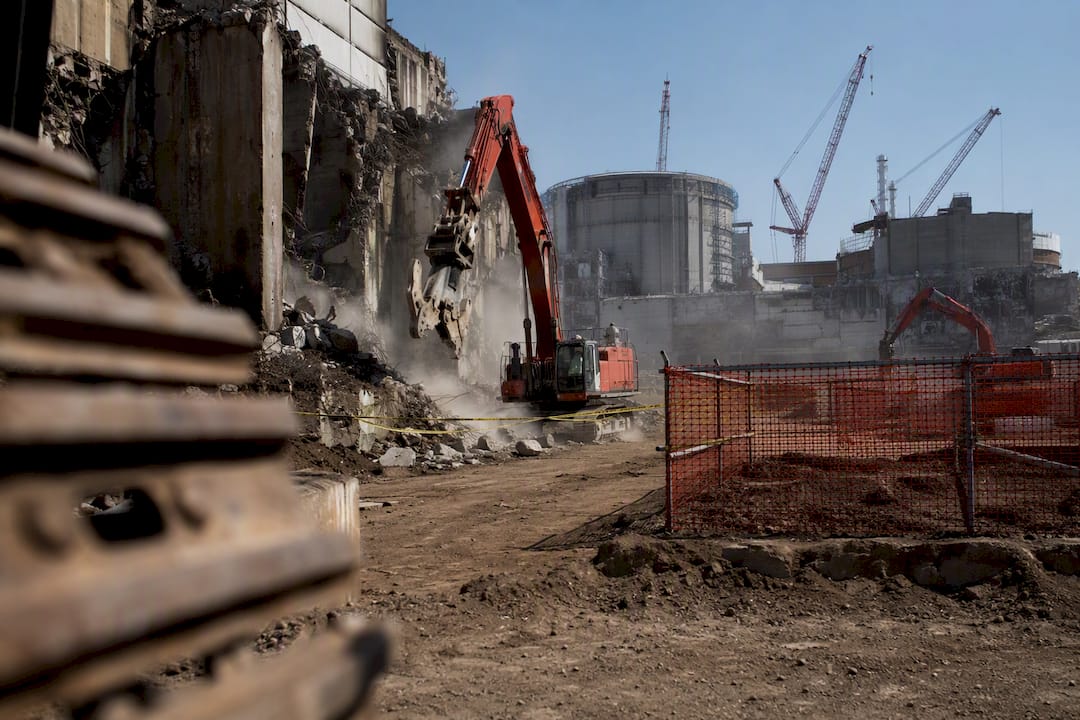
Power plant decommissioning is the phased, compliance-driven process of taking a facility from operation to full site release, covering everything from fuel handling and abatement to final demolition and regulatory closeout. For most owners, the lowest-risk path is a single-source, turnkey delivery model that combines abatement, demolition, remediation, and regulatory management under one accountable contractor rather than a patchwork of specialty vendors.
Three agencies set the rules you’ll work within: the NRC governs nuclear closures, EPA and state regulators oversee contamination and consent decrees at fossil sites, and OSHA sets the safety floor for every demolition phase regardless of fuel type.
Every project, nuclear or fossil, moves through three core phases:
- Transition and planning — characterization surveys, regulatory filings, and financial assurance confirmation
- Major dismantlement and remediation — abatement, demolition, and waste disposal
- License termination or site release — final surveys, closeout documentation, and redevelopment handoff
Pro Tip: Lock in your funding assurance mechanism before you file your first regulatory notice. Regulators and communities both read a fully funded trust as a sign the project will finish, not stall halfway through.
Key Takeaways
Turnkey, single-source contracting reduces the coordination and liability risk that drives cost overruns in power plant decommissioning.
| Point | Details |
|---|---|
| Definition and approach | Decommissioning moves through planning, dismantlement, and license termination, best managed through unified project delivery. |
| Regulatory milestones | Nuclear owners must file a PSDAR within two years of shutdown and complete work within 60 years under NRC rules. |
| Funding assurance | Trust funds, surety, and parent guarantees must match site-specific cost estimates and get reported biennially. |
| Cost drivers | Coal ash remediation and asbestos removal often exceed structural demolition as the largest budget line items. |
| Contractor choice | Cornelius Wrecking offers nationwide, OSHA and asbestos-certified turnkey demolition and decommissioning services. |
Table of Contents
- What Drives a Power Plant Closure, and Why It Changes Your Plan
- What Regulatory Milestones and Funding Rules Apply to Decommissioning?
- Breaking Down the Scope: What Actually Gets Done on Site
- How Much Does Power Plant Decommissioning Cost, and What Drives the Timeline?
- How Should You Choose a Decommissioning Contractor?
- What Happens to the Site After Decommissioning?
- Why a Single-Source Contractor Reduces Your Project Risk
- Sources
What Drives a Power Plant Closure, and Why It Changes Your Plan
Plants retire for one of three reasons, and each one reshapes your schedule differently. Economic unviability gives you the most runway to plan. A negotiated consent decree gives you almost none. Aging infrastructure sits somewhere in between, often forcing closure before a replacement asset is ready.
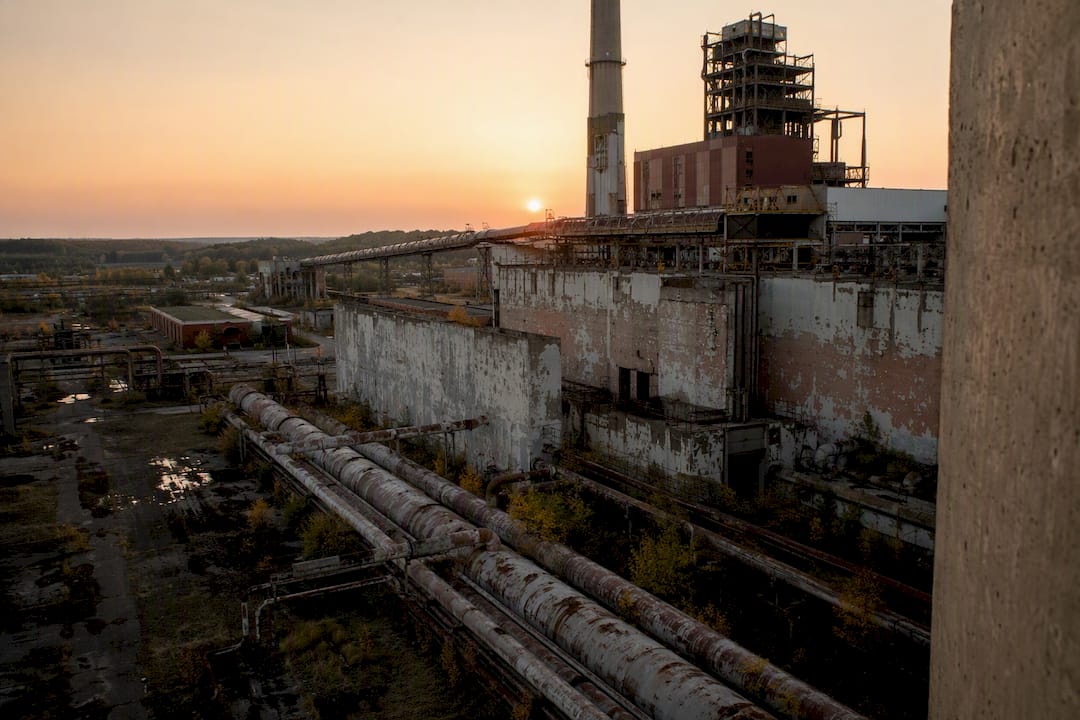
Consent-decree-driven closures deserve special attention because they compress everything, demanding careful coordination as seen in complex data center retrofit and rack cleanup projects where scheduling and permitting logistics are tightly managed. When a settlement sets a hard shutdown date, planning windows that would normally run two or three years get squeezed into months, which raises litigation exposure and forces public engagement to happen in parallel with technical work instead of ahead of it.
Salvage value offers some offset. Turbines, transformers, structural steel, and copper can recover meaningful capital during dismantlement.
- Accelerated closures compress planning and permitting timelines
- Public and legal scrutiny intensifies when a consent decree is the trigger
- Asset recovery helps the budget but rarely offsets environmental liability at coal ash or radiological sites
- Aging-asset retirements allow more lead time but often coincide with grid reliability pressure
What Regulatory Milestones and Funding Rules Apply to Decommissioning?
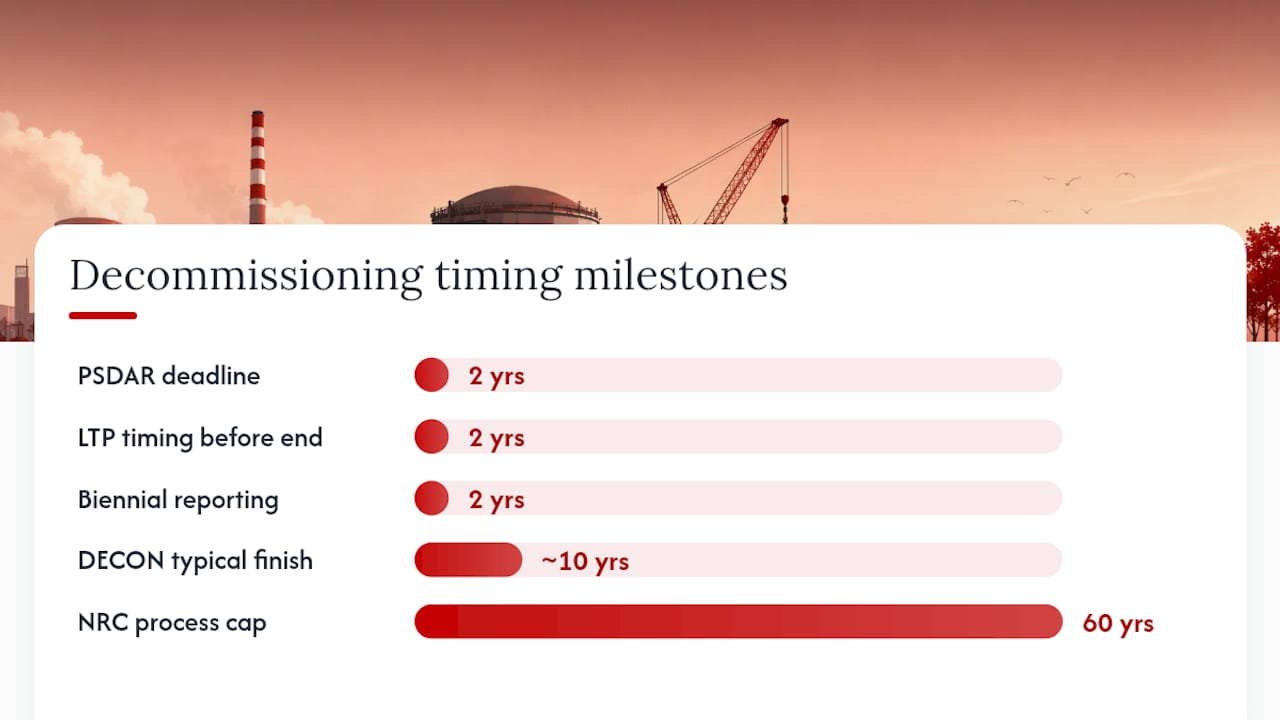
Nuclear decommissioning follows a defined federal sequence. Once a reactor stops generating power, the licensee must certify permanent cessation, then submit a post-shutdown decommissioning activities report (PSDAR) within two years. A license termination plan (LTP) follows at least two years before the license actually ends, and a final status survey confirms the site meets release criteria. The NRC caps the entire process at 60 years from shutdown, though most licensees choose one of two strategies:
- DECON — immediate dismantling and decontamination, typically finished within a decade
- SAFSTOR — deferred dismantling, allowing radioactivity to decay for years before major demolition begins
Funding assurance runs alongside these filings. Owners maintain trust funds, surety bonds, or parent-company guarantees, and report status to regulators on a biennial cycle with updated site-specific cost estimates. Industry-wide, licensees have set aside close to $53 billion for decommissioning obligations, a figure that underscores how seriously regulators treat financial readiness.
Fossil plants operate under a looser federal structure. EPA remediation guidance sets best practices, but there’s no standardized national timeline for cleanup. Consent decrees, state permits, and site-specific agreements do the real scheduling work, and terms vary widely by state.
Breaking Down the Scope: What Actually Gets Done on Site
Site characterization comes first, and it’s not optional paperwork. Radiological surveys (nuclear sites), geotechnical testing, and hazardous-materials assessments produce the deliverables that define everything downstream: how much asbestos abatement you need, whether coal ash gets capped in place or hauled off-site, and where contaminated soils require full excavation versus containment.
Abatement work typically covers asbestos insulation, lead-based coatings, and combustion residuals like coal ash. The decision between encapsulation and full removal usually comes down to future land use, disposal cost, and how strict the applicable cleanup standard is for that parcel.
Demolition and dismantlement follow. Heavy lifting, selective dismantling of components with salvage value, and full structural teardown all happen under OSHA’s demolition safety framework, which governs engineering surveys, utility disconnection, and fall protection throughout. Nuclear sites add a final radiological survey before any release determination.
- Commission independent characterization surveys before scoping abatement contracts
- Require documented disposal manifests for every waste stream, not just summary totals
- Segregate hazardous and non-hazardous debris on-site to avoid costly re-handling
- Confirm long-term monitoring obligations for coal ash or radiological residuals before closing the project file
Pro Tip: Verify zero-energy isolation, electrical, hydraulic, mechanical, and thermal, in writing before crews touch any structure. Skipping this step is one of the most common causes of serious incidents on complex industrial sites.
How Much Does Power Plant Decommissioning Cost, and What Drives the Timeline?
Nuclear decommissioning costs run into the hundreds of millions per unit in most published estimates, with fuel handling, spent fuel storage, and radiological remediation accounting for the bulk of that spend rather than the physical demolition itself.
Fossil plants tell a different cost story. Structural demolition is often the cheapest line item. Coal ash remediation and long-term monitoring frequently outstrip demolition costs entirely, and asbestos removal combined with long-haul disposal logistics can quietly dominate a project budget that looked modest on paper.
- Build contingency at 15% to 25% of base scope for projects with unresolved characterization data
- Treat coal ash and legacy contamination as a separate cost center, not a line item inside “site cleanup”
- Require quarterly budget reforecasts once physical demolition begins, since unknowns surface fastest during that phase
Owners who size contingency too thin almost always end up requesting supplemental funding mid-project, which slows everything and invites regulatory scrutiny.
How Should You Choose a Decommissioning Contractor?
Coordination risk is the single biggest threat to schedule and budget on a decommissioning project, and EPRI’s guidance frames the work as integrated transition management, not simple demolition. That framing matters because it argues for single-source delivery: one contractor accountable for abatement, demolition, and remediation sequencing reduces the finger-pointing that happens when three separate vendors each blame the other for a missed handoff.
A multi-contractor model can still make sense on very large sites where specialized nuclear expertise genuinely doesn’t overlap with civil demolition capacity. For most fossil and mid-size nuclear projects, though, diffusing liability across vendors adds coordination cost that outweighs any bidding advantage.
- Verify OSHA compliance history and current asbestos abatement certifications directly, not just self-reported claims
- Request evidence of validated disposal network relationships, including facility licenses for the specific waste streams your site will generate
- Confirm bonding and insurance limits match your project’s total liability exposure, not just its contract value
- Negotiate holdbacks tied to remediation sign-offs rather than calendar milestones alone
Pro Tip: Write your contingency management rules into the contract itself, not a side letter. Disputes over “who owns the overrun” are far easier to resolve when the trigger conditions were agreed before mobilization.
What Happens to the Site After Decommissioning?
Your intended reuse should be decided before contracts go out for bid, because EPRI’s guidance is explicit that land-use planning at the outset materially changes remediation requirements, scope, and schedule. A site slated for unrestricted public use needs a far stricter cleanup standard than one destined for continued industrial use.
Some retired coal sites have found a second life as renewable energy installations, a path that benefits from existing grid interconnection infrastructure already in place at the site. Others become logistics hubs or return to open industrial land.
- Unrestricted release requires the strictest, most expensive remediation standard
- Continued industrial or brownfield use often permits containment rather than full removal
- Renewable energy redevelopment can leverage existing grid ties but still requires full site clearing first
Community engagement and local permitting almost always shape the final timeline more than the technical remediation work does.
Why a Single-Source Contractor Reduces Your Project Risk
Cornelius Wrecking works nationwide from a St. Joseph, Missouri base, handling demolition and excavating projects that include power plant and energy facility decommissioning alongside marine vessel and petroleum refinery work. The firm carries OSHA and asbestos abatement certifications directly, which matters because those two credentials cover most of the liability exposure discussed in the procurement section above.
That combination lets one crew and one project manager carry abatement, demolition, and site remediation coordination through to final closeout, instead of handing responsibility between three separate specialty vendors at each phase transition.
- Nationwide demolition and excavating capacity for large industrial and energy sites
- OSHA and asbestos abatement certifications held directly, not subcontracted out
- Experienced crews and equipment fleet suited to heavy structural demolition and mass earthwork
- Marine, refinery, and power facility dismantling experience under one operating structure
Integrated delivery, one crew accountable end to end, is the practical answer to the diffused-liability problem that stalls so many multi-vendor decommissioning projects.
Zach’s take: start with three things
If you’re staring down a shutdown date, do this first: confirm your funding assurance mechanism is actually adequate for the site-specific cost estimate, not the estimate from five years ago. Second, commission characterization surveys before you write a single bid spec. Cutting that corner is how scope surprises turn into change orders.
Third, pick a turnkey contractor over a patchwork of specialists unless your site genuinely needs split expertise. Public meetings and regulator briefings go smoother when you can point to one accountable team, not a chain of subcontractors. Document every major decision as you make it. You’ll need that paper trail more than you think.
— Zach
Ready to Scope Your Decommissioning Project?
Cornelius Wrecking handles the full sequence, abatement, demolition, and site remediation coordination, under OSHA and asbestos abatement certifications, for energy facilities and heavy industrial sites nationwide. If your project involves overlapping regulatory deadlines and hazardous-materials scope, a single accountable contractor cuts the coordination risk that stalls multi-vendor jobs. Reach out through the Cornelius Wrecking contact page to request a project quote and walk through your site’s characterization needs, timeline, and disposal logistics with the crew that will actually execute the work.
Sources
- Backgrounder on Decommissioning Nuclear Power Plants | Nuclear Regulatory Commission
- Decommissioning US Power Plants: Decisions, Costs, and Key Issues
- Plant decommissioning, remediation, and redevelopment | EPA (guidance)
- OSHA — Demolition
Recommended
Planning a demolition or excavating project?
Get a fast, no-obligation quote from Cornelius Wrecking.
Request a Quote