Avoid Change Orders: OSHA Ready Pre Demolition Survey for US Owners
Avoid Change Orders: OSHA Ready Pre Demolition Survey for US Owners
A pre-demolition survey is a written, multidisciplinary inspection that documents structural condition, hazardous materials, and utility status before a building comes down. Regulators like the EPA and OSHA treat this documentation as a baseline expectation, and contractors like Corneliuswrecking build it into every project scope. Done right, it identifies hazards early, supports your permit application, and gives every bidder the same information so their numbers actually compare.
TL;DR:
- Conducting a thorough pre-demolition survey requires specialized professionals, including licensed engineers and accredited asbestos inspectors, depending on project complexity.
- The survey must include a written engineering assessment, hazardous materials testing, utility disconnection verification, and possibly ecological and waste audits, tailored to project size and risk factors.
- Regulatory compliance depends on timely submission of OSHA 29 CFR 1926.850, EPA NESHAP asbestos notifications, and local permit documentation, which rely heavily on accurate, complete surveys.
- Costs and timelines for surveys vary widely; early scheduling of asbestos sampling and utility verification can prevent delays and reduce the risk of costly change orders.
- Using a single contractor to manage multidisciplinary surveys ensures coordinated findings, minimizes conflicts, and streamlines the transition from inspection to demolition.
Table of Contents
- What Does a Pre Demolition Survey Cover?
- Core Survey Components: What Each Specialist Checks
- OSHA, EPA NESHAP, and the Permit Paper Trail
- Who Should Perform the Survey, and What It Costs
- Checklist and Deliverables for Your Bid Package
- How Corneliuswrecking Applies Surveys on Complex Jobs
- The Compliance Gap Most Owners Never See Coming
- Get a Coordinated Survey and Demolition Plan From Corneliuswrecking
- Where to Verify These Requirements
- Sources
- FAQ
What Does a Pre Demolition Survey Cover?
A full survey pulls together five distinct workstreams, each producing its own written record: structural assessment, hazardous materials testing, utility mapping, ecological review, and a waste audit. Not every project needs all five. A single-family teardown might skip the ecological check entirely, while a decommissioned refinery needs every category plus a few more.
Certain triggers make a survey mandatory rather than optional:
- Building age (older structures typically require asbestos testing)
- Structure size and occupancy type, since industrial and commercial buildings carry heavier documentation requirements
- Municipal permit rules, which frequently list a written survey as a submission requirement, not a suggestion
It’s worth drawing a line between this and a pre-bid walk-through. A walk-through is a contractor’s informal visit to eyeball scope before pricing a job. A pre-demolition survey is a formal, documented inspection, often performed by licensed or accredited specialists, and it becomes part of the legal and regulatory record. One is a sales tool. The other is evidence.
Core Survey Components: What Each Specialist Checks
Each discipline on a survey team looks for something different, and mixing them up is how projects end up with gaps.
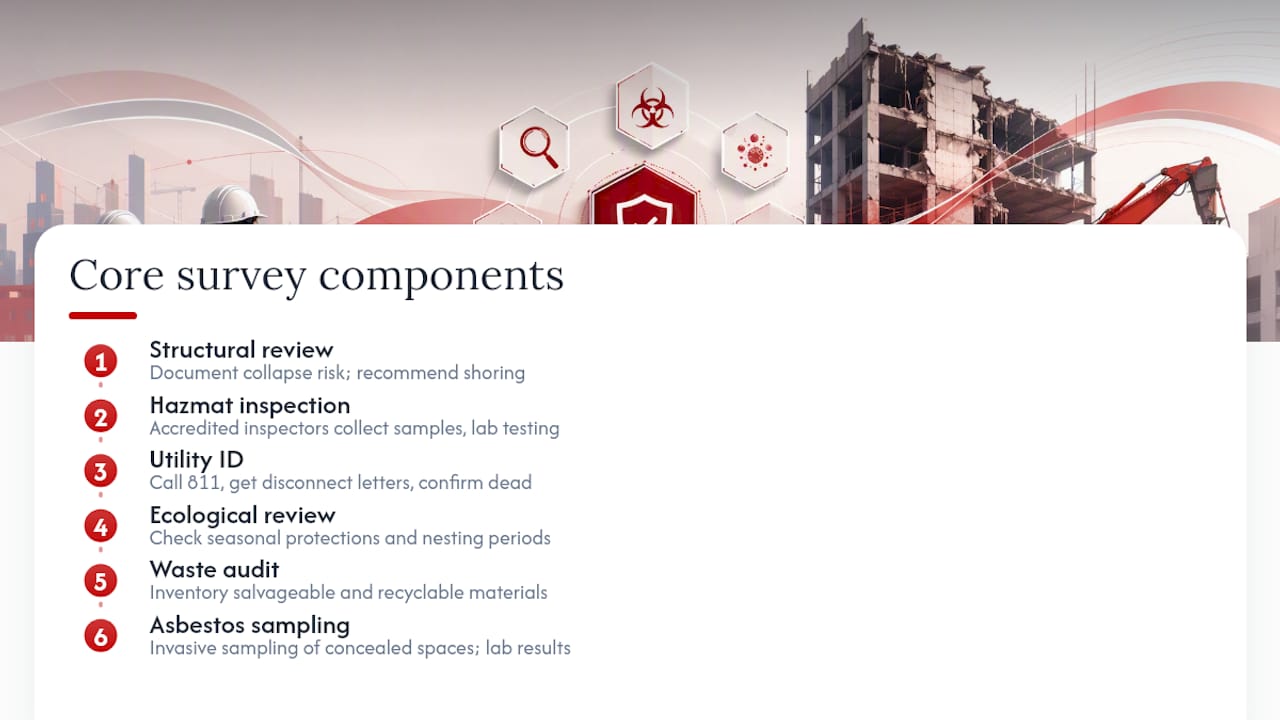
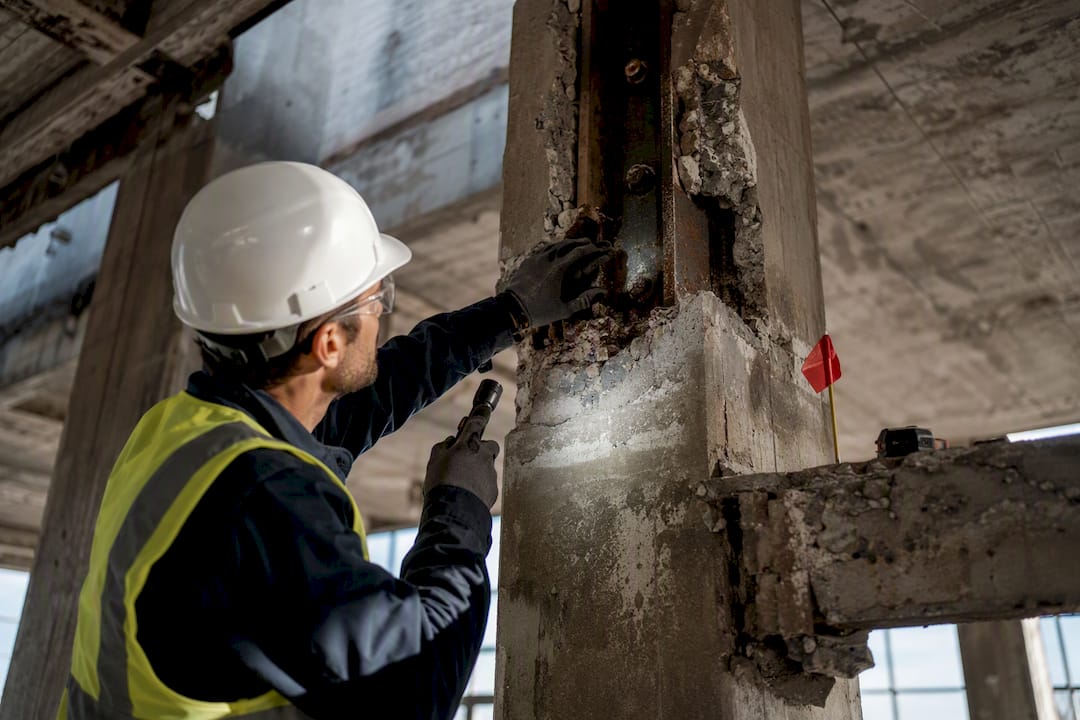
Structural and engineering review. OSHA requires this piece to be performed by a competent person who documents structural condition, flags collapse risk, and recommends shoring or bracing before crews touch the building. This isn’t a walk with a clipboard. It’s an engineering judgment call that shapes the entire demolition sequence.
Hazardous materials inspection. An asbestos research and development survey is more invasive than a general hazmat scan. It requires accredited inspectors to open walls, pull samples from concealed spaces, and send materials to a lab rather than relying on visual assessment alone. Results have to sync with NESHAP notification timing, since abatement often has to finish before demolition permits clear.
Utility identification. Surveyors call 811, pull utility company disconnect letters, and physically confirm lines are dead on site rather than trusting a map. Abandoned or orphan lines are the real threat here. Experienced crews will tell you undocumented process piping and old utility runs rarely show up on municipal records, and they’re a leading cause of mid-project stoppages.
Ecological review. Needed less often, but seasonal timing matters when protected species or nesting periods are in play near the site.
Waste audit. This inventories what can be salvaged or recycled, which directly shapes how the bid specification gets written.
Pro Tip: Ask your surveyor for utility verification letters, not just a map printout. A letter from the utility company confirming disconnection holds up in a dispute; a map does not.
OSHA, EPA NESHAP, and the Permit Paper Trail
Three regulatory obligations show up on almost every commercial and industrial demolition, and skipping any one of them tends to surface as either a stop-work order or a bid dispute later.
- OSHA 29 CFR 1926.850 requires a written engineering survey completed by a competent person before demolition operations start. A verbal walkthrough does not satisfy this. Enforcement checks specifically for a document, and its absence is one of the more common citation triggers on demolition sites.
- EPA NESHAP asbestos notification kicks in when regulated asbestos-containing material is present. Owners generally must file written notice well in advance before renovation or demolition activity begins.
- Local permit submission almost always asks for survey evidence as a prerequisite, not a formality. Cities want the engineering survey, the hazmat report, and often the utility disconnection letters attached to the permit application itself.
Documentation does double duty. It keeps inspectors satisfied and it protects you in a bid dispute, since a contractor can’t claim “unforeseen conditions” against a site that was already surveyed and documented in writing.
Who Should Perform the Survey, and What It Costs
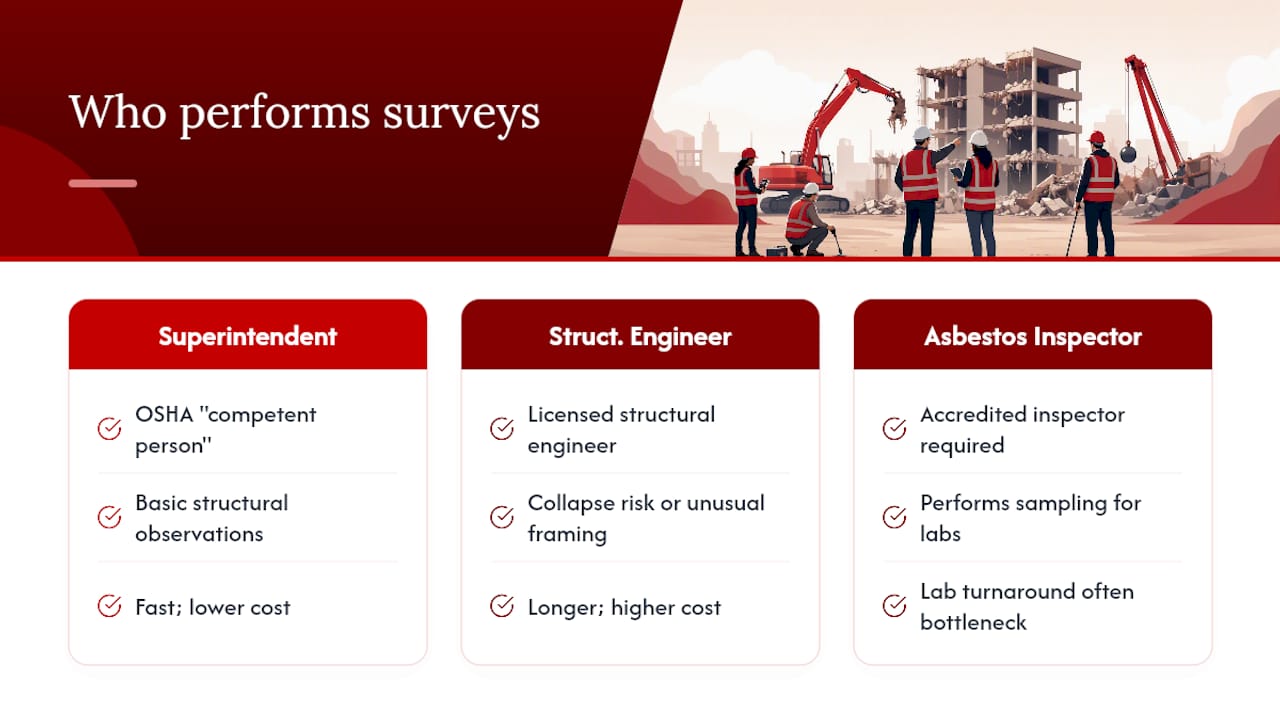
Matching the right credential to the right task matters more than most owners realize. A general contractor’s site superintendent can often serve as OSHA’s “competent person” for basic structural observations, but a licensed structural engineer needs to sign off on any building with real collapse risk, unusual framing, or fire or flood damage. Asbestos work needs an accredited inspector, full stop. State certification programs exist for exactly this reason.
Timelines vary sharply by project type. A straightforward residential survey might wrap in a day or two, including lab turnaround for asbestos samples. An industrial site with process piping, buried tanks, or multiple structures can stretch the survey phase into weeks once you factor in sampling, lab queues, and permit review.
Cost tracks the same variables: square footage, how many samples the hazmat inspector needs to pull, whether buried tanks or process piping complicate the structural review, and whether ecological timing forces a seasonal delay.
Pro Tip: Get your hazmat sampling scheduled early. Lab turnaround, not the site visit itself, is usually the longest bottleneck between survey and permit approval.
Checklist and Deliverables for Your Bid Package
A bid package built on a proper survey gives every contractor the same starting information, which is exactly what keeps their numbers comparable. Require these items before you send anything out to bid:
- Written engineering survey documenting structural condition, collapse risk classification, and shoring recommendations, signed by a competent person or licensed engineer
- Hazmat report with lab results, listing material type, location, and quantity following the format used in pre-demolition hazardous materials survey reports
- Utility disconnect letters from each affected utility company, plus 811 confirmation records
- Ecological notes, where applicable, covering species or seasonal restrictions
- Waste audit identifying salvage and recyclable materials
- Photos and existing plans attached as supporting documentation
Attach every item to the bid documents themselves, not just a project summary. Bidders working from incomplete information tend to price in a risk premium or, worse, hit you with change orders once real conditions surface. Vetting the contractors bidding on that package matters just as much. A contractor verification process before signing anything catches problems a clean survey alone won’t.
How Corneliuswrecking Applies Surveys on Complex Jobs
Survey findings change decisions in real time. A structural report that flags an unstable roof truss reorders the entire demolition sequence, moving shoring work ahead of anything else. A hazmat report showing asbestos in pipe insulation determines whether abatement crews go in before or alongside structural crews, since NESHAP notification timing has to line up with the permit schedule.
On multi-discipline projects, coordinating one contractor to manage the structural, hazmat, and utility surveys together, rather than juggling three separate vendors, tends to catch conflicts between findings before they become field problems.
Some demolition contractors carry OSHA and asbestos abatement certifications and apply such coordination on projects ranging from industrial facilities to marine vessel dismantling. Owners running smaller residential jobs can often hire specialists directly. Complex industrial or energy sites usually benefit from a single contractor managing the whole survey process.
The Compliance Gap Most Owners Never See Coming
Most owners treat the survey as a box to check before the real work starts. That’s backwards. The survey is the real work, at least the part that determines whether the demolition goes smoothly or turns into a change-order fight three weeks in.
The conventional advice, get an inspection, file your paperwork, undersells how much the survey shapes sequencing decisions on the ground. A structural finding about an unstable wall doesn’t just get logged. It reorders which crews go in first. A hazmat result doesn’t just trigger a notification filing. It dictates whether abatement has to finish before a single piece of structural work starts.
If you take one thing from this: prioritize the written engineering survey and the hazmat report before you write your bid specification, not after. Owners who skip intrusive checks behind walls or above ceilings routinely discover concealed hazards mid-demolition, and by then the schedule and budget are both already blown. A thorough survey costs real money upfront. Skipping one costs more, later, when you have far less control over the outcome.
— Zach
Get a Coordinated Survey and Demolition Plan From Corneliuswrecking
Corneliuswrecking is the alternative to juggling three separate vendors for your structural, hazmat, and utility surveys. One coordinated contractor means one point of responsibility, fewer conflicting reports, and far fewer change orders once demolition actually starts.
Some demolition contractors with appropriate certifications manage survey and demolition work across residential, commercial, and industrial sites, including power plant decommissioning and marine vessel dismantling, serving multiple states and nationwide projects. That range matters when your site has process piping, buried tanks, or structural conditions that a general contractor isn’t equipped to evaluate.
If you’re planning a demolition and want a contractor who handles the survey, the abatement, and the teardown under one scope, contact Corneliuswrecking for a project evaluation and get a clear read on what your site actually requires before you write a single bid specification.
Where to Verify These Requirements
- EPA pre-demolition inspection guidance: cost-efficient inspection steps and bid-comparability benefits
- OSHA demolition standards: engineering survey requirement and competent-person criteria
- NDA pre-start survey template and Harvard EHS inspection form: practical checklist structures for structural, utility, and environmental fields
Sources
- Pre-Demolition Inspections | US EPA
- Demolition - Overview | Occupational Safety and Health Administration
- Construction pre-demolition inspection form | Harvard EHS
- Pre-Demolition Hazardous Building Materials Survey Report
FAQ
What Is a Pre-Demolition Survey?
It’s a written, multidisciplinary inspection covering structural condition, hazardous materials, and utility status, performed before demolition begins to support safety, permitting, and comparable contractor bids.
What Do You Need to Do Before Demolishing a House?
At minimum, secure a written engineering survey from a competent person, complete asbestos testing if the structure is older, confirm utility disconnection with the utility companies, and file any required NESHAP notification well in advance.
What Are the OSHA Rules for Demolition?
OSHA 29 CFR 1926.850 requires a written engineering survey by a competent person before any demolition operation starts, covering structural condition, collapse potential, and utility control.
What Is a Pre-Construction Condition Survey?
It’s a documented assessment of existing structural and site conditions completed before construction or demolition activity, similar in purpose to a pre-demolition survey but often used to establish a baseline for nearby properties.
Who Can Perform a Pre Demolition Inspection?
A licensed structural engineer or OSHA-recognized competent person typically handles the structural piece, while an accredited asbestos inspector handles hazardous materials testing. On complex projects, coordination under a single scope can be provided by some contractors.
Planning a demolition or excavating project?
Get a fast, no-obligation quote from Cornelius Wrecking.
Request a Quote