Owners: Tank Farm Dismantling Checklist to Cut Liability and Delays
Owners: Tank Farm Dismantling Checklist to Cut Liability and Delays
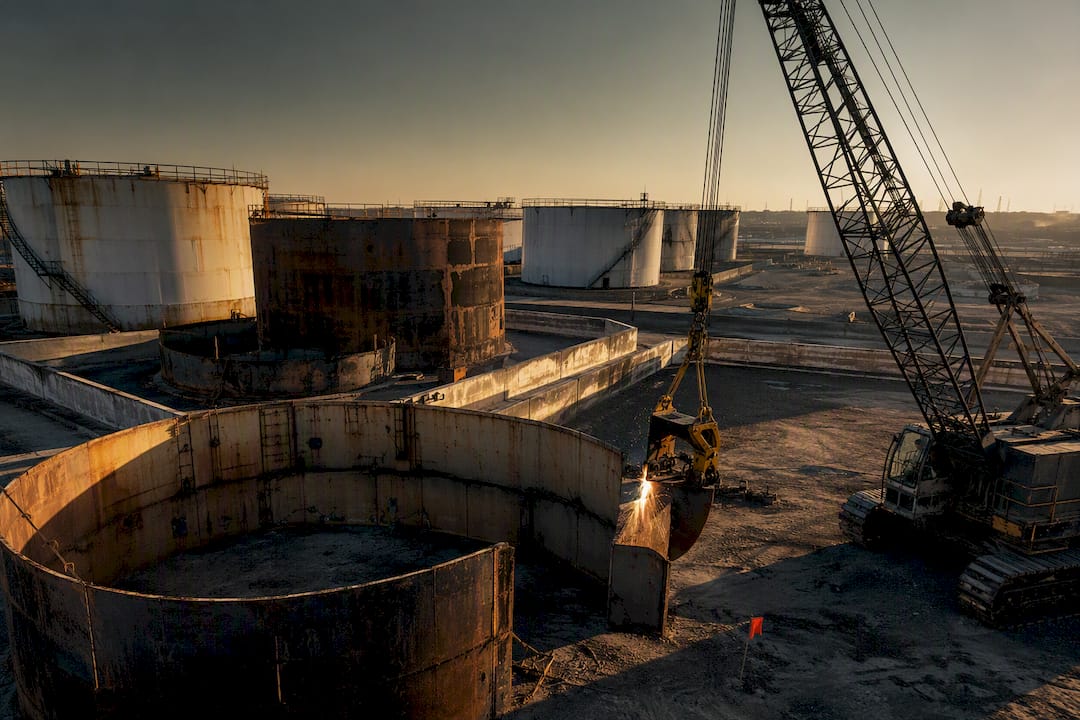
Tank farm dismantling is a regulated, staged decommissioning project that runs from field survey through cutting, waste disposal, and site remediation. The priority on day one is commissioning a qualified contractor to conduct a field survey and open a regulatory scoping conversation before any equipment shows up. Before signing a contract, verify three things: current OSHA and asbestos abatement credentials, a documented waste and disposal chain, and a track record of managing regulatory approvals without stalling the schedule.
TL;DR:
- Conduct a thorough field survey and soil sampling early to identify contamination and structural risks that could significantly alter project scope.
- Obtain all necessary environmental permits, agency approvals, and regulatory engagement before physically beginning dismantling activities to prevent delays.
- Ensure continuous air monitoring, gas-free certification, and asbestos management are maintained throughout decontamination and cutting phases for safety compliance.
- Use on-site shearing or cold cutting methods for tanks with flammable contents to reduce ignition risks, and plan logistics for salvage of recyclable metals to offset costs.
- Expect higher costs and longer timelines in contaminated sites with extensive piping, legacy issues, or regulatory delays, emphasizing the importance of staged budgeting and planning.
Table of Contents
- Quick Checklist: Staged Summary and One-Page Action List
- Stage I: Field Survey, Risk Assessment, and Site Characterization
- Stage II: Planning, Permits, and Regulatory Engagement
- Stage III: Cleaning, Gas Freeing, Decontamination, and Inerting
- Choosing the Right Dismantling Method for Your Site
- What Happens to the Waste After a Tank Comes Down?
- Health, Safety, and Compliance Controls You Should Require
- What Drives the Timeline and Budget on a Tank Farm Job?
- Cornelius Wrecking: What to Expect When You Engage Us
- How the Project Workflow Actually Unfolds
- Short Editorial Perspective: Reduce Liability Before You Reduce Steel
- Start Your Tank Farm Dismantling Project With a Real Field Survey
- Sources
- FAQ
Quick Checklist: Staged Summary and One-Page Action List
Every tank farm dismantling project moves through the same three stages, even when tank count and contamination levels vary widely.
- Stage I: Field survey, tank and piping inventory, soil and groundwater sampling, document review.
- Stage II: Method statements, environmental management plans, permit applications, agency meetings.
- Stage III: Gas-freeing, decontamination, cutting/shearing, crane lifts, waste transport, site remediation.
Expect air permits, hazardous waste generator notifications, and possibly a demolition permit from the local building authority. Watch for two red flags early: a contractor who skips soil sampling to save time, and a bid that doesn’t separate contingency costs from base scope. Both tend to blow budgets later.
Stage I: Field Survey, Risk Assessment, and Site Characterization
The field survey is the highest-leverage activity in the entire project, and a competent survey done early limits scope creep more than any later decision. Surveyors inventory every tank, pipe run, and containment bund, and rate each for structural condition and corrosion risk.
Soil and groundwater sampling gets triggered wherever tanks show signs of past leaks, staining, or vapor readings above baseline. Reviewers pull operational logs, safety data sheets, and prior inspection records, since decades-old tanks often carry undocumented modifications that field crews need to know about before cutting anything.
Utility locates round out this stage. Old tank farms frequently have abandoned lines that were never mapped, and hitting one mid-project stalls work for days while the contractor sorts out ownership and shutoff.
Stage II: Planning, Permits, and Regulatory Engagement
Large tank farm projects commonly involve reviewing well over 200 documents before a permit application even goes in, according to project data from EBP’s decommissioning work. That volume covers historical operating records, environmental reports, and prior compliance filings, all of which shape the method statement.
A solid method statement spells out the sequence of work, the equipment involved, and the specific hazards at each step. The environmental management plan pairs with it to define monitoring thresholds, spill response, and dust and vapor controls. Expect multiple agency meetings during this stage, not just a single permit submission. Some jurisdictions accept closure-in-place as an alternative to full removal when specific criteria are met, but that route still requires its own documentation trail and doesn’t eliminate remediation obligations if contamination is present.
Stage III: Cleaning, Gas Freeing, Decontamination, and Inerting
Nothing gets cut until a tank is certified gas free. That certification typically comes from a qualified competent person or industrial hygienist who confirms oxygen levels, flammable vapor concentrations, and toxic gas readings all sit within safe entry limits.
Cleaning removes residual hydrocarbons, sludge, and scale before decontamination crews address any asbestos in gaskets, insulation, or coatings. Decommissioning practices that emphasize cleaning to gas-free standards before shearing, reduce fire risk and protect crews during hot work later in the process.
Air monitoring continues throughout, not just at the initial certification. Contractors should log readings at intervals and keep those records as part of the project file. Skipping continuous monitoring on a multi-day cleaning operation is one of the more common shortcuts that leads to incidents.
Choosing the Right Dismantling Method for Your Site
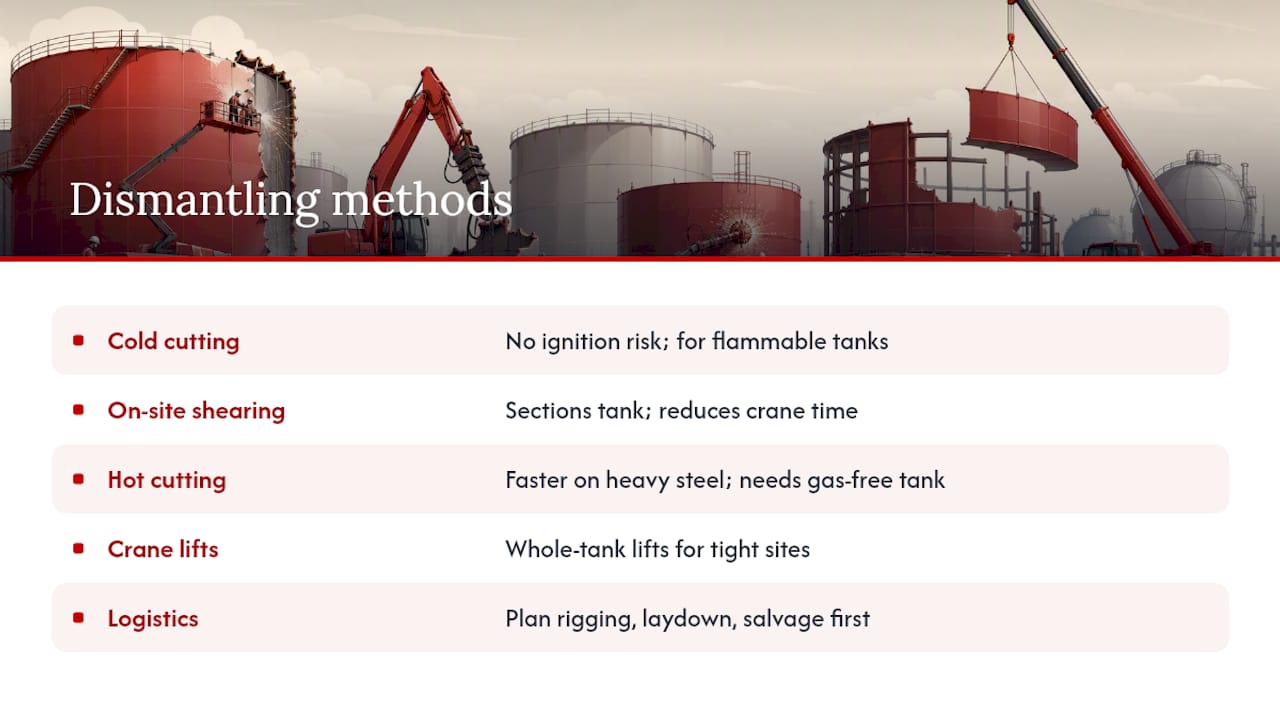
Cutting method depends on the tank’s condition and what sits nearby. Cold cutting and on-site shearing are the standard choices for tanks that once held flammable product, since they avoid the ignition risk that hot cutting introduces. Hot cutting still gets used on tanks confirmed clean and gas free, mainly because it’s faster on heavy steel.
Mechanical shearing works well when a tank can be broken into manageable sections on-site, cutting down on crane time and transport loads. Full crane lifts make sense for tanks in tight urban lots or where sectioning risks structural collapse mid-cut.
Logistics planning matters as much as the cutting method itself. Rigging plans, laydown zones for cut sections, and a salvage strategy for scrap steel all need to be locked in before Stage III starts. Planned salvage and on-site shearing can meaningfully offset demolition costs through recyclable metal revenue, which is worth factoring into the bid comparison.
What Happens to the Waste After a Tank Comes Down?
Tank farm demolition generates several distinct waste streams, and each one has its own disposal path. Scrap steel goes to metal recyclers. Contaminated soil, if sampling confirms it, heads to a licensed remediation or disposal facility. Liquid residues pumped out during cleaning typically go to a permitted treatment facility, and any asbestos-containing material follows separate abatement disposal rules entirely.
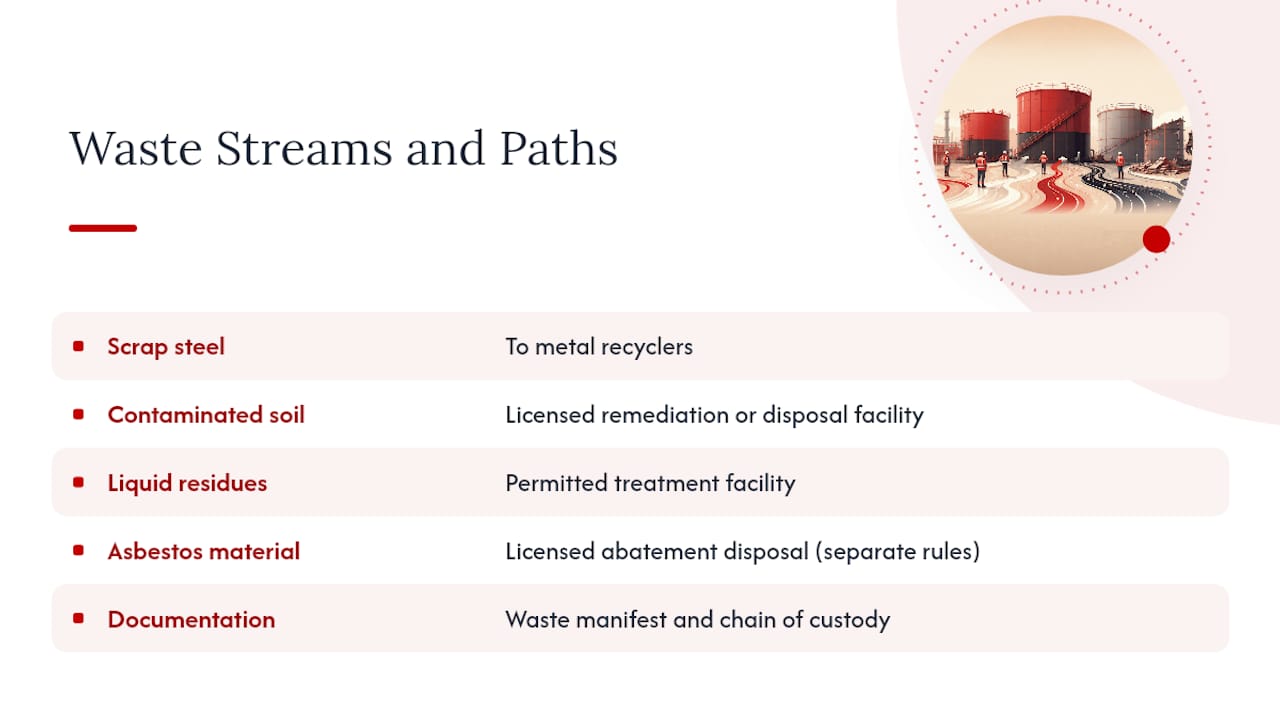
Every load needs a waste manifest documenting origin, contents, and destination, forming a chain of custody that regulators can audit later. Choosing a permitted, licensed disposal facility isn’t optional. If sampling confirms soil or groundwater contamination, remediation work follows, and site closure typically requires verification testing to confirm cleanup levels before the site gets a clean bill of health.
Health, Safety, and Compliance Controls You Should Require
Confined-space entry procedures, hot-work permits, fall protection, and continuous air monitoring aren’t optional add-ons. They’re baseline requirements on any tank farm project, and a contractor who treats them as extras is a contractor to avoid.
Ask for proof of current OSHA training records and asbestos abatement certification before work starts, not after. Every project should have a designated competent person for demolition activities, someone with the authority to stop work if conditions change. Beyond training, check that the contractor maintains incident reporting procedures, keeps detailed recordkeeping, and carries insurance coverage appropriate to hazardous work. A contractor unwilling to share this documentation upfront is telling you something.
What Drives the Timeline and Budget on a Tank Farm Job?
Tank count, tank size, and site access set the baseline schedule, but contamination is what usually blows past it. Industrial tank farm removals differ from a single residential oil tank job in almost every dimension: more piping, larger volumes, and a much higher chance of legacy contamination that wasn’t documented anywhere.
Permit lead times vary by jurisdiction and can add weeks if agency meetings get rescheduled. Winter weather delays earthwork and remediation in northern states, and subcontractor availability for specialized cutting crews tightens during peak construction season. Build contingency into the budget, not just the schedule. A staged procurement approach, where you commit to Stage I and II before locking in Stage III pricing, keeps you from overpaying for scope that the survey might eliminate.
Cornelius Wrecking: What to Expect When You Engage Us
One qualified contractor brings OSHA and asbestos abatement certifications, a full equipment fleet, and nationwide project experience to tank farm dismantling, including work tied to power plant decommissioning and marine vessel removal. Project kickoff starts with a field survey and a documented scope review, followed by method statements and a risk assessment before any crew mobilizes. Clients receive waste manifests and disposal chain documentation throughout, giving you an audit trail from first cut to final haul.
How the Project Workflow Actually Unfolds
The workflow on a real tank farm dismantling job rarely moves in a straight line, but it follows a consistent pattern. The field survey comes first, and it’s not a quick walkthrough. Surveyors document tank conditions, piping runs, containment integrity, and collect soil samples at locations flagged by historical operating records or visible staining.
Document review happens in parallel with the survey, not after it. Reviewers work through operational logs, prior environmental assessments, safety data sheets, and any regulatory correspondence tied to the site. On larger projects, that document set can exceed 200 individual files, and gaps in the paper trail often surface issues the visual survey missed, like an old tank swap that was never permitted.
Regulatory meetings follow once the survey and document review produce a clear picture of scope. These aren’t rubber-stamp sessions. Agencies want to see the method statement, the environmental management plan, and confirmation that contamination findings will be addressed rather than papered over. Authorization to begin physical work typically comes only after these meetings close out, which is why contractors who build agency relationships ahead of bidding tend to move faster than ones meeting regulators for the first time on your project.
Structural engineering assessments often factor into method selection at this stage too. A tank showing corrosion or structural fatigue may require mechanical shearing instead of a full crane lift, and that decision needs to be locked in before mobilization, not improvised on-site once cutting begins.
Short Editorial Perspective: Reduce Liability Before You Reduce Steel
Most tank farm owners treat dismantling as a demolition problem. It’s actually a liability problem that happens to involve demolition. Soil testing and regulatory engagement upfront cost less than discovering contamination mid-project, when crews are idle and the clock is running on a rented crane.
Sequence the highest-risk tanks first, stage your mobilizations around permit approvals rather than crew availability, and favor contractors who handle abatement and safety compliance under one roof instead of subcontracting it out.
— Zach
Start Your Tank Farm Dismantling Project With a Real Field Survey
When you need one team handling demolition, asbestos abatement, and heavy equipment logistics instead of coordinating three separate vendors on a hazardous industrial site, consider a contractor with those integrated capabilities. That single point of accountability is what keeps a tank farm project on schedule when contamination findings or permit delays throw off the original plan.
Reaching out costs nothing and gets the field survey scheduled faster. When you submit an inquiry, include your tank count and sizes, any known or suspected contaminants, site access constraints, and your target timeline. That information lets the team scope the survey correctly on the first visit instead of sending a crew back for details they should have had upfront. Visit the Cornelius Wrecking site to submit a project inquiry or request a quote for your tank farm dismantling job.
Sources
- Tank farm decommissioning plan
- How much does it cost to remove an oil tank? (Angi)
- Tank dismantling for industrial storage tanks (Darda)
- Tank Removal & Closure Services | NIMCO
- Efficient and safe decommissioning of old fuel farms (OTS Group)
FAQ
How Much Does It Cost to Remove an Abandoned Oil Tank?
Cost varies widely based on tank size, accessibility, and whether contamination is found, since environmental liability from hidden leaks is often the biggest cost swing factor rather than the removal itself. Industrial tank farm jobs run far higher than a single residential tank due to piping complexity and remediation scope.
Is There a Way to Get an Abandoned Storage Tank Removed for Free?
Some state environmental programs offer cost assistance for eligible abandoned residential tank removals, but industrial tank farm projects are almost never covered and fall to the property owner or operator to fund directly.
What Is an Acceptable Way to Decommission an Underground Storage Tank?
Full removal with soil and groundwater testing is the standard approach, though closure-in-place is sometimes accepted as an alternative when strict regulatory conditions are met and documented.
Can I Sell Property With an Underground Tank Still in Place?
You can, but many buyers and lenders require tank removal or documented closure-in-place approval before closing, since an undocumented tank represents unresolved environmental liability that complicates the sale.
How Long Does a Tank Farm Dismantling Project Typically Take?
Timelines depend heavily on tank count, contamination findings, and permit lead times, with the field survey and regulatory approval stages often taking as long as the physical dismantling itself.
Planning a demolition or excavating project?
Get a fast, no-obligation quote from Cornelius Wrecking.
Request a Quote